UT IN OMNIBUS GLORIFICETUR DEUS.

UT IN OMNIBUS GLORIFICETUR DEUS.

UT IN OMNIBUS GLORIFICETUR DEUS.

UT IN OMNIBUS GLORIFICETUR DEUS.

UT IN OMNIBUS GLORIFICETUR DEUS.

Thursday, September 30, 2010

'Major, major': Death by plastic

LIFE OR death, paper or plastic? Plastic plague, plastic horror, plastic scourge, plastic problem, plastic nightmare, plastic monster. The bad words connected with plastic are so numerous and the havoc it creates in our lives are so “major, major” so why do we still find ourselves asking one another why plastic continues to rule our lives? (Thank you, former Miss Earth Eco-Tourism, 2010 Miss Philippines and Miss Universe runner-up Venus Raj for your unforgettable “major, major.”)

There is even a saying that goes, “Plastic, like diamonds, are forever.” But the saying stops there as, unlike diamonds, they are not a girl’s or the earth’s best friend.

From the rising of the sun to its setting, we are constantly touching or holding something plastic. Just look around you now. How many things can you see that are made of plastic? The arm of the computer chair on which my arms rest as I write this piece is made of hard plastic.

And speaking of chairs and other furniture—and I must announce this now to shame those concerned—there is a chunk of a sofa with plastic upholstery that has been dumped into an open manhole along Mauban Street in Quezon City. It’s been there for several weeks and I was told that that piece of furniture was placed there to prevent students from a nearby school from falling into the hole. Oh, what thoughtfulness indeed on the part of the barangay officials. Because of their creativity, they should be delivered to the likes of hostage-taker Rolando Mendoza.

Plastic has become a major part of lives. It has many great and practical uses. It can take the place of expensive and need-to-conserve materials, such as wood and metal. Plastic can both be a blessing and a scourge.

But the plastic thing we could all do without or have less and less of are plastic bags.
The clamor of environmentalists all over the world to ban or limit the use of plastic bags continues to be aired but despite decades of campaigning, they are still the “major, major” things used for carrying purchased goods.
On this first anniversary of the devastating typhoons “Ondoy” and “Pepeng,” we remember with horror the unprecedented rampaging floods that turned many parts of Luzon and Metro Manila into virtual oceans and wreaked havoc on millions of lives. Mother Nature sent a message to remind us of our long list of sins against her. One of them is our garbage, and a huge bulk of this garbage that clogged the waterways are plastic bags.

Thursday, September 23, 2010

ML posters from the edge

ON EXHIBIT this week at the Bantayog ng mga Bayani Memorial Center are posters of the martial law era expressing protest and defiance against a cruel dictatorship. Just to remind, this week marks the 38th anniversary of the declaration of martial law which lasted 14 years (1972-1986).

We are not celebrating that ignominious chapter in our history. What we are celebrating is the courage of those who fought and fell in the night, and of those who survived and continue to keep watch over our freedoms.
If I may humbly say it, many of the posters on exhibit came from my collection which I donated to Bantayog last year. I donated 75 posters most of which date back to the late 1970s and 1980s. I kept them all these years and waited until I could find a place where they could be shared and preserved for posterity. They’re of no use if they are just tightly rolled and kept in some corner at home. Bantayog’s archives-museum is indeed the place for them.
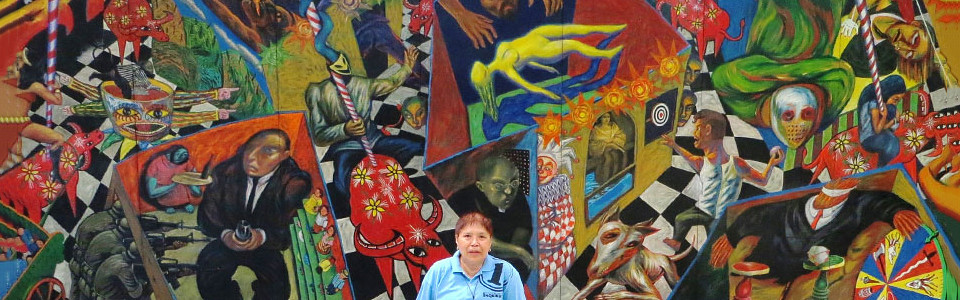
But I am still holding on to a few more, one of which is the poster version of a huge human rights mural on canvas (tarps weren’t in use then) which shows a freedom fighter struggling to rise in defiance despite being trampled upon by military might. I remember that mural occupying the whole backdrop of the stage at the Pope Pius XII auditorium where we held a conference sometime in the early 1980s. Former Sen. Jose W. Diokno was one of the speakers at the time. I still have the photos.

But where is that mural? Was it hastily destroyed after the conference? Was it too big to keep? That painting was rendered in a somewhat cubist style and was very dramatic. On display at the Bantayog exhibit are several smaller murals but that huge one is not there.

If many of the posters on exhibit bear the words “from Ceres” written in bold, it’s because I wanted to be sure that, if for some reason they got into the wrong hands, I would be able to claim them back. But I am pleased to say now that the Bantayog museum is properly managed and there is no reason to fear that archival materials would suffer neglect.

Thursday, September 16, 2010

The latest on hunger, MDGs

Philippine Daily Inquirer/OPINION/by Ma. Ceres P. Doyo
WEBCAST LAST Tuesday afternoon from Rome was the presentation of the latest figures on world hunger by the Food and Agricultural Organization (FAO) of the United Nations. You could watch the webcast and get the latest data by logging on to http://www.fao.org/webcast/. It’s like being there at the press conference yourself.

And while you are at your computer, you might as well sign the “Petition to End Hunger” (www.1billion.org) which shows famous actor Jeremy Irons blowing a whistle, fuming and telling you to be “mad as hell.” It’s a great way to connect.
The release of the FAO figures came in advance of the UN Millennium Development Goal (MDG) Summit in New York next week, which President Aquino will be attending, and the publication of FAO’s annual flagship report, “The State of World Food Insecurity,” (SOFI) which is due in October.
Here’s the lowdown from FAO.

The bad news is that the latest estimate of the number of people who will suffer chronic hunger this year is a staggering 925 million.

The good news is that it is 98 million down from 1.023 billion in 2009. This is a 9.6 percent decline, mostly in Asia. But FAO and WFP are not happy with this and said that the number of hungry people in the world still “remains unacceptably high” despite the gains that pushed the figure below 1 billion.

Lamented FAO director-general Jacques Diouf, “But with a child dying every six seconds because of undernourishment related problems, hunger remains the world’s largest tragedy and scandal. This is absolutely unacceptable.”

And so it goes without saying that the first MDG, which is “eradicate extreme poverty and hunger,” would be difficult to achieve. Diouf warned that the continuing high global hunger level “makes it extremely difficult to achieve not only the first MDG but also the rest of the MDGs.”

Hereabouts last week, Mr. Aquino told a multi-sectoral Stakeholders’ Step-Up Campaign Forum on the Philippines’ MDGs that he was not giving up on meeting the 2015 target date for the MDGs. He sounded optimistic despite the National Economic and Development Authority’s (Neda) grim report that said the country might miss many of the MDGs, including cutting poverty by half.

Here are the eight MDGs that nations all over the world have been working on since 2000.

Eradicate extreme poverty and hunger

Achieve universal primary education

Promote gender equality and empower women

Reduce child mortality

Improve maternal health

Combat HIV/AIDS, malaria and other diseases

Ensure environmental sustainability

Develop a global partnership for development.

It is worth noting that many countries, including some of the poorest, are moving forward toward the goals. This is proof, one UN report said, that setting bold, collective goals yields results. But it also pointed out that improvements in the lives of the poor have been slow and some hard-won gains were eroded by climate change, food and economic crises.

The 2010 lower global hunger number, the FAO report said, resulted largely from renewed economic growth expected this year, particularly in developing countries, and the drop in food prices since mid-2008. The recent increase in food prices is now threatening the further reduction of hunger.

But one must see beyond figures. There is a problem, and it is a structural one, FAO said. How explain the fact that historically, the number of undernourished continued to increase even in periods of high growth and relatively low prices? FAO concluded that economic growth, while essential, will not be sufficient to eliminate hunger within an acceptable period of time.

The success stories—and they do exist in Africa, Asia and Latin America—must be replicated and multiplied.

Other key findings in the FAO report: Two-thirds of the world’s undernourished live in just seven countries—Bangladesh, China, Congo, Ethiopia, India, Indonesia and Pakistan. Here in Asia, Myanmar and Vietnam are reported to have achieved MDG1 and China is close to doing so.

What about the Philippines? A Neda press statement said that “the country is lagging behind.”

The three major areas that the country must focus on, Neda said, is poverty reduction, education and maternal health. Efforts should also be focused on improving the performance of boys in basic education, as well as reducing the cases of HIV/AIDS.

The report was optimistic in meeting the targets on reducing child mortality, promoting women empowerment, reversing the incidence of malaria and TB and providing access to sanitary toilets.

And so, what more to do in the next five years?

Among the recommendations is the need to sustain the high economic growth experienced this year, and for this to be shared by the poor. Neda said: “The economy needs to attract local and foreign investments to spur economic growth. To do this, physical infrastructure has to be improved, water and power have to be made available at competitive rates, and more transparent systems in doing businesses need to be established.”

Localizing MDGs is key. Neda has come out with 10 province-specific reports on Agusan del Norte, Agusan del Sur, Batangas, Biliran, Camarines Norte, Eastern Samar, Marinduque, Romblon, Sarangani and Siquijor.

The Philippines’ fourth progress report will be presented at the High Level Plenary Meeting on the MDGs in New York on Sept. 20 to 22, which President Aquino will attend.

We have five years to go…

* * *

I will be at the International Book Fair at SMX at 3 p.m. today for book signing of “Bituin and the Big Flood/Si Bituin at ang Malaking Baha” (Anvil 2010), an illustrated story book I dedicate to the children who lost their lives during the typhoons “Ondoy” and “Pepeng” and to the children who survived.

Thursday, September 9, 2010

Take it from the Bernidos

LAST WEEK I wrote a series of page 1 feature stories on the 2010 Ramon Magsaysay (RM) awardees, the Filipino awardees among them. But space was never enough for more that need to be said about them. And so I write again about husband and wife Christopher Bernido and Ma. Victoria Carpio-Bernido who introduced an innovative way of teaching the sciences, physics particularly, in the remote town of Jagna in Bohol.
The RM Award Foundation honored the Bernidos for “their purposeful commitment to both science and nation, ensuring innovative, low-cost and effective basic education even under Philippine conditions of great scarcity and daunting poverty.”
Chris and Marivic, both with doctoral degrees in physics, left their teaching jobs at the University of the Philippines in 1999 to run a small school, the Central Visayan Institute Foundation (CVIF), in Bohol.

It was not easy in the beginning. Marivic quotes Saints Bernard of Clairvaux and John of the Cross to explain how she grappled with difficulties in the beginning and entered the “dark night of the soul.” But as the psalmist says, joy comes in the morning.

Thursday, September 2, 2010

Women in cirisis negotiations

WE. ARE. SORRY. 

But let us not grovel. We must be humble and admit mistakes, inefficiencies and stupid thoughtlessness. We must take it on the chin as a people, but we must not grovel on the ground. Let us show in concrete that we want to make things right but we must not allow anyone to walk all over us. Hate statements and tit-for-tat accusations that hark back to wrongs committed in the distant past will not help heal wounds.

That is my two cents on the aftermath of the botched Aug. 23 hostage crisis that ended in the death of eight Hong Kong tourists and a Filipino hostage taker.

There has been a hurricane of morning-after opinions and analyses, a lot of blame throwing, mea culpas, prayers, acts of reparation, expressions of sympathy from all sides. But the fact remains: there is no name for the pain of the families who lost loved ones in the tragedy that happened on our soil.

In my desire to know more about hostage crises, I surfed the Internet and found an article written by Sergeant Kevin Curreri in The Journal for Women and Policing published by the Australasia Council of Women and Policing. The title of the article is “Women and Crisis Negotations.” Curreri is the state negotiator training officer of the Queensland Police Service.

Curreri writes that in the 1970s the New York Police Department developed the idea of hostage negotiations by using detectives who had the “gift of gab” to deal with hostage takers. Negotiators are persons who deal with persons described as “being in crisis,” which refers not just to hostage takers but to suicidal ones as well. (In the Philippines we’ve had lots of the latter climbing on billboard structures.) And so the words “crisis negotiation” have replaced “hostage negotiation.”

In Queensland, Curreri says, invitations for applications for the negotiators’ course are made about every two years. Applicants are short-listed based on experience, referrals and demonstrated aptitude. They are then psychometrically profiled and interviewed by the occupational psychologist of the police’s Negotiator Training Team. Their communication ability during stress are assessed.

Curreri says that at one time, when calls for applications were made, 179 applied. Only 15 were chosen. They attended a four-week, live-in course to train in the negotiation process and then were sent to the field to work with experienced negotiators for 12 months.

There are several basic principles that a negotiator should bear in mind. One is that the negotiator’s basic function is to modify another person’s behavior through verbal communication. To do this, the negotiator must gain influence over the subject.

There are two types of influence: the hierarchical and the personal. Hierarchical refers to a person exerting influence by his or her standing in society. Personal is more difficult and takes time.

Active listening and demonstration of empathy are keys to influence. “We attempt to show the subjects that we have heard not only what they are saying, but how they feel about the situation they are in. We then attempt to demonstrate … that we are trying to understand what it must be like to be in their shoes. Demonstration of empathy assists in establishing rapport or trust.”

Once rapport has been established it becomes easier for the negotiator to exert personal influence on and modify the subject’s behavior. Curreri emphasizes that employing negotiation techniques instead of automatically resorting to a tactical resolution significantly reduces the chances of injury to persons and minimizes civil liability. However he recognizes that not every incident will result in a peacefully negotiated end.

Still, negotiators could assist the tactical teams in gathering intelligence and maneuvering the subject to a position most conducive to a tactical resolution. I think Curreri means the application of force.

Curreri thinks more women should be involved in crisis negotiations. There are diverse communication styles and practices in the two gender groups, among them conversational skills. Women, Curreri says, tend to approach sharing information, listening, making decisions and handling conflicts and disagreements differently than men do. He cites Deborah Tannen who suggests in her book “You Just Don’t Understand” that men enjoy giving info as a way to show expertise while women like sharing info to build relationships. Men do “report talk” while women do “rapport talk.”

Women share information to help others gain the same level of knowledge as they have, equalize the playing field and build rapport. Tannen says that men frequently interrupt and compete for airtime while women wait to speak until others are heard. There.

Curreri adds that women can use a subject’s gender biases to achieve a result. Women could be seen as less threatening and thus lower a subject’s defenses. As in, “It’s okay to be afraid. I promise I won’t hurt you.”

But Curreri points out that there are certain occasions when women negotiating may be counterproductive because of cultural and religious biases. “We must recognize that as negotiators our goal is to achieve behavioral change in the subject person through verbal communication.” In some cases, where women may be the cause of a subject’s problems (as in the case of heart-broken male suicidals who hold their kids hostage), women negotiators would not be the best choice.

But there are many incidents when women may be able to exert influence, personally or hierarchically. In the case of hostage taker and dismissed cop Rolando Mendoza, the intervention of his brother and fellow cop worsened the situation.

Would his mother or wife have done better?

Wednesday, September 1, 2010

Filipino RM awardees 2010: Physicist couple showing the way

MANILA, Philippines—Amid the grim education scenario in the Philippines, a bright light shines from the remote town of Jagna in Bohol province.

There, husband and wife Christopher Bernido and Ma. Victoria Carpio-Bernido, both physicists, introduced a way of teaching and learning that has produced amazing results.

More than a decade ago, they left their academic careers at the University of the Philippines (UP) and went back to a rural setting to run a struggling school and help students achieve their academic potentials.

Their efforts catapulted them to national and international attention and became a source of inspiration.

The Bernidos were among seven awardees honored Tuesday by the Ramon Magsaysay Award Foundation in ceremonies at the Cultural Center of the Philippines.
The Bernidos were recognized for “their purposeful commitment to both science and nation, ensuring innovative, low-cost and effective basic education even under Philippine conditions of great scarcity and daunting poverty.”
The Bernidos are among 42 Filipinos whom the foundation has honored since the awards began in 1958.

Chris, 53, is from Bohol while Marivic, 48, is from Naga City in Camarines Sur province. They finished at UP and earned their doctorate degrees in physics from the State University of New York. They both taught at the UP National Institute of Physics, where they met and fell in love.

Now, Chris said in an interview, “we have 490 children”—a reference to the students in their care.

Tuesday, August 31, 2010

Japanese RM awardee dreams of peace fest in Hiroshima


MANILA, Philippines—Why not a global festival of peace in a Japanese city demolished by the atomic bomb?

This is one of the dreams of Hiroshima Mayor Tadatoshi Akiba, one of the seven 2010 Ramon Magsaysay awardees to be honored Tuesday, the birth anniversary of the late Philippine president after whom the award is named.
Akiba, 67, was two years old when the United States dropped atomic bombs on Hiroshima and Nagasaki in August 1945. The bombs instantly killed between 150,000 and 200,000 people in the two cities, according to a US-funded study. Many who survived still suffer from ailments caused by the A-bomb.
Akiba’s family did not suffer a direct hit but some things have remained in his memory.

“One of my earliest memories was the firebombing of my hometown Chiba City near Tokyo. I was only two and a half years old but I remember scenes,” Akiba said.

The war and its aftermath haunted the precocious boy. Now he is campaigning for a world free of nuclear weapons.

That world is possible, Akiba said.

“I am so confident that we are now studying in Hiroshima the feasibility of entering a bid for the 2020 Olympics. What could be better than to celebrate our entry into (a) new nuclear weapons-free world with a global festival of peace in Hiroshima?”

Award ceremonies Tuesday

The Ramon Magsaysay Award Foundation cited Akiba for “his principled and determined leadership in a sustained global campaign to mobilize citizens, pressure governments, and build the political will to create a world free from the perils of nuclear war.”

He is the 24th Japanese and one of the 267 individual Ramon Magsaysay awardees since 1958.

Five of this year’s seven awardees—a Filipino couple, a Bangladeshi, a Chinese and a Japanese—will personally receive their awards in ceremonies Tuesday at the Cultural Center of the Philippines. Two other Chinese awardees are not coming, one for being ill and the other for unclear reasons.

“When I was a child, I watched a movie that showed children who suffered from the A-bomb. Scenes in the movie merged with my childhood experiences,” Akiba told the Inquirer.

Akiba spent his high school years in the United States as a scholar. After finishing his BS and MS in Math at Tokyo University, he went back to the United States to pursue his doctorate at Massachusetts Institute of Technology.

Meeting the ‘hibakusha’

His US stay brought disturbing thoughts.

For example, Akiba said, many in the United States thought that Japan’s bombing of Pearl Harbor in 1941 was the absolute evil and that the American decision to drop the A-bomb on Japan in 1945 was right.

Akiba taught in US universities for several years but returned to Japan in 1987 and became a professor at Hiroshima Shudo University. He became acquainted with the hibakusha (survivors of the A-bomb), one of whom, Akira Ishida, became his mentor in the advocacy against nuclear weapons.

“The hibakusha are not in Japan only,” Akiba said. “There are hibakusha now living abroad.”

‘No more Hiroshima’

With prodding from the hibakusha, Akiba joined politics and became a member of the Diet (Japan’s parliament) from 1990 to 1999. Then he became Hiroshima mayor, a post he still holds.

Now on his third term, he continues to take up the cause of the hibakusha.

The horror that visited Hiroshima and Nagasaki was not entirely lost on world leaders. In 1970 the Nuclear Non-Proliferation Treaty (NPT) came into force.

But despite cries of “No more Hiroshima, no more Nagasaki,” the NPT was ignored by nuclear-armed states and those that have since acquired nuclear-weapons capability.

By 1980, there were close to 50,000 nuclear weapons in the world with destructive power equal to a million Hiroshima-type A-bombs, according to one report.

Tales of horror

Before he entered politics, Akiba was already involved in the nuclear disarmament campaign. In 1979, he launched the Hibakusha Travel Grants Program that invited Americans and journalists to Hiroshima and Nagasaki to listen to the hibakusha’s tales of horror.

The aim was to draw attention to the horrors of war and world annihilation.

Akiba felt that Hiroshima, being history’s first A-bomb victim, had the moral obligation to warn the world of the dangers from such weapons. He put his city at the forefront of an international campaign against nuclear weapons, continuing his predecessors’ efforts.

In 1982, Akiba spearheaded the Mayors for Peace movement. Mayors, he thought, were best positioned to mobilize citizens to be advocates for peace.

Mayors for Peace now has 4,069 member-cities from 144 countries and regions worldwide. In the Philippines, 16 cities are members.

People rarely suffer alone

Why cities and city mayors?

“Tragedies usually come to the cities,” Akiba said, adding that there was a lot that could be done at the city level.

“Mayors generally arise from the collective consciousness of their cities. We are close to our citizens. We suffer when they suffer. City mayors can influence their national governments more effectively.

“People rarely suffer alone. The suffering of any individual is actually the suffering of at least a family, if not a neighborhood. And a city is a vital, true and personally relevant level of collective identity.”

That is why we speak of Guernica, Ypres, Auschwitz, My Lai, Dresden, Akiba said. “This is why cities that suffer massive destruction become cities that work for peace.”

Past examples must be followed, Akiba urged. “The Ottawa Process that led to the treaty to ban antipersonnel landmines is one. The Oslo Process that led to the treaty to ban cluster munitions is another.”

In 2003, Mayors for Peace forged ahead with a “2020 Vision” campaign to pressure governments to abolish nuclear weapons by 2020, the 75th anniversary of the Hiroshima-Nagasaki bombings.

In 2020, Akiba said, the average age of the hibakusha would be 86.

In 2008 the movement issued the Hiroshima-Nagasaki protocol, a road map to guide governments toward total abolition of nuclear weapons.

Akiba considers the 65th commemoration at the Hiroshima Peace Memorial early this month very special because of the presence of United Nations Secretary General Ban Ki-moon.

“He was the first UN secretary general to attend the ceremony,” Akiba said, “and he met with the hibakusha.”

For the first time, the US government sent a representative to the ceremony.

By working together, Akiba mused, people could create a world free of war, violence, starvation, widespread environmental destruction and institutional slavery.

And nuclear weapons would have no place in such a world. With a report from Inquirer Research

Monday, August 30, 2010

Bangladesh's RM awardee: Disabled also have dreams

MANILA, Philippines—Inclusive, barrier-free and mainstreaming. These are key words that A.H.M. Noman Khan has turned into reality for countless disabled persons of Bangladesh and beyond.
Khan is one of the seven 2010 Ramon Magsaysay awardees who will be honored on Tuesday, birth anniversary of the late President after whom the award is named.
Khan, 59, is being recognized for “his pioneering leadership in mainstreaming persons with disabilities in the development process of Bangladesh, and in working vigorously with all sectors to build a society that is truly inclusive and barrier-free.”
Khan is a big and able-bodied Asian who had no direct experience with disabled persons in his early life, but after being exposed to them and their plight in the early 1990s, he became totally devoted to this special sector. And there was no turning back.
The Ramon Magsaysay Award has caused quite a stir in his country, Khan happily tells the Inquirer. He is certain the award will significantly increase people’s awareness of the issues affecting the disabled in Asia.

Khan is the 10th Bangladeshi to win the award since it was started in 1958. One well-known Bangladeshi awardee is Muhammad Yunus, who received the award in 1984 and, later, the Nobel Peace Prize. The Ramon Magsaysay Award Foundation has honored 267 individuals and 17 institutions in the past 52 years.

Sunday, August 29, 2010

2 RM awardees cancel trip

THE ANNUAL Ramon Magsaysay Awards rites have become another unfortunate casualty of the botched hostage-rescue fiasco.
Two of the three Chinese recipients of the Ramon Magsaysay Awards for 2010, both government bureaucrats, will not be coming to receive the honors on Aug. 31.
But the third Chinese awardee, photojournalist Huo Daishan, is already in the country and is participating in the series of lectures and meetings that have been arranged by the Ramon Magsaysay Award Foundation.

The Inquirer was scheduled to interview yesterday the two awardees—Fu Qiping, a farmer and village chief in China’s Zhejiang province, and Pan Yue, a vice minister in the Ministry of Environmental Protection—but was told by an RMAF official that the two would not be coming.

The RMAF source said one of the Chinese awardees “might have taken ill,” and did not give a reason for the second one’s nonappearance.

There are speculations that their absence may have something to do with the diplomatic tension between Beijing and Hong Kong on one hand and the Philippines on the other caused by the Aug. 23 hostage crisis in Manila that ended in the killing of eight Hong Kong tourists.

Chinese photographer wins RM for helping save a river


ONE DAY, Chinese photojournalist Huo Daishan was shocked to see that the Huai no longer looked like the river of his childhood.

It was highly polluted, emitted toxic fumes, yielded dead fish, and killed people. It had become a river of death.
“I lived there,” Huo, 56, told the Inquirer. “I played there when I was a child. The water was clear and we could see fish. We could even drink the water.”

Huo is one of the seven 2010 Ramon Magsaysay (RM) Awardees who will receive honors on Aug. 31, the birth anniversary of the late President after whom the award is named.
He is being recognized for “his selfless and unrelenting efforts, despite formidable odds, to save China’s river Huai and the numerous communities who draw life from it.”
Huo is one of three Chinese RM awardees this year, and the 16th from the People’s Republic of China since the RM Awards began in 1958. The two others, both government bureaucrats, will not attend the awarding ceremony. (See banner story.)

The RM Awards Foundation honors individuals and institutions that have shown “greatness of spirit in selfless service to the peoples of Asia.”

The award is given to “persons—regardless of race, nationality, creed or gender—who address issues of human development in Asia with courage and creativity, and in doing so have made contributions which have transformed their societies for the better.”

The great Huai River is known to have cradled ancient Chinese civilization.

By its banks lived great figures in Chinese history, among them Confucius, Mencius and Laozi. Legendary figures Fuxi, ancestor of all Chinese people, and Dayu, water control hero, were associated with it.

Friday, August 27, 2010

PTS at 100: Continuing the fight against TB

EVEN BEFORE Magellan set foot on these islands in 1521 and long before scientists pinned down the bacillus that caused tuberculosis (TB), Filipinos already had various names for the disease. The Kapampangans called it malalangi while the Ilocanos called it sarot. The Tagalogs called it sigan while the Visayans called it anos. The tubercular patient in the Visayas was called anoson.

In present-day 21st century Philippines everybody just says TB.
There seems to be no record of the natives’ attempts to fight the disease before and during the Spanish era. It was only after the Spanish-American War or the beginning of the 1900s that TB began to interest health authorities. And it had to compete with deadly pestilences of that time, such as the bubonic plague, smallpox, cholera and dysentery, that exacted a dramatic toll on populations all over the world.
TB was (and is) more of a silent killer. Many historic figures, consumptive saints among them, died of the lung disease. The Philippines’ own president, Manuel L. Quezon, succumbed to the disease in 1944 while the country was fighting a war and lay in ruins. But the name Quezon not only lent a real face to the ailment, it also opened the door to TB patients who would otherwise have languished in penury and pain.

The imposing landmark, the Quezon Institute (QI), that stands on a sprawling prime lot in Quezon City (donated by the Ortigas family) is testament to this. But before QI, there was its founding organization, the Philippine Tuberculosis Society (PTS) that operates QI and PTS clinics in the country.

This year is the society’s 100th in operation. The non-stock, non-profit PTS is the pioneering institution in TB prevention, control and treatment in the Philippines. Its corporate predecessor, the Philippine Islands Anti-Tuberculosis Society, was founded in 1910, antedating both the Philippine Commonwealth (1935) and the republic (1946).

QI’s beginnings date back to 1918 when 14 nipa huts for TB patients were built in the area where it stands now. The place was called Santol Sanatorium and it operated on the belief at that time that isolation, bed rest, fresh air and nutritious food were the effective cure for TB.

Thursday, August 19, 2010

Oca on community organizing and ballroom dancing

A GREAT pillar in community organizing (CO) and the Church’s programs of social action, justice and peace has passed on.
Oscar Francisco, “Oca” to the countless many, passed away on Aug. 15 at the age of 64. He was many things to many people. He was an activist, organizer, builder, trainor, legislator, writer, dancer. He was also a great raconteur and romantic. He left behind his wife Edna (also a seasoned NGO worker), their three children and countless communities and groups that he had touched.
It was the heart attack, not the diabetes and failing kidneys, that claimed him.

Oca’s name is synonymous with CO. Despite his twice-weekly dialysis in the past two years, he remained active in the field of CO, having co-founded the Institute for Democratic Participation in Governance. Why, he even had a network he named with tongue in cheek, Dialogue (Dancing Instructors Action for Local Governance and Empowerment).

Oca recently served a year in Congress as representative of the Alliance for Rural Concerns. His ailment did not prevent him from shuttling between Manila and Leyte-Samar.

Last March he invited a bunch of us to Tacloban City and Balangiga, Eastern Samar, to show us people’s participation in local governance and community development. He invited fellow “alumni” from the National Union of Students of the Philippines, Student Catholic Action and the Church-based National Secretariat of Social Action (where Oca spent many years in justice, peace and development work and where I got to know him)—and brought us down to the grassroots to see for ourselves changes in people’s lives. I did write about that trip (“Balangiga in the cusp of development,” March 18, 2010).

Oca also wanted to stress to us the significance of getting back the bells of Balangiga that were carted away by US soldiers during the Philippine-American war. Oca wanted the bells returned to Balangiga by September (next month) and had again scheduled a trip for us there. He hoped newly elected President Aquino would strongly push for the return of the bells after 100 years. Two are in Wyoming, USA, and one is in South Korea.

One of the stuff Oca gave us to read was a serious discourse he had written, “Reflections on Community Organizing and Ballroom Dancing.” Oca presents CO as an act of creation and celebration and smashes the totalitarian view that there is only one correct reading of the world and history.