UT IN OMNIBUS GLORIFICETUR DEUS.

UT IN OMNIBUS GLORIFICETUR DEUS.

UT IN OMNIBUS GLORIFICETUR DEUS.

UT IN OMNIBUS GLORIFICETUR DEUS.

UT IN OMNIBUS GLORIFICETUR DEUS.

Showing posts with label News. Show all posts

Friday, December 30, 2022

 COLUMNISTS

HUMAN FACE

‘Chasing Windmills’

 / 05:06 AM December 30, 2022

Eyes are on the city of Utrecht in the Netherlands, where Communist Party of the Philippines’ (CPP) founder Jose Ma. Sison died on Dec. 16 after his almost four decades in the land of windmills. Utrecht is where a group of Filipinos is on self-exile, working for decades to promote the fulfillment of the CPP’s ideological and political agenda in the Philippines. They belong to the so-called RAs (reaffirmist wing) of the CPP and its National Democratic Front of the Philippines-New People’s Army allied with Sison that remain after the RJs (the rejectionists) broke away. The latter have since created their own paths individually or as political groups in mainstream Philippine society.

What now? is the question in the minds of both the pro-Sison and not-so-pro-Sison who had once worked together to fight the Marcos dictatorship. That was long before so-called people’s revolt emerged from left field, so to speak, to steal the thunder and ousted the dictator and his helmsmen/women who had plundered this country and brought it to its knees.

Those are the big stories. But forming the warps and woofs of the antidictatorship movement were lives under the radar, some lived outside the home country and in the service of the ideology they believed in and fought for.

Such was the life of Maya Butalid, a political activist who was sent to and worked as a CPP functionary in the Netherlands from 1983 until 1993—a good 10 years—after which the CPP split into the so-called RAs and RJs, and the leadership descended into a bloody purge that saw comrades killing fellow comrades. When the smoke had cleared, persons essential to the hierarchy abroad, like Butalid, had to make decisions for themselves, their families, and their future.

The book “Chasing Windmills” (Olympia Publishers, London, 2022) tells Butalid’s story of leaving the home country in service of a political ideology, and staying for good in a foreign land that she and her family embraced as their own. That is, despite her break from those who brought her to the land of windmills, symbols of quixotic pursuits. But that is going ahead of the story.

“My windmills,” writes Butalid, “[were] the challenges that I successfully faced during the various phases of my life.” She describes her written work as “conversations with my soul.”

The book’s chapters do not necessarily follow a timeline, but one can see a first half and a second half—life as a CPP functionary abroad while doing so-called solidarity work, and life after—with flashbacks set in the homeland.

Born in 1957, in Cebu City, Butalid studied at the University of the Philippines, where she developed into a political activist. Butalid recounts her search for God while in the university (a whole chapter), and how it led her to the oppressed sectors of society. To make a long story very short, Butalid found answers in political activism. One thing led to another, and before long, she was holding important positions (as political officer, among them) in the underground movement.

“Chasing Windmills” is a collection of no-frills stories about Butalid’s journey mainly in the Netherlands, raising a family abroad, working with the CPP hierarchy in exile, and breaking away, integrating, and immersing herself in Dutch society as an immigrant, pursuing higher studies (a master’s degree from the University of Tilburg), building a career, serving as a civil servant. She even went through a bout with cancer.

I was looking for juicy bits about the CPP characters in Utrecht, her bosses, the cabal that gave directives to the underground movement in the Philippines, but they were few and far between. Those in the know might be able to tell whereof Butalid speaks, the whys, the wherefores. These could have been instructive. There was much that was left unsaid. “Chasing Windmills” is not a tell-all.

The instructive parts, especially for immigrants in Europe, are Butalid’s observations, reflections, and the lessons she learned that could benefit those caught in a cultural maelstrom, while pursuing a meaningful life for one’s growing family, details about day-to-day life, decision-making, seeking new avenues to be of service, etc.

From 2003 to 2010, Butalid served as Tilburg city councilor. She now works with the Netherlands Council for Refugees and, since 2012, with Pasali, a development nongovernment organization in Mindanao. Butalid and husband Carlo have two daughters and four grandchildren.

As it was in the beginning of the book when Butalid wrote about her search for God in her youth, so does she end with the chapter “About God,” the constant one while she chased her windmills.

Read more: https://opinion.inquirer.net/159926/chasing-windmills#ixzz7s2ktw9HV
Follow us: @inquirerdotnet on Twitter | inquirerdotnet on Facebook

Thursday, March 3, 2022


HUMAN FACE

Timely and timeless: Diokno@100

Former senator Jose “Pepe” W. Diokno, lawyer, human rights defender, former political prisoner, and nationalist who died at age 65 in 1987 would have turned 100 on Feb. 26, 2022. Human rights advocates organized activities to honor his memory, to stoke further the embers sorely needed to keep the flames alive, flames to light the road ahead. The skies are darkening and this country is in the gloaming, in that hour between daylight and night.

ADVERTISEMENT

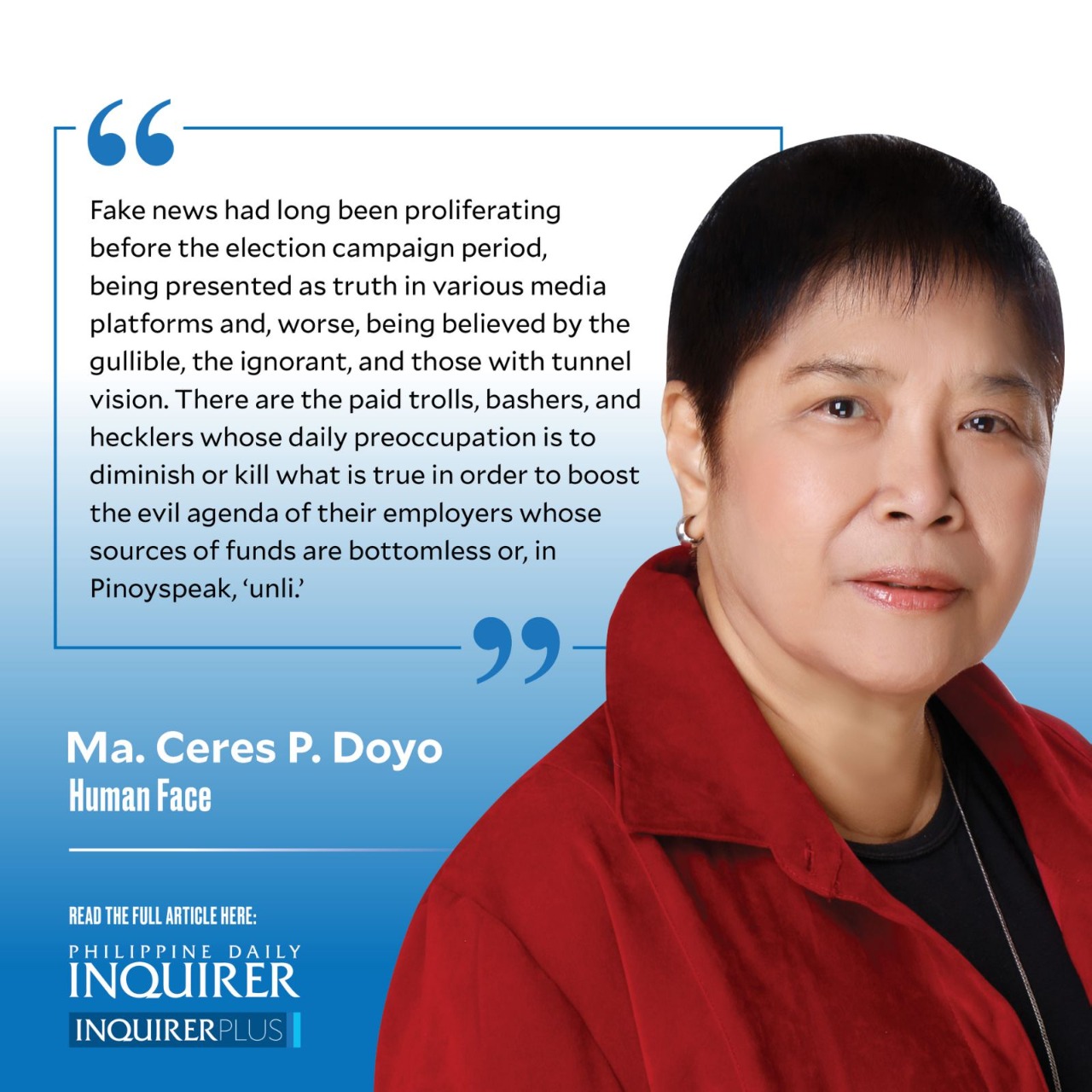
But enough with figures of speech. Fake news had long been proliferating before the election campaign period, being presented as truth in various media platforms and, worse, being believed by the gullible, the ignorant, and those with tunnel vision. There are the paid trolls, bashers, and hecklers whose daily preoccupation is to diminish or kill what is true in order to boost the evil agenda of their employers whose sources of funds are bottomless or, in Pinoyspeak, “unli.”

Yesterday, I again went over “A Nation for Our Children,” a collection of Diokno’s writings and speeches. It behooves us to hearken to him, this man whom the late Bishop Julio Labayen called “a prophet of our times.”

FEATURED STORIES

In 1983, Pepe Diokno delivered the Jose Rizal Lecture at the Philippine PEN Conference where the theme was “The Writer in a Climate of Fear.” That was three weeks before the assassination of Ninoy Aquino, the watershed moment that would explode into nationwide rage.

Diokno’s main source was Rizal’s own writings, the “Noli” and the “Fili.” Meticulously referenced, Diokno’s long lecture was directed at writers who, as he quoted Rizal, “feel their wings but find themselves in chains, choking for want of the air of freedom.”

Today, we choke even more because of the cacophony of falsehoods that threaten to deaden the senses.

Diokno freely translates poet Cecilio Apostol on Rizal: “But if a bullet destroyed your cranium/ Your ideas in turn destroyed an imperium.”

Diokno’s lament: “Rizal’s writings did destroy an empire. But, to our sorrow, they failed to change society. The late Leon Ma. Guerrero, perhaps the best English translator of Rizal, has stressed Rizal’s ‘timelessness, or more precisely, [his] timeliness in another world and another age.’

“So our tasks as Filipinos remain the same as they were in Rizal’s days: regain our freedom as individuals, assert our sovereignty as a people, and use our freedom and our sovereignty to create a just society. And your tasks as writers also remain the same. For as Rizal said, ‘The struggle must commence in the field of ideas before it can descend into the arena of action.’

“I do not ask you to lead, or to teach, and much less to agitate our people for this or that cause or credo. What I ask of you is much simpler: to be great writers. Great in the sense in which Rizal spoke of the greatness of man: ‘A man is great, not because he goes ahead of his generation, which is in any case impossible, but because he discerns what it wants.’ That, ultimately, is your job; to discern what our people want and say it clearly so that they themselves will see it, and seeing, gather their strength to achieve it.

ADVERTISEMENT

“It is a dangerous and difficult task you must undertake. You face the same risks Rizal did: harassment by interrogation and libel suits which some of you have already experienced, arrest and detention which others among you have undergone, torture perhaps, even disappearance and extra-legal execution…

“In today’s climate of fear, how can we afford to face those dangers? It is precisely because of the climate of fear that we cannot afford not to face those dangers. We must damn the risks … say what must be said, and suffer the consequences. Writers can lay down their pens and tear up their manuscripts—but I know of no human—and writers are nothing if they are not human—who can completely silence his conscience.”

In another speech from which the book’s title was taken, Diokno said: “[Ferdinand E.] Marcos has built his entire social system on a system of falsehoods, on a system of repressing creativity, and on creating in our people a feeling of impotence and helplessness. What are we doing to our children? Our system must be the complete opposite. Our system must tell our children the truth.”

So, damn the risks.


Read more: https://opinion.inquirer.net/150569/timely-and-timeless-diokno100#ixzz7sDTXs4qG
Follow us: @inquirerdotnet on Twitter | inquirerdotnet on Facebook

Sunday, January 17, 2021

FOTY runners-up Essential workers: The many faces of pandemic heroism


FOTY RUNNERS-UP

Essential workers: The many faces of pandemic heroism

 / 05:40 AM January 17, 2021

MANILA, Philippines — While health care frontliners focused mainly on COVID-19 patients seeking or receiving treatment in medical facilities, people from other sectors and fields also labored and risked their own well-being to keep the rest of the population alive, healthy and informed.

Without them, families, groups and individuals under lockdown and in isolation would have been rendered helpless, much like voyagers in a listing ship amid a tempest, its captain stricken ill, and with no safe haven in sight. 


Classified by the government as essential workers, they delivered the necessities and services that keep the business of life going: the food producers/providers (fishers and farmers) and manufacturers, the delivery people, those who minded drugstores, markets, groceries, banks, water stations, cash remittance centers and telecommunications facilities. Count, too, the power providers, law enforcers, drivers, security guards, contact tracers, garbage collectors and those engaged in funeral services.

Also highly at risk

Many other medical workers, not at the front lines but also highly at risk, continued to respond to various health emergencies, such as child deliveries, broken bones and sudden ailments.

Essential, too, were persons in spiritual ministries who assisted the dying and gave balm to the grieving.

And not to forget: the media practitioners who continuously provided the latest data on not only the pandemic but also the world at large, separating the chaff from the grain, to prevent misinformation and false reports from adding to the fear and confusion of people groping in the dark.

With the government suspending school operations, classes were held online notwithstanding the sorry state of internet connections, gadgets too expensive for poor families, and teachers ill-prepared for distance learning. Teachers, alas, were left out of the list of essential workers as they were expected to work from home (and not climb onto rooftops or scale hills to catch internet signals).

Prominent 2nd place

While work-from-home became the new normal for those who mercifully did not lose their jobs to the pandemic, essential workers continued to ply the deserted streets and alleys—the government having also suspended the operation of mass transportation—to get to their posts, or stayed behind desks in near-empty establishments to keep watch and make sure that someone would answer calls.

And so the essential workers, or “front-liners in general,” as the Inquirer editors called them during the voting, take a prominent second place as the Inquirer’s 2020 Filipinos of the Year (FOTY).

Why? Said one editor-voter: “The battle against the virus needs all hands on deck. They also played a key role in ensuring the public’s protection, because they also put their lives at risk, because they kept the country, the economy and society functioning through their supporting role.”

Many of them may not have realized in the beginning that they are that “essential,” and that they, too, have streaks of heroism in them. But they got their special vote, their time of day, their time to shine.

And so, in fine: “Everyone has come together in an unprecedented way in this crisis. Everyone is heroic in his/her own way. They have bravely put their lives on the line every day since the start of the pandemic. They have been unwavering in their commitment to help save as many lives while coping with delayed salaries and government incompetence. They are also the face of the modern Filipino hero—courageous, competent and compassionate.”

For more news about the novel coronavirus click here.
What you need to know about Coronavirus.
For more information on COVID-19, call the DOH Hotline: (02) 86517800 local 1149/1150.

The Inquirer Foundation supports our healthcare frontliners and is still accepting cash donations to be deposited at Banco de Oro (BDO) current account #007960018860 or donate through PayMaya using this link .

Subscribe to the Inquirer COVID-19 Newsletter
Read more: https://newsinfo.inquirer.net/1384529/essential-workers-the-many-faces-of-pandemic-heroism#ixzz6mneJhlyX
Follow us: @inquirerdotnet on Twitter | inquirerdotnet on Facebook

2020 Filipinos of the Year: Health care frontliners


2020 Filipinos of the Year: Health care frontliners

 / 05:42 AM January 17, 2021

(Editor’s Note: Every year since 1991, the Philippine Daily Inquirer has sought to recognize the Filipino individual or group who, in the judgment of the newspaper’s editors, made the most positive impact on the life of the nation.)
ILLUSTRATION BY RENE ELEVERA

 ILLUSTRATION BY RENE ELEVERA

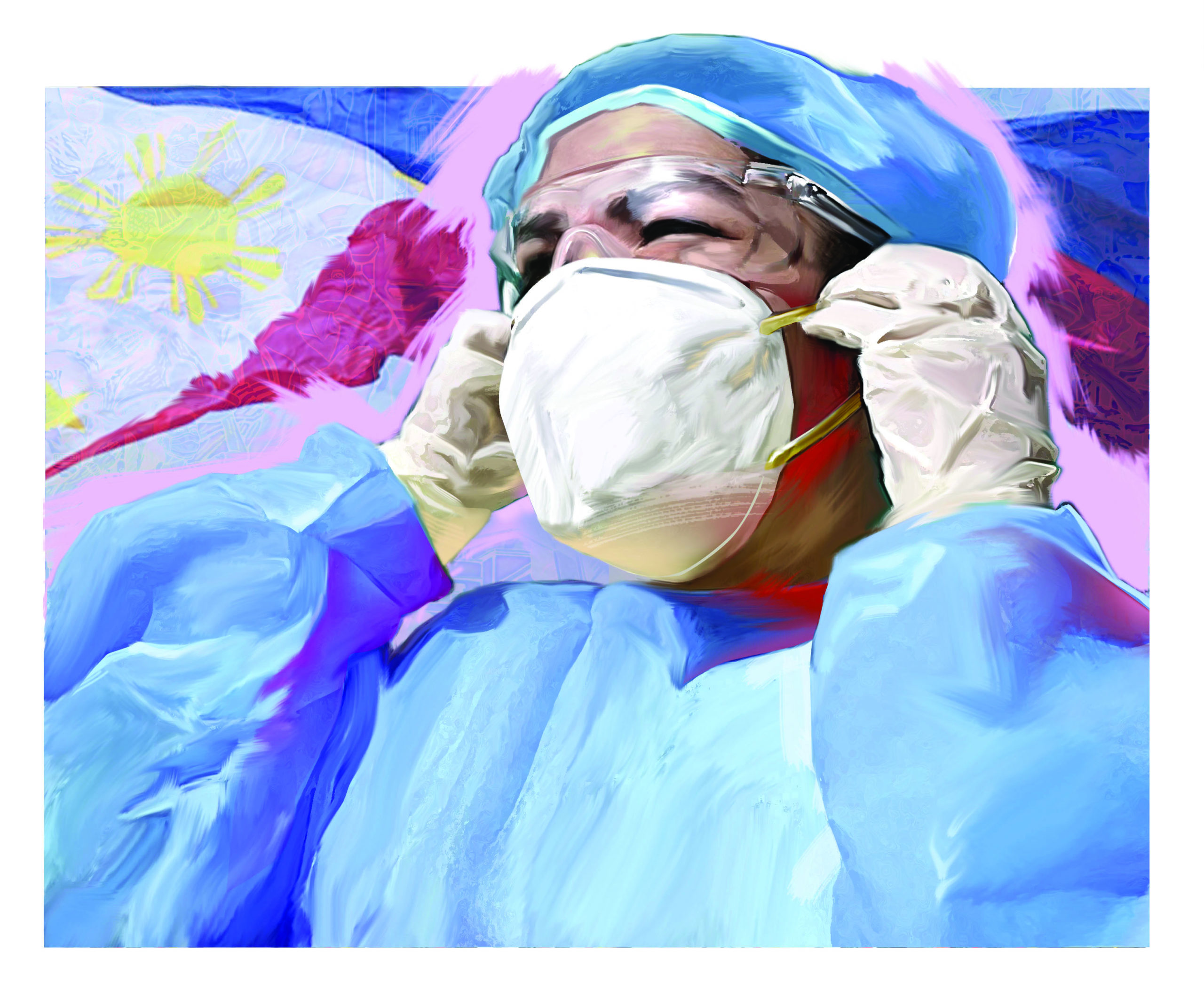
Masked and hooded, or covered from head to foot with protective suits, their eyes peering into a world threatened by an unseen, merciless enemy that they themselves fear, they heeded the call to serve and put their own lives on the line so that others may heal and live.


Many of them could have been the last to gaze into the eyes of those in the throes of death from COVID-19, their comforting words the last to be heard. Their gloved hands held the very sick, the frightened, despairing and lonely in medical facilities where many fear to tread or are not allowed in. Never have their oaths as medical practitioners been so tested.

When it became clear that the highly transmissible novel coronavirus had made landfall in the Philippines in the beginning of 2020, or even earlier, health experts sounded the alarm. But it took the government some time to gather itself and face the enemy head-on.

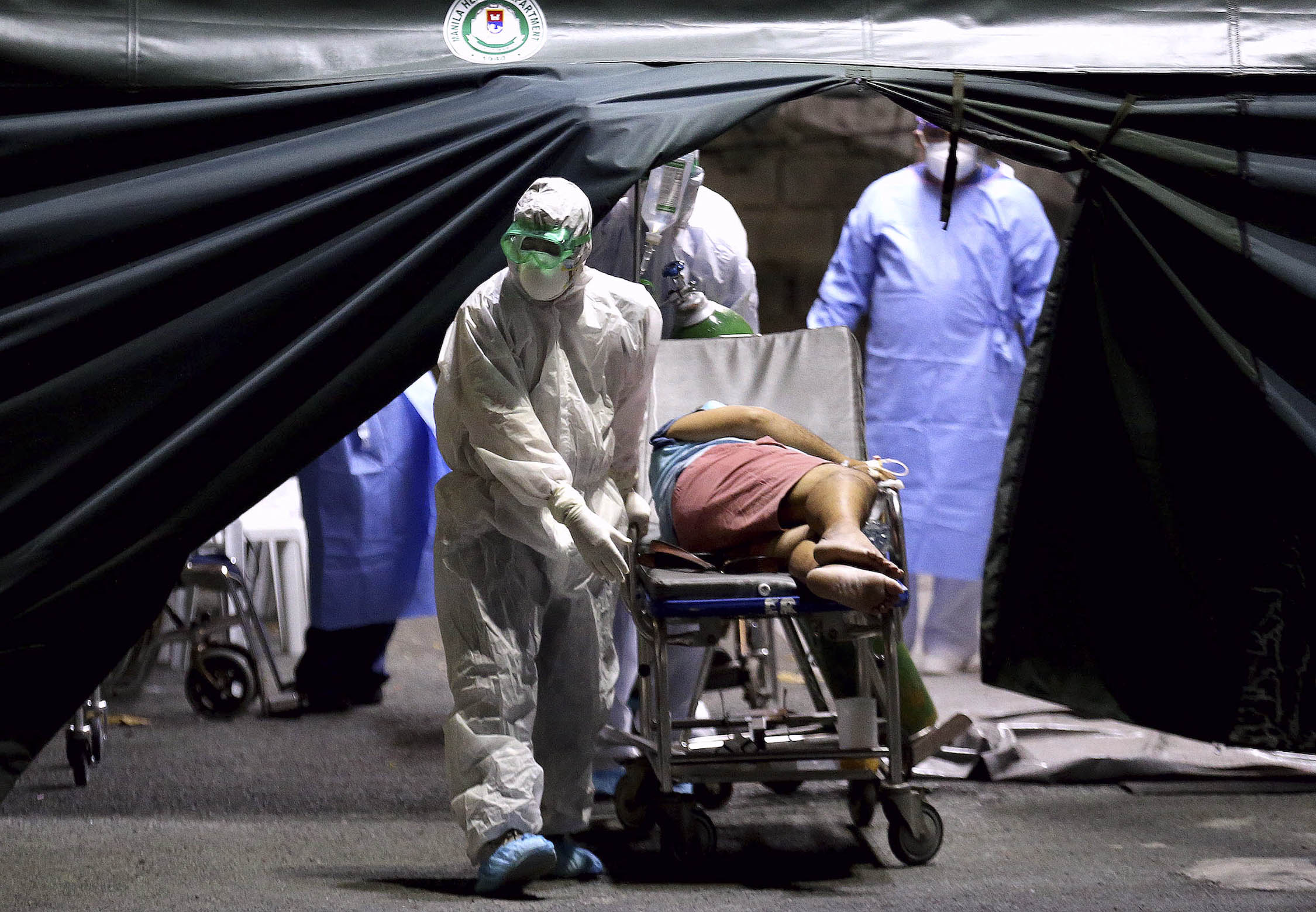
It did not take long for the virus to feel at home in a country where health protocols are observed more in the breach. Soon, when the infected and symptomatic became gravely ill, health-care practitioners became by default the first line of defense: the nurses, doctors, medical technologists and staff in hospitals and health facilities where many life-and-death battles would be lost or won. Like ducks to water, they went down to the trenches, the doctors and nurses with their Hippocratic oath and Nightingale pledge under their belt.

They came to be called health-care front-liners (the latter word heretofore rarely used except in shooting wars). Front-liners because they were front and center, in the enemy’s crosshairs, so to speak, directly receiving and caring for COVID-19 patients. Meanwhile, out in the field, equally indispensable epidemiologists, scientists, other public health experts and law enforcers tried to find ways to track and slow down the spread of the virus.

No one knew then what havoc the virus would wreak on the planet and on this country so rich in human and natural resources but so short in many other essentials, disaster preparedness among them, as well as compassionate, creative and proactive leadership.
FIRST FEW CASES Health workers begin tackling an unfamiliar and dangerous challenge in this April 2020 photo of a Covid-19 patient being brought into a public hospital in Manila. —RICHARD A. REYES

Death count

After the World Health Organization officially declared on March 11, 2020, that a Covid-19 pandemic was indeed sweeping the globe, and two months into a lockdown that began in the Philippines in mid-March and put major cities and provinces under various degrees of quarantine that spelled economic disaster, the count of front-liners infected and dead of COVID-19 began.

By Aug. 28, 2020, according to data from the Department of Health (DOH), 6,735 health workers had been infected. Of these, 40 have died and 6,070 have recovered. The death toll rose to 61 as of Oct. 1, 2020.

By the end of the year a total of 13,629 front-liners had been infected and 76 had succumbed.

The Philippines is said to have had the longest lockdown in the world. And yet…


While the government had promised material compensation befitting wounded and fallen health-care front-liners, there were instances where families, though grieving still, needed to collect on the promises. But they had to contend with the government’s “confusing guidelines on hazard pay” and what one bereaved described as “the penchant of government to say things that it would not fulfill.”
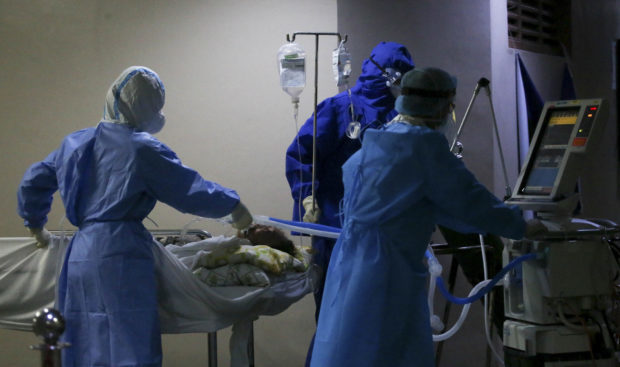
TILL THE VERY END For many Covid-19 fatalities forced to be isolated from their loved ones, the last voice they heard or touch they felt was that of medical workers. —LYN RILLON

Soldiering on

All these, while proof of massive corruption was surfacing at Philippine Health Insurance Corp. (PhilHealth), the state-run health insurance agency.

The front-liners soldiered on as many other Filipinos ensconced safely at home whined about not knowing what to do with themselves and their time; as jobless breadwinners begged for food for their families and business people counted their losses; as some turned to prayer and pious works, or became inspirational gurus, preachy sages and poets on social media; as stranded persons camped out on the streets.

They may have had their share of personal issues, but the front-liners held the fort in their respective “war zones.”

Did they even have the time to contemplate how the world had seemingly ground to a halt but their lives had not—to the point that they could not even pee regularly because of the time it took to shed their protective armor under which they sweated profusely even in freezing, antiseptic hospital units?

At one point in August, the health-care system staggered dangerously under the heavy load of cases, and the front-liners cried out for a reprieve. But not everyone in the government, not even President Duterte, was sympathetic.

Yet, overworked, underpaid and underappreciated, they have learned to live with this national reality, all the while knowing that greener pastures awaited them elsewhere. But a ban imposed in April prevented nurses from leaving the country, dashing the hopes of those bound for dream jobs abroad.
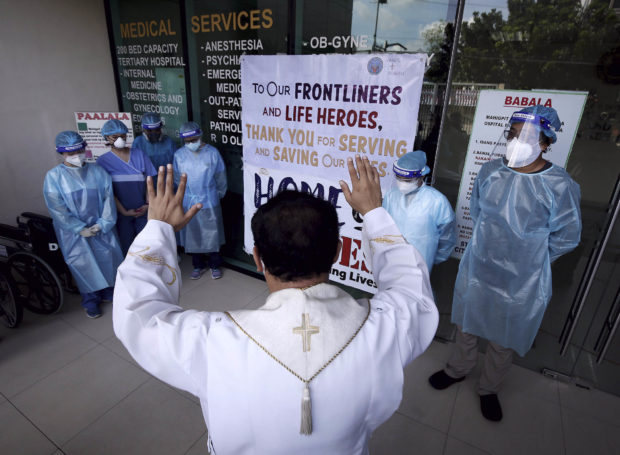
FOR STRENGTH Prayers are said not just for the sick and dying—but also for the professionals risking their own lives as they perform their duty. —RICHARD A. REYES

Heroes in scrubs

The Philippine health-care system is in short supply of health practitioners. According to the International Labor Organization, there are 430 doctors and nurses per 10,000 people in Germany; 337 in the United States; 254 in Britain; and only 65 in the Philippines.

Why? As a nurse bound overseas put it, she was “better off in a war zone in the Middle East than at home.”

In the United States, a nurse can earn as much as $5,000 a month; in the Middle East, $2,000; in Germany, up to $2,800. In the Philippines, despite the emergency hiring efforts, the DOH can offer a starting salary of only $665 (around P31,900) a month, plus a COVID-19 hazard allowance at a maximum of $10 (P500) a day. 

Health-care workers serving at home as front-liners are hailed as modern-day heroes in scrubs. They now receive heaps of praise and thanks from their fellow Filipinos, likened to soldiers in a war that has yet to see an end.

But these lifesavers have also been victims of discrimination and harassment, even regarded as life-threatening, because the ignorant saw them only as carriers of the dreaded virus.

Community ostracism was not uncommon: A nurse was driven out of her living quarters, another doused with bleach, the collective plied with tactless remarks by an elected official. A front-liner was barred from a business establishment. A nurse positive for COVID-19 was found seated on a sidewalk; she was made to leave her boarding house and she had nowhere else to go.

A number of front-liners demur, saying: “We are just doing our jobs, we are not heroes.”

But to COVID-19 survivors they are heroes, God-sent angels in protective suits. Nowhere is this more evident than in hospital scenes of survivors being wheeled out for discharge and applauded by medical staff. The survivors and their families return the applause. Behind their face shields and masks, the thanked and the thankful break into smiles and weep.

With COVID-19 vaccines now being manufactured, Filipinos wait with both relief and a studied skepticism exacerbated by the recent controversy on the illegal procurement and administration of contraband vaccines on the Presidential Security Group, which their Commander in Chief has defended and justified.

The health-care front-liners do not seem to be on the priority list.

To speak of the front-liners in general terms only is to miss the heart of the story. For more than just collectively adhering to their sworn duty and professing love for their work, they have given a human face, a human voice, and a human feel to the word “compassion,” and a breadth of meaning to the word “vocation,” what it is to hearken to the call not just of duty but also of something loftier, nobler.

During the Oct. 20 “Bayaning Nars” awards, the Philippine Nurses Association quoted Pope Francis as paean to their 15 honorees, 14 of whom were dead: “Nursing is more than a profession, it is a vocation, a dedication. During this pandemic, they have given an example of heroism. Some have even given their lives.”

An editor who voted for the health-care front-liners as the Inquirer’s 2020 Filipinos of the Year wrote: “Despite being unprepared for the massive and unprecedented health emergency, they held their ground, putting themselves in the line of fire and preventing an even greater number of Filipinos from getting sick and dying of COVID-19. Many of them lost their own lives in this epic struggle. They were fearful but were determined to serve in the early days of the pandemic when the prospect for relief was bleakest. They humbly said that they were the last line of defense in this fight, but in reality and in many instances, they were the only line of defense.” 

Time was of the essence in saving lives. In the early days of the pandemic a young doctor biked daily to the overcrowded Philippine General Hospital instead of waiting for rides that had yet to be arranged for front-liners. She was hit by a truck and died.

A young ER nurse only two years out of college tested positive for COVID-19 not once but twice. Each time she simply quarantined herself in her apartment, and after testing negative, went right back to work. It was her generation stepping up to the challenge.
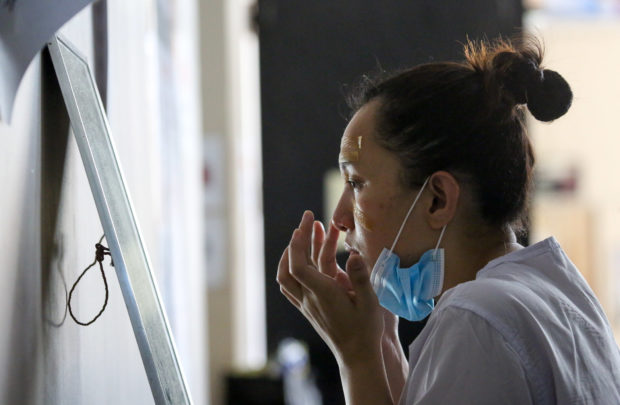
BATTLE WEARY Forced to keep goggles and a face mask on during 12-hour shifts, a nurse has to apply a gel dressing on her face to prevent chafing of the skin. —LYN RILLON

‘Crazy yet rewarding’

Here is an excerpt from her journal in the early months: “It’s been tough psychologically. I leave my 12-hour shift absolutely exhausted especially when I go over worst cases in my head. It is all very scary, to be perfectly honest. It is really a crucial moment for all of us in health care during this time. It is crazy yet so rewarding. We show up strong, united and ready to provide care every single day. But we are also losing staff to sickness or quarantine.

“It’s been chaotic, people flock outside the ER just to have their swabs done. We have set up a ‘tent city’ outside the ER to keep us from being overrun by contagious people. We are triaging to alleviate the pressure on the ER. As ER nurses we cannot lose our cool, we’ve seen it coming, we come prepared but this one is different.”

Different and unprecedented, indeed, the COVID-19 pandemic has taken its toll on every aspect of life. It has also drawn out the best from many of us and, without doubt, the best and the most from the health-care front-liners.

Long after this historic pandemic is over and, God forbid, when an unknown peril lurks again on the dystopian horizon, we will look back at 2020 with awe and gratitude for the health-care front-liners who pulled us from the brink. And hope they would be there again for us as they were, and still are.

For more news about the novel coronavirus click here.
What you need to know about Coronavirus.
For more information on COVID-19, call the DOH Hotline: (02) 86517800 local 1149/1150.

The Inquirer Foundation supports our healthcare frontliners and is still accepting cash donations to be deposited at Banco de Oro (BDO) current account #007960018860 or donate through PayMaya using this link .


Read more: https://newsinfo.inquirer.net/1384531/2020-filipinos-of-the-year-health-care-front-liners#ixzz6mnZqrXOh
Follow us: @inquirerdotnet on Twitter | inquirerdotnet on Facebook