


UT IN OMNIBUS GLORIFICETUR DEUS.

UT IN OMNIBUS GLORIFICETUR DEUS.

UT IN OMNIBUS GLORIFICETUR DEUS.

UT IN OMNIBUS GLORIFICETUR DEUS.

UT IN OMNIBUS GLORIFICETUR DEUS.

Thursday, July 19, 2007

World Day of Justice

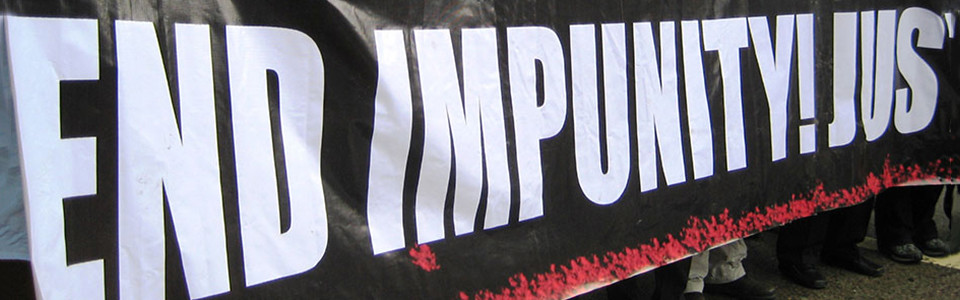
Last Tuesday, July 17, was World Day of Justice. The day marked a milestone in the history of international law and international justice. Nine years ago in 1998, 120 states attending the Plenipotentiary Conference in Rome adopted the Rome Statute, the founding treaty of the International Criminal Court (ICC). As of today, 139 states have signed and 105 have ratified.

It should be noted that while celebrations were taking place all over the world, here in the Philippines a summit on extrajudicial killings attended by stakeholders from civil society, the government and the church, as well as legal experts and individuals in search for justice, was taking place.

Here are some pertinent facts about the ICC. The ICC is the first permanent international judicial body capable of trying individuals for genocide, crimes against humanity and war crimes when national courts are unable or unwilling to do so.

The ICC represents one of the significant opportunities for the world to prevent or significantly reduce the deaths and devastation that result from conflicts. The Rome Statute of the ICC came into force on July 1, 2002 and since then, much has been achieved in the establishment of the court. Located at the Hague in the Netherlands, the court is now a fully-functional institution. The senior court officials are now seated in place and are proceeding with formal investigations.

Thursday, July 12, 2007

Remembering Lean

The youth of this generation ought to have and ought to know someone like him, someone so passionate and dedicated to a vision and a cause. And yet so endearingly likeable. Ask his friends and comrades.

He was the quintessential student or youth activist. Leandro “Lean” Alejandro was all of 27 when he was killed in a hail of bullets 20 years ago. He was emerging from his organization’s office when the forces of evil swooped down on him and gunned him down. The predators had caught up with their prey and would turn him into mincemeat. What they did not know was that the spirit of this young man would live on and beyond, while the rot in his attackers’ murderous souls would continue to fester as long as they lived.

To quote writer Jo-Anne Q. Maglipon who made a moving testimony at Lean’s 47th birthday: “Someone else like Lean had to take more.” Lean is now beyond it all, and yet his example remains within reach. Will someone like him again emerge on the horizon?

Two nights ago, Lean’s friends from a wide spectrum, mainly political activists of all shapes, sizes, stripes, colors, ages and advocacies gathered to celebrate his life and also their own. “Gabi ni Lean: Isang Pag-alaala” was a night of remembering. Words, music, food and drinks flowed at the PETA theater in Quezon City. There was much laughter, and sometimes tears, as people recalled the life and times of Lean through live and video testimonies. This was to again connect to this young man who lived intensely, bravely and romantically.

Thursday, July 5, 2007

57 blood-red years

Showbiz celebrity brats like Paris Hilton and other wannabes out there have a lot to learn from this great woman.

Long before she became a movie icon and had her name on the firmament of genuine stars Rosal Rosal (Florence Danon) had already begun to have a life outside of the glitzy world of showbiz.

“I was in this world but not of this world,” she likes to say. It’s a biblical phrase she often quotes to stress that the movie persona she was known for was not what she was in real life. Of course, people know that by now.

This year, Rosal Rosal marks 57 years of service to the Philippine National Red Cross’ (PNRC) Blood Program. It’s been close to six blood-red decades since she started to lend her time, talent and treasure to an endeavor few celebrities like her have embraced. Indeed, blood is thicker than the sweat and tears she had shed to get the work done.

At 16 going on 17 Rosal found herself in the world of movies. Her Eurasian looks landed her strong character roles, vixen roles among them, when she was younger. That was also about the time that she got drawn to charity work and to the work of the Red Cross.

It all started with a little boy who lay sick and unconscious in the Philippine General Hospital. Rosal chanced upon him and his distraught mother during one of her hospital visits. She did all she could to help, she looked for blood and medicines for him. Her efforts paid off. “When he opened his eyes,” Rosal remembers with tears, “his first word was, ‘Nanay.’”

Thursday, June 28, 2007

The way of ‘he’ in Nanjing

Nanjing, China—“O God, with a thousand names…” I could have invoked.

What is striking about this picture? Close to 200 eminent persons belonging to and professing different religious faiths, as well as eminent persons not professing any faith, gathered together at the 3rd Asia-Europe Interfaith Dialogue in Nanjing, China. (Two previous ones had been held in Bali and Larnaca.)

They came from 39 Asian and European countries. Diplomats and government officials outnumbered the religious leaders and civil society representatives. The majority (124 of 158 official delegates, or 78.5 percent) were men.

During the three days that they were gathered, no prayers were said, no chants were heard, no outward display of religiosity was seen. There were no common rituals (usually musts in multi-religious, multi-cultural gatherings I have attended in the past).

I must note that, in contrast, Filipinos (the women especially) are big on rituals when it comes to ecumenical faith gatherings no matter how tense and serious these are. In the Philippines we usually start off with priests, imams, pastors, nuns and lay leaders leading the opening prayers. Especially in so-called interfaith dialogues.

There was none of the above in this in Nanjing. That’s what struck me. Those are externals (internal?), you might say. Well, I thought prayer—communal and personal—was basic to all faiths, a wellspring from which understanding, peace and goodwill could flow forth. For prayer is the language of the heart. In Nanjing the language was diplomatese.

Thursday, June 21, 2007

‘Trauma, interrupted’: Naming the pain

What can art do in the face of global suffering? Can artists interrupt the trauma or do they intensify the pain when they step into it and try to do something to ease it?

These are some of the questions posed by women artists in the art exhibit “Trauma, interrupted” at the Cultural Center of the Philippines (June 14–July 29).

The art works in different media are the 18 artists’ expression of their deep emotions (rage, shame, hope, peace) and resolve that have arisen from pain and trauma they’ve had to deal with—their very own or the collective pain and trauma of the women they have encountered.

The exhibit explores the links between trauma, art and healing. The art works, curator Dr. May Datuin said, challenge us to come to terms with a range of traumas, including those resulting from conflict situations, natural disasters, human rights violations, mental and physical afflictions.

The exhibit is dedicated to the memory of Tomasa Salinog or Lola Masing of Antique whom Japanese soldiers turned into a “comfort woman” during World War II. She died last April 6 at the age of 78. The exhibit also honors the more than 50 Filipino comfort women (the Malaya Lolas) and many Asian women who had come forward to speak about their ordeal and demand recognition and apologies from the Japanese government. (So far, no apologies. Most former comfort women have refused to accept funds from Japanese donors.)

It is also dedicated to women from all walks of life, women who have been wounded emotionally, spiritually, physically, and who seek to become whole again.

Thursday, June 14, 2007

The power of “The Ninth”

Pacifists, fascists, religious, communists, Nazis, romantics, tyrants, humanists, revolutionaries, despots, freedom fighters. What do they have in common? They have felt inspired by Ludwig van Beethoven’s Ninth Symphony, particularly its fourth and last movement known as “Ode to Joy.”

What is it about “Ode to Joy” that movements and leaders who hold divergent beliefs and ideologies have claimed it to be the anthem that embodies their quest?

Last week the German Cultural Center held another screening of “Tne Ninth”, the award-winning documentary by Pierre-Henry Salfati. This was part of the long-running celebration of the 50th anniversary of the Treaty of Rome which created the European Economic Community, the forerunner of the present 27-member European Union. “Ode to Joy” is the EU’s anthem, by the way. It was re-arranged for the EU by Herbert von Karajan.

It’s a familiar tune, only many don’t know that it is from Beethoven’s Symphony No. 9 in D minor’s last movement, which ends with a rousing orchestral and choral climax that could set you aflame. Beethoven’s inspiration for the finale was Friedrich Schiller’s poem “Ode on die Freude”.

Thursday, June 7, 2007

The grace of remembering

Last week’s column (“Disappeared”) which was about remembering those who vanished in the night, and where I used excerpts from an article (“The Missing and Dead and those who Survive to Tell the Story.”) that I wrote in the 1980s elicited some heart-tugging feedback. One of them was from poet Grace Monte de Ramos who had been moved many years ago by that feature story that came out in the Mr.& Ms. Special edition (the “subversive” edition edited by the present Inquirer editor in chief) and was “provoked” to write a poem.

For Grace, last week’s column piece again released a stream of memories.

I seldom use readers’ letters and the ensuing exchange of thoughts (via e-mail) in this column but maybe this one with Grace would resonate with those who believe that we should not totally leave the past behind.

Thursday, May 31, 2007

Disappeared

Today, in observance of the International Week of the Disappeared, a gathering of human rights advocates, relatives and friends of desaparecidos (Spanish for disappeared) will take place at the Bantayog ng mga Bayani. Commemoration rites will be held at 5 p.m. at the new Salonga Building’s Yuchengco Auditorium.

If you have not been to that hallowed place, then go some time. It is at the corner of EDSA and Quezon Ave. You can’t miss the Castrillo bronze landmark, a soaring monument of a mother lifting up her fallen son from the ground. Quietly explore the place, light candles and run your fingers on the names of contemporary heroes and martyrs etched on black granite. (The desaparecidos as a group have their own Bantayog in the Baclaran Church grounds.)

Today is also the 30th anniversary of the disappearance of lawyer and activist Hermon C. Lagman. He is one of the many activists who disappeared and believed to have been summarily executed during the dark years of martial rule. The Lagman family and the Families of Victims of Involuntary Disappearance (FIND) are the organizers of today’s affair.

The search never ends even as new names are added to the list today, an era supposed to be far removed from those terrifying Marcos-dominated years. But dark forces continue to stalk the land, defying laws and values that are meant to put in place justice and humanity in this country.

We have not really put the past behind. The mourning continues. Sadly, politically and ideologically motivated abduction and disappearances have become part of our culture. And no one side has the monopoly of victimhood or of glaring impunity.

Numbers are cold. Behind the numbers are names. Behind the names on the list are real persons. They had lives, they have families, friends and communities that grieve for them and have become diminished because of their disappearance.

Thursday, May 24, 2007

Where have the piano makers gone?

Where have all the piano makers gone? Gone with globalization every one.

That’s my take on the vanished piano-making industry in the Philippines. Almost gone too are the craftsmen and artisans who built these great musical instruments that had brought music and liveliness to Philippine homes and concert halls.

But not entirely. Australia-based Filipino visual artist Alwin Reamillo, who comes from a family of piano makers, is back, trying to prove that the music from Philippine-made pianos need not die. Not if the few remaining piano builders could be brought back to old abandoned workshops, and with their hands (some gnarled because of tricycle driving), pick up the scattered pieces, strings, ivory keys, metal scraps and all, and put them together.

This is what Reamillo’s art exhibit “Mang Emo+Mag-himo Grand Piano Project” is doing. This exhibit is not Reamillo’s alone. Collaborating with him are piano craftsmen Jaime Pastorfide, Sabas Rabino Jr. and Tranquilino Tosio Jr., all from the Reamillo family’s closed-down piano factory that produced the Wittemberg pianos.

The exhibit’s catchy name comes from the nickname of Reamillo’s father Decimo, who was fondly called Mang Emo. “Mag-himo” is Visayan for “to make”. Mang Emo, Reamillo says, learned the rudiments of piano making by working for a piano company. Later, with his trained craftsmen, and with his brother and nephew as partners, he built a company that began with piano repair and restoration. They later went into fine pianos, some of which are in the Philamlife Auditorium, Miriam College and the Benedictine Sisters in Leyte.

Thursday, May 17, 2007

A teacher, a sheltering tree

It was hard keeping track of the body count or the exact number of casualties during the campaign period and the election day itself. The Inquirer put at 147 the death toll since the election campaign began on Jan. 14, the Philippine National Police total is 143.

I know the number stands for individual lives with faces and names, and with a network of families, friends and colleagues grieving for them. But sometimes the tally and the list of names just seem to numb feelings because they are just numbers to those of us who do not know the victims personally. This is not to say they do not matter.

One case suddenly stood out of the rest though. It was the death of a teacher. She died with a poll watcher, their bodies found in a toilet where they had taken refuge after gunmen wearing bonnets set the school house ablaze.

Why should a teacher die this way?

The name of the high school teacher is Nellie Banaag and the local poll watcher is Leticia Ramos. Their names happen to be familiar Filipino names. They are Everyteacher, Everypollwatcher. Banaag is a common family name in Batangas and there must be thousands of Leticia Ramoses in the Philippines, two former diplomats among them.

Thursday, May 10, 2007

Lola Masing, comfort woman

Tomasa Dioso Salinog of San Jose, Antique, one of the many World War II so-called comfort women in Asia who suffered sexual abuse under the Japanese Imperial Army, died of multiple organ failure last April 6. She was 78.

I met Lola Masing at the International Military War Crimes Tribunal held in Tokyo in 2000. Lola Masing led a dozen former comfort women from Philippines and joined dozens from several Asian countries (China, Taiwan, Malaysia, Indonesia, East Timor, South Korea, among them) who bravely testified. A Dutch woman victim and a contrite former Japanese soldier also told their stories.

I remember that gathering to be a heart-rending occasion. Aging women went up the stage to testify, sometimes weeping, fainting, while old footage, photos and documents on the atrocities were being flashed to serve as backdrop. Some women from China who managed to attend were victims of the infamous “Rape of Nanking”, a well documented historical tragedy.

Lola Masing was only 13 in 1942 when Japanese soldiers broke into their house and took her away. The soldiers beheaded her father when he tried to save his only daughter.

“For two years,” Lola Masing narrated in her March 2007 letter to Japanese Prime Minister ABe, “I was kept as a slave to be raped and abused by Japanese soldiers. They took away the only member of my family. Alone, in abject poverty and with no one to take care of me, I could not go back to school and had to work in order to survive. The war and sexual slavery had destroyed my life and my future…

Thursday, May 3, 2007

Under siege on World Press Freedom Day

It’s World Press Freedom Day today and the son of one of the country’s media icons is missing. Abduction is the most likely reason for the disappearance of Jonas “Jay Jay” Burgos who was reportedly seen being taken away by unidentified men at a mall. Who were they? Where have they taken him? Why?

I hope this column becomes stupid reading because Jason was found alive while I am writing this (yesterday). But this is not the case right now while I am emailing this to the Inquirer close to deadline time.

I’ve never used the press releases of those running for office but re-electionist Sen. Ralph Recto sent something well said, he could very well have said it for us, the members of the media (this is not a plug and I have not yet decided whether I will vote for him):

“The country owes the Burgos family a great deal of gratitude for the freedom it enjoys today (and) it should repay their valor by finding a missing kin. We cannot let the son of a great man who helped give us back our democracy be a victim of undemocratic methods his father strongly raged against. During dangerous times his father did not disappear for teaching us about freedom so why should his son go missing for simply teaching some folks about farming in these supposedly normal times?”