
UT IN OMNIBUS GLORIFICETUR DEUS.

UT IN OMNIBUS GLORIFICETUR DEUS.

UT IN OMNIBUS GLORIFICETUR DEUS.

UT IN OMNIBUS GLORIFICETUR DEUS.

UT IN OMNIBUS GLORIFICETUR DEUS.

Thursday, May 2, 2013

Sainthood for Archbishop Oscar Romero

Philippine Daily Inquirer/OPINION/by Ma. Ceres P. Doyo

While many Filipino Church leaders are now on the campaign trail to openly and blatantly discredit candidates whom they consider “antilife” and anti-Catholic because these candidates went against the official Church stand on the Reproductive Health Law and supported it, I don’t see a groundswell that would spell the ultimate doom of these pro-RH candidates in the May 13 polls. Meaning, candidates will rise or fall not on RH issues.

A backlash may even result from Negros Bishop Vicente Navarra’s divisive “Team Patay-Team Buhay” campaign tack of separating the heaven-destined from the hell-bound. I know some scandalized Catholic voters who plan to vote only for those that the Church has officially maligned in order to boost their chances of winning.

What these powerful male bishops and their zealous followers do not know is that the more they divide, the less likely they will conquer. For those Catholics they have scandalized (including me), the issue is not so much about whether one is pro- or anti-RH as about their crass manner of dividing this country. What experts in division and alienation. They have reduced everything to pro-RH and anti-RH. They even “up yours-ed” the Comelec by cutting in half their oversized campaign posters. A lesson on how to go around the law.

What these powerful male bishops and their zealous followers do not know is that many religious women and lay workers who have made it their business to immerse among the poor (the “laylayan ng lipunan,” as President Aquino referred to those in the margins of society) are secretly pro-RH (not proabortion, for heaven’s sake). As one of them so succinctly quipped and turned the RH issue on its head: “We are not against reproduction and we are not against health.”

I have long suggested that to rid themselves of the prochoice=antilife mislabeling, they should go a step farther than the prolife=anti-RH and work on being “proquality life.”

What many anti-RH, natural-family-planning-only advocates do not know is that the Iglesia ni Cristo, known for its solid-voting style, is in fact against natural family planning. The INC considers natural family planning unnatural and morally unacceptable. So if the INC voters will base their voting choices on the RH issue only (and I hope this is not the case), they will, of course, be pro-RH candidates. A great balancing force against the anti-RH Catholics, who do not comprise the majority anyway.

Once more with feeling: As one who values her Catholic beliefs, I am absolutely scandalized by the divisive maneuverings of the male hierarchy and their zealous followers. I do not want to use strong offensive adjectives to describe them and their actions because otherwise, their agenda to divide wins.
                                                                         * * *
While this election side show is going on, there are developments in the Church that deserve to be noticed. Among them is the reopening of the “long-stalled” canonization of martyred Archbishop Oscar Romero of El Salvador. Gunned down in 1980 while celebrating Mass, Romero was openly sympathetic to “liberation theologians” and those who fought political repression and injustice.

Wrote David Gibson for Religion News Service: “But the news that Pope Francis, just six weeks on the job, has cleared the way for the long-stalled canonization of [Romero] is a stunner that sends another important signal about the new pope’s priorities.”

Gibson quoted Jesuit theology professor Fr. Harvey Egan: “Sainthood is often as much about politics and image as anything else. It’s not surprising to me that this present pope, being from South America, having the same inclinations as Romero, would unblock the process and say, ‘Push his cause through,’ and I think rightly so.”

Romero championed the poor and human rights during the bloody war in El Salvador. A right-wing death squad gunned him down while he was at the altar. There is a famous black-and-white photo that shows Romero slumped on the floor, surrounded by nuns. Being proliberation had its price.

Although Romero was instantly hailed as a martyr, his cause did not sail smoothly, partly, it is surmised, because then Pope John Paul II and his doctrinal enforcer Josef Cardinal Ratzinger (who would later become Pope Benedict XVI) were not too fond of left-leaning liberation theology.

In the 1980s, here in the Philippines where many militant clergy, religious and Church workers fought against the excesses of martial rule, Romero was an icon. He was an inspiration to priests, nuns and bishops who strode the fine line. And then the name Romero seemed to have vanished in the Church firmament.

The good news is that two weeks ago, Archbishop Vincenzo Paglia, a Vatican official who is in charge of Romero’s cause, announced that he and the Pope had met on the matter and that Romero’s case was now “unblocked.” In other words, proceed.

Martyrdom, in Church parlance, means dying for one’s faith and not for some ideological or political reasons. Martyrdom can be a fast path to beatification (the process before canonization). The usual requirements can be waived and only one miracle—instead of two—is required for sainthood.

There is no Catholic San Oscar yet, but there is a Saint Ansgar (German for Oscar).

If there is “The Last Lecture” by Randy Pausch, there is “The Last Sermon” by Romero, a bloody one, I must say, because he spoke of actual cases that happened within that month that he was himself killed.

These lines are worth remembering: “[T]he Church, the people of God in history, is not attached to any one social system, to any political organization, to any party. The Church does not identify herself with any of those forces because she is the eternal pilgrim of history…” #

Thursday, April 25, 2013

Coconut sunrise

Philippine Daily Inquirer/OPINION/by Ma. Ceres P. Doyo

 
Coconut woman is calling out/And every day you can hear her shout/Get your coconut water/Man, it’s good for your daughter/Coco got a lot of iron/Make you strong like a lion…

Thanks to Harry Belafonte’s hit song “Coconut Woman,” the wonders of the coconut had been immortalized in song long before coconut advocates of this decade aggressively pushed it to its deserved place in the world’s diet and quashed the West’s self-serving black prop.

Coconut refers not only to the edible fruit (or nut) but to the entire wonder tree—from root to crown—of which this country is blessed to have in abundance. But it is bitter knowledge that the Philippines’ natural bounties have not always been harnessed to benefit the many.

To say it bluntly, our coconut industry has miserably failed to be a flagship industry when it could have been. In decades past it was squeezed dry by rapacious beings that left the poor coconut farmers even poorer. Think coconut levy during the dark days of martial rule.

I have written a number of coconut articles of different lengths and focus. The coconut levy issue has always left me aghast because of how its wily crafters got away. To this day, the small coconut farmers who should have benefited from the levy have not seen the fruit of their forced contributions. “Kahit singkong duling (Not even a cross-eyed centavo)…”

More than a decade ago, entrepreneurs went into nata de coco (coconut gel) production. Alas, lack of supervision and quality control spelled doom while the Thais got the better of us. And then there was the advent of the virgin coconut oil (VCO), the wonder potion that health buffs swear by.

Books and books have been written on this VCO. But there’s more to the coconut. There are individuals who have taken the word—spoken or written—to the next level. They not only speak and write coconut. They do coconut every day.

One of them is Jun A. Castillo Jr. who runs Coconut House at the Quezon City Memorial Circle, a small restaurant (more branches to open, he hopes) that showcases coconut products—delectable dishes, ice cream, coco sugar, and coconut health drinks. Ah, I must tell you about the drinks—sparkling coconut water, pasteurized coco nectar (tuba without the alcohol), skimmed coconut milk, coco coffee. There is even a “coco not soy” that tastes like oyster sauce.

Thursday, April 18, 2013

Symphonic diplomacy with North Korea

Philippine Daily Inquirer/OPINION/by Ma. Ceres P. Doyo


In February 2008 I followed with bated breath the New York Philharmonic Orchestra’s musical voyage to the Hermit Kingdom, aka North Korea, which then US President George W. Bush called “The Axis of Evil.” Being a lover of classical music, I couldn’t wait to find out what the concert’s repertoire would be, what great symphonic work would be performed.

Other questions in my mind then: How will this orchestra from the United States—among the world’s best—be received? Will music bridge the divide? Will there be locals playing? I was thinking of a North Korean Lang Lang. That was five years ago when North Korea’s strongman Kim Jung Il was still alive and the then heir to his despotic rule, Kim Jung-un, was not yet on the scene. Now he is, this 28-year-old-or-so “Dear Leader III” who threatens to push the Armageddon button if anyone so much as cross his imagined boundaries.

The NY Philharmonic’s 2008 performance is still on YouTube for music lovers to watch and be awed that something like that ever happened. That is, given North Korea’s current bellicose stance against its perceived enemies—the United States, South Korea, Japan and their allies.

With North Korea’s recent threatening posturings of the nuclear kind, I cannot help but recall those symphonic moments. As in, where have all the grace notes gone?

Thursday, April 11, 2013

A mission hospital in Samar

Philippine Daily Inquirer/OPINION/by Ma. Ceres P. Doyo

 
While the election campaign noise rises to a deafening level all over the country, somewhere a quiet miracle unfolds without much fanfare, without the cackle of do-gooders aka politicians, but accompanied by humble appeals that this worthwhile endeavor will see completion.

The Missionary Benedictine Sisters in the Philippines are building a 25-bed hospital in Pambujan, Northern Samar, in response to the community’s critical need. This is not a fancy hospital, but neither is it going to be a barely surviving one that will serve as the last stop of the dying poor or a morgue for the dead poor.

It is going to be the best for the least, one that the poor and the almost poor can proudly claim as their hospital because it serves their needs well at little or no cost. A dream, in other words, but also a dream that should come true.

I am told that generous supporters have come forward to pay it forward. The Salazar family has donated a 3.5-hectare piece of land where the St. Scholastica’s Mission Hospital will rise and stand as an example of persons helping persons with real names, addresses, illnesses and medical needs. The building construction will be shouldered by Hyundai Asia Resources Inc., courtesy of CEO Fe Perez-Agudo, a St. Scholastica’s College alumna whose struggle to get a good education is a real-life telenovela tearjerker. Her phenomenal rise in the corporate world, despite the challenges she had to hurdle in her youth, is one for the books.

But I digress. And not to forget AIM of Vanves, France, that will provide a mobile bus clinic. But much more is required for the hospital to be completed and, more importantly, for it to be sustainable. Sustainability, the in-word in these resource-challenged times, is key. Else why build something with a very limited lifetime or one that will be taken over by rot because resources ran out?

Thursday, April 4, 2013

Letter from a local candidate: A sampler

Philippine Daily Inquirer/OPINION/by Ma. Ceres P. Doyo

A friend of mine is running for vice mayor. She was a town councilor in the past; she gave her all and gave up, swearing never to get involved in local politics again. But she has changed her mind and has paired up with a dreamer and political virgin who is running for mayor.

Short on campaign funds and political backing from above, the two candidates are using a different strategy: person-to-person, small barangay meetings, letter-writing and prayer requests. No miting de avance. I am not disclosing my friend’s identity except to say that she was once a nun and is now into farming and environmental advocacies. In one State of the Nation Address, President Cory Aquino hailed her as among the “new heroes of democracy.” Here are excerpts from my friend’s campaign letter titled “Journey to a Dream.” (It is in both Filipino and English.)        

***
Please pray for us and our town… It is blessed with nature’s bounty and has hundreds of springs flowing from nine rivers. It is a “first class” municipality with an annual income of P100 million that comes mainly from the livestock and poultry producers. We claim to be the “Egg Basket of the Philippines.” But our town is a dirty town.

We have no proper waste disposal. And so our air is dirty, our rivers are dirty, our springs are dirty. Our politics is dirty. We have a newly built Police Station and a Court of Justice. They stand side by side at an end corner of our wet market amidst stinking garbage.

Nearby hospitals can attest to the alarming number of patients suffering from serious ailments that can be traced to an unhealthy environment. Our town leaders have nonessential priorities. The big covered court between the church and the municipal hall is regularly included in the Annual Budget. The last one amounted to more than P10 million. If not for the intervention of a few concerned citizens and the National Historical Commission and the Department of Tourism, a new P90-million municipal hall would have occupied the remaining open space of the town plaza.

Thursday, March 28, 2013

Suicide and the 'feeding frenzy'

Philippine Daily Inquirer/OPINION/by Ma. Ceres P. Doyo

In suicide cases, experts say, guilt should never be owned and blame should never be assigned.

I find myself repeating myself—like today—whenever there is a high-profile case of suicide and a blame game ensues. And then it is followed by a “feeding frenzy,” which was how someone in the health sector described the finger-pointing and the media overload in the case of University of the Philippines student Kristel Tejada, who killed herself.

The reason that most everyone—her schoolmates, parents, sympathizers—is pointing to is Kristel’s becoming despondent over having to go on leave because of her failure to pay her tuition.
Explanations have been given on why UP’s policies were so, which indeed need to be addressed, but breast-beating on the part of its officials was also displayed, partly perhaps to appease those who clamor for changes in school policies.

Tejada instantly became the poster girl for school reforms, especially in public universities that are supposed to offer the best for the least. Suddenly she was turned into a martyr whose death could ignite a variety of causes. Because of the media attention, her death seemed heroic even though her suicide note did not say exactly why she wanted to leave this world.

God forbid a suicide contagion among the young who are emotionally disturbed and who may think their “meaningless” lives can achieve meaning if they end their lives in order to drive home a point.

Thursday, March 21, 2013

'Pope Kiko' and the grace of office

Philippine Daily Inquirer/OPINION/by Ma. Ceres P. Doyo

“Pope Kiko.” The common Filipino nickname and endearment for those named Francisco and its other versions was in my thoughts the moment the Vatican’s cardinal deacon intoned, “Habemus Papam Franciscum.”

The new Pope from Argentina we call Francis in English will be signing his papal name in Latin as Franciscus PP—that is, unless he wants to break with tradition. (The um in Franciscum as used in the announcement is just a Latin suffix, “the standard ending of neuter nouns and adjectives of the second declension,” says an ask-anything Internet site.)

There are a number of guesses as to what PP really means—pontifex primus, pastor pastorum, etc., nasty ones among them. The Vatican website does not give the meaning of PP (an invitation for punsters to guess) but it officially lists Pope Francis in Latin as Franciscus.

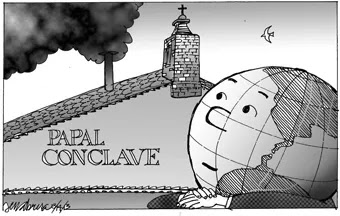
But what’s in a name? Immediately after the new Pope’s choice of name was announced, St. Francis of Assisi (Francesco d’Assisi, patron of Italy and lover of God’s creatures) was in most everyone’s mind. For the huge crowd that had waited for the white smoke that was to signal the good news, the seagull seen near the Sistine Chapel chimney was a confirmation of the Pope’s choice of name. That is, even before Pope Francis (who is not a Franciscan but a Jesuit) had explained why he picked the poverello of Assisi, not Francis Xavier, the great Jesuit missionary to Asia, or Francis de Sales, a doctor of the Church.
It was during his audience days later with thousands of journalists that Pope Francis explained his choice of the rich man who left everything in order to live poor and serve the poor. St. Francis (1181-1226) was not a priest, but the Franciscan Order that he founded, and the hundreds of congregations of brothers, sisters and priests that have sprung worldwide over the centuries, are proof of his great charisma.

Thursday, March 14, 2013

Women's conclave and other thoughts

Philippine Daily Inquirer/OPINION/by Ma. Ceres P. Doyo

I am privileged to have been invited to a regular gathering of Catholic Filipino women theologians—or women doing theology—and participate in a discussion of issues that concern the Catholic Church, especially those affecting women who work in spreading God’s message of love, peace, justice and equality, as well as those that these women serve. I call our gathering a “women’s conclave.”

The meetings are so vibrant and liberating to the spirit, sometimes raucous one moment and solemn the next. The women are always full of hope, laughter and eagerness to listen. I don’t consider myself a foreign entity there, not so much because of some background in theology of my own as because I am a woman similarly concerned with where a huge body (I don’t want to say “powerful institution”) with a massive following such as the Catholic Church—to which I belong—is headed.
Our last meeting was held a week or so ago, when speculations were high on who the next pope would be. How will he deal with women’s issues and restive women in the Church? Will he break or thicken walls? Will the Church be more inclusive or exclusive?  
 
We had a good laugh when someone said that technically, women could be elected cardinals without first becoming ordained priests. A theologian said this is true, a backdoor way for women to get to the conclave that would elect a pope. But this is possible only in theory, and not in practice. But granted that this is in fact possible, how will the conclave go? I suppressed the wicked thought that the women cardinals might end up tagatimpla ng kape (making coffee). I imagined a particular feisty woman theologian, author and feminist lost in a sea of scarlet, humbly doing a Martha. But I should keep that naughty and impious thought to myself.

Thursday, March 7, 2013

'Defining moment' in Philippine-Swiss ties

Philippine Daily Inquirer/OPINION/by Ma. Ceres P. Doyo

At a forum two days ago on the newly signed Human Rights (Violations) Victims Reparation and Recognition Act of 2013, I shared a table with some rights abuse victims of the martial law years. They were not the nationally known biggies.

The gathering was held at the Bantayog ng Mga Bayani grounds in Quezon City, where the names of martyrs and heroes of the dark days are etched on black granite.

A woman from Tarlac showed me documents related to her desaparecido (disappeared) father who was snatched by unknown men in front of her when she was 12 years old. Her father was an organizer of peasants, she told me. Would her family be qualified to receive compensation? she wondered.

I asked a man from Bulacan about his case. Already among the 9,539 so-called “Hawaii claimants,” he was eager to know more about the new compensation law. He suffered torture in prison: Electricity was applied on his genitals, he told me. While speaking he kept rubbing his chest, then added that his torturers also kept pulling and twisting his nipples and that it took a long time for his nipples to get back to their original look.

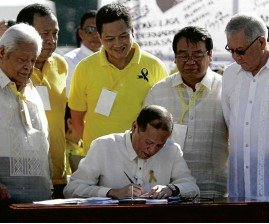
The gathering was an eye-opener especially for those victims who have not been in the loop for many years. The crafters of the law, among them Representatives Edcel Lagman and Neri Colmenares, spoke about how the bill went through the wringer for many years. They shared inside stories in the bicameral sessions and how the bill finally got signed by President Aquino at last week’s 27th anniversary of the 1986 People Power uprising. Bantayog executive director Nievelina Rosete spoke on little-known facts about the early days of the hunt for the Marcos loot and Sen. Jovito Salonga’s recovery efforts.

But the speech of Swiss Ambassador Ivo Sieber held its own. A source of sound bytes on the Marcos Swiss accounts—recovered many years ago but held for a long time in the national treasury until the compensation law was passed—Sieber said the President’s signing of the compensation law was “a remarkable moment for Philippine-Swiss relations.”

Thursday, February 28, 2013

Etta's valedictory: Farewell to a dark night

Philippine Daily Inquirer/OPINION/by Ma. Ceres P. Doyo

There we were, several dozens of us, wearing white T-shirts just handed to us, the back emblazoned with the words in bold font: “MARTIAL LAW SURVIVOR.” There could have been more of us, but not all survivors invited to the 27th anniversary of the Edsa People Power uprising could make it.

This was not going to be just any anniversary. President Noynoy Aquino was going to sign the Human Rights Victims Reparation and Recognition Act at the morning celebration. It had not been publicly announced and was not even stated in the program. It was going to be a surprise.

I could have gone there as a media person, but I chose to sit with fellow martial law survivors. We wore the “survivor” T-shirts over the shirts we came in, but just before the signing many of us turned the T-shirts around so that the printed part at the back would be in front. For the President to see, and for the cameras, too.

Like the rest of the seated guests, we were given laminated tags that said “VIP.” Someone remarked, “Very Important Prisoner,” as many of the survivors present were during the dark years of martial rule. The remark brought forth a tsunami of memories.

Because of the blocked roads to the People Power monument, Commission on Human Rights (CHR) Chair Etta Rosales had invited me to ride to the celebration with her. I drove to her home so early in the morning. Over a hurried breakfast of pandesal and coffee, I reminded her that I had been to her home many years ago, to interview her when she was a high-profile teacher-activist who fought the Marcos regime and who would later be imprisoned and tortured.

In the van with several other survivors, Etta rehearsed her speech while I timed her. She was to speak before the President’s signing of the law.


Here is Etta’s valedictory, a farewell to a dark night. She spoke for the tens of thousands who survived martial rule and for those who fell in the night.

Thursday, February 21, 2013

Women Writers in Media Now in Aliww exhibit

Philippine Daily Inquirer/OPINION/by Ma. Ceres P. Doyo

We, the Women Writers in Media Now (Women), upon the prodding of the Ateneo Library of Women’s Writings (Aliww), are “exhibiting ourselves” as writers starting today until April 30. The 4:30 p.m. exhibit opening is preceded by a 3 p.m. forum where three of us—Marites D. Vitug, Jo-Ann Q. Maglipon and I—will speak.

See details of the 18th Paz Marquez Benitez Memorial Lecture-Exhibit at: http://womenwritersinmedianow.blogspot.ca/.

“Procure, preserve, promote” writings by and about Filipino women. These three Ps sum up Aliww’s mandate, which has led to the creation of archival “rooms” for women where print items are preserved, items that “allow entry into the world of a woman who has distinguished herself in a particular field.” By providing researchers access to such primary sources, Aliww facilitates the writing of a national history that includes and acknowledges the contribution of Filipino women. I did write about Aliww a couple of years ago in the Sunday Inquirer Magazine (“More than a library of her own,” March 26, 2011). Now on its 18th year, Aliww holds at least two exhibits a year, says director Rica Bolipata Santos.

Here’s Women’s history:

Women writers on edge, gathered on the edge…

In 1981, nine years into the martial law era, a handful of women journalists and literary writers, appalled by the suppression of freedom of expression by the dictatorial regime, gathered, planned, plotted.
The first meetings were tame. The women wanted to hone their writing skills, critique one another’s works and invite veterans to share writing tips and secrets. Their favorite venue was the Heritage Art Gallery where Odette Alcantara welcomed groups and individuals who needed a place to meet, create and express. The women’s meetings soon evolved into regular forums on issues such as press freedom. The mood would shift from serious to irreverent, from heady to intense, from silly to downright subversive.

From and through all these, things began to emerge and converge.
 

Thursday, February 14, 2013

Reporting on the papacy

 
Philippine Daily Inquirer/OPINION/by Ma. Ceres P. Doyo

With Pope Benedict XVI’s stunning announcement of his resignation from the papacy—the first in almost 600 years—the Catholic world is again praying, speculating, evaluating. The Pope cited reasons of age and health. Who will fill the Shoes of the Fisherman?

A most sought-after Vatican journalist nowadays is John L. Allen Jr., a prize-winning Vatican correspondent for the US publication National Catholic Reporter (NCR). After news on the Pope’s resignation broke, an international television news network had Allen on camera right away. But it was an Italian journalist—a woman in the male-dominated Vatican—who broke the news first. I didn’t quite catch her explanation on how she had scooped everyone, but she sounded rather humble and matter-of-fact about it.
Allen may be considered the “dean” of Vatican journalists. He is described as “the journalist other reporters—and not a few cardinals—look to for the inside story on how all the pope’s men direct the world’s largest church.”

When the charismatic Pope John Paul II died in 2005, Allen’s revised and updated book “Conclave: the Politics, Personalities and Process of the Next Papal Election” (Doubleday, 2004) became a favorite reference. I got my copy from the Jesuit theologian Fr. Catalino Arevalo, and it served me well when I was assigned to write pieces before and after the conclave.

 Arevalo also gave me a primer, “Papal Transition,” a good guide for journalists, by Rev. Thomas J. Reese, SJ (editor in chief of the Catholic weekly America). It answers 27 questions, including what happens when a pope dies, is in a coma or resigns, what happens at the conclave and after it, etc. And for incorrigible gamblers-bettors, Reese provides a one-liner on what website to visit.