




UT IN OMNIBUS GLORIFICETUR DEUS.

UT IN OMNIBUS GLORIFICETUR DEUS.

UT IN OMNIBUS GLORIFICETUR DEUS.

UT IN OMNIBUS GLORIFICETUR DEUS.

UT IN OMNIBUS GLORIFICETUR DEUS.

Wednesday, April 16, 2014

Fr. Suarez says last Mass on Easter before returning donated land to San Miguel

 
The “healing priest” Fr. Fernando Suarez will celebrate his last Mass at MonteMaria in Alfonso town, Cavite province, on Easter Sunday after his Mary Mother of the Poor Foundation (MMPF) decided to return the 33-hectare property donated to it by San Miguel Corp. (SMC).
 
Suarez is known in the Philippines and abroad for his gift of healing. Many people who have experienced or witnessed the miraculous healing have confirmed the priest’s gift.
 
But like most gifted people, Suarez always says he is only a channel and that it is God who heals those who have faith.
Not all bishops welcome Suarez in their ecclesiastical territories and some have been speaking unfavorably of him in a recent series of reports on the Monte Maria property published in the Inquirer.
 
But Bishop Antonio Palang, SVD, DD Vicar Apostolic of the Vicariate of San Jose, Occidental Mindoro province, has issued a letter to dispel doubts about his integrity.
 
In that letter, Bishop Palang says: “To whom it may concern: Between March 5 and 9, 2014, a series of articles was printed in the Philippine Daily Inquirer newspaper. The article alleged irregularities in the charitable foundation called Mary Mother of the Poor that [Fr. Fernando Suarez] founded. In addition, his healing ministry and lifestyle were also attacked.
 
“I certify that the accusations in these articles are unfounded and not true. Fr. Fernando Suarez [of the] Missionaries of Mary Mother of the Poor is a priest of good standing in the Apostolic Vicariate of San Jose, Occidental Mindoro.”
 
San Mig and MonteMaria
 
Last month, the Inquirer published a five-part series that highlighted the withdrawal by food and beer giant San Miguel Corp. (SMC) of its donation of a 33-hectare property in Alfonso town, Cavite province, that would have been the site of an MMPF project, the MonteMaria Shrine complex, which would include a statue of the Virgin Mary taller than the 30-meter Christ the Redeemer statue in Rio de Janeiro.
 
Among the reasons cited was failure of the MMPF to erect the structures within five years of the donation.
The series also quoted critics who questioned Suarez’s ministry and lifestyle.
 
Suarez was in the Holy Land when the series was published. In his absence, MMPF board member Deedee Sytangco (former spokesperson of President Cory Aquino) offered some explanation.
 
Only after Suarez had returned from the pilgrimage that he was able to air his side, which appeared in the fifth part of the series.
 
“It was too late, the damage had been done,” a friend of Suarez said.
 
Columnist Ramon Tulfo also wrote negatively about Suarez. The priest later said Tulfo had personally apologized, admitted he was misinformed and sought to be prayed over.
 
GMA News Channel 11’s “Mareng Winnie’s Bawal ang Pasaway” aired Winnie Monsod’s interview with Suarez for two Monday nights last month.
 
Monsod asked Suarez point-blank about the allegations. Suarez either explained them away or flatly denied them.
When asked if he thought SMC might have had something to do with the bad press he was getting, Suarez answered yes.

Christian forgiveness
 
Suarez himself had admitted that MMPF could not meet SMC’s expectation, which was to build the Marian complex as originally planned within five years. The foundation has decided to return the property.
 
Interviewed backstage by a TV5 crew after last Palm Sunday’s Mass, Suarez confirmed that the SMC property will indeed be returned.
 
The MMPF, he said, had offered SMC one of three things: Make a loan so that the MonteMaria project could proceed, build a columbarium, or just build the statue of the Virgin Mary. SC rejected all three.
 
The original MonteMaria project is no more. But a Marian site for prayer and healing remains on the horizon.
Suarez has denied accusations of having a lavish lifestyle, but admitted that playing tennis kept him sane, his way of warding off stress, and that he was merely invited to tennis clubs frequented by the rich.“I ask for nothing, I decline nothing,” he would always say when questioned about donations to him and to the foundation.
 
Suarez ministers to both the poor and the rich, to people from all walks of life who come to his healing Masses.
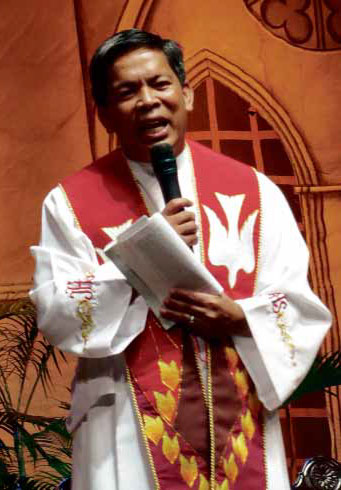

‘MOVING ON, REJOICING’ “The healing priest,” Fr. Fernando Suarez, delivers the homily during the Palm Sunday Mass at Meralco Theater.He spoke about moving on with service and sacrifice with rejoicing. CERES P. DOYO

He had some strong words for those who had written negatively about him without getting his side.Merely saying later that they were misinformed, which was not an excuse.He considered suing for libel those who besmirched his reputation and his ministry but Christian forgiveness prevailed over him, he said.
 
Moving on
 
Despite the negative publicity, Suarez continues to pack them in. The Meralco Theater was packed when he concelebrated Mass and delivered the homily on Palm Sunday.
 
The homily theme assigned to him, “Moving On,” was in sync with his personal decision to move ahead and not look back on hurts and accusations hurled at him.
 
Pointing to the cross as a starting point, Suarez urged the people to move on from there toward sacrifice and service. Suarez gave meaning to every letter in the word “cross.”  C, he said, stood for Jesus saying, “Come to me.”  R was not only for repentance but, more important, for rejoicing. O stood for openness to God’s message. The two S’s in the word “cross” stood for sacrifice and service, which, Suarez said, is what mission is all about.
 
Mission, not commission
 
“Mission,” he stressed, “not asking for commission.”
He could have been referring to the P10-billion pork barrel scam that involved lawmakers and government officials who allegedly channeled public funds to dubious organizations and into their own bank accounts.
Those who seek commissions, Suarez said, end up in distress.
Admitting to being a fan of Pope Francis, Suarez, while delivering his homily, was holding a copy of the Pontiff’s apostolic exhortation “Evangelii Gaudium (The Joy of the Gospel)” and often quoted from it.He sometimes picked up his cell phone and read from it quotes from the Pope.
 
Live joyful lives
 
Christians must live joyful lives, he said, echoing the Pope’s exhortation. “Do not be too hard on yourself,” he said, paraphrasing Sirach 14:11: “My child, treat yourself well. Do not deprive yourself of enjoyment.”
As long as it is not sinful, Suarez added. But he also said: “Do not be afraid of the cross. Jesus is offering us joy. Then we can move on.”

Shifting to a light mood, Suarez said someone commented about his good looks. “I said it’s because I am being persecuted,” he said, laughing.Suarez’s down-home homilies and Batangueño humor resonate well with Filipinos from all walks of life.
 
Ministry among Mangyan
 
Suarez also spoke about his new mission assignment among the Mangyan in Occidental Mindoro.
Bishop Palang recently assigned him to be the apostolic vicar to the Mangyan in the diocese in addition to MMPF apostolate among the poor and the running of a formation house for seminarians on the remote island of Ilin off Occidental Mindoro.
 
He separated from the Canada-based Companions of the Cross and founded the Missionaries of Mary Mother of the Poor (MMMP), which has a “pious association” status for now.Bishop Palang took Suarez and his group into his diocese several years ago.Suarez described his arduous mountain trek to a Mangyan community in Lagnas town in Mindoro and the difficult life of the Mangyan.
 
“When I asked them what we could do together, their answer was, ‘Father, let us build a church,’” he said. Poor as the Mangyan were, they did not ask for material assistance, he added.

Road to God's heart
 
Suarez was one of six priests who concelebrated the midday Mass after the Palm Sunday Family Recollection organized by the Angel Mission, a group of lay people animated by Fr. Jerry Orbos, SVD.
 
The yearly recollection for lay people is now in its 18th year, said Sytangco, one of the organizers.The other Mass celebrants aside from Orbos were SVD priests Ed Guarin and Paul Dogba; Nelson Cabanero, SMM, and Eliseo Santos, SDB.The blessing of the palms was part of the service.
 
Before the Mass, the audience listened to personal testimonies from lay people who had undergone physical and moral sufferings followed by the healing of body and spirit. Santos, a Salesian, delighted the audience with his talk punctuated with witty remarks and his creative use of props.
 
Let it go, let it be
 
Orbos, who writes a Sunday column in the Inquirer, kept pointing to the road to God’s heart. He sang the refrain of the hit song “Let It Go” that segued into the Beatles’ “Let It Be.” After the Mass, Suarez did a general healing prayer for those with physical, mental and spiritual ailments. He did not go down to the audience to touch the sick. Instead, a priest holding a monstrance with the consecrated host went around for eucharistic healing. #

Thursday, April 10, 2014

Her womb and other Lenten thoughts

Philippine Daily Inquirer/OPINION/ by Ma. Ceres P. Doyo

Former President Joseph Estrada, accused of plunder, had a problem with his knees and he was allowed to fly to Hong Kong for surgery. There were concerns about his not returning and facing the charges against him. But he did return, resumed house arrest in his Tanay rest house, was convicted, and was quickly pardoned by his successor, Gloria Macapagal-Arroyo.

Toward the end of her 10-year presidency, Arroyo developed a life-threatening, potentially disabling condition involving her cervical spine. Also accused of plunder and under hospital arrest, she had undergone very delicate operations. Arroyo’s attempt to leave the country while in a wheelchair was dramatically foiled at the airport by the Department of Justice. Now a congresswoman representing the second district of Pampanga, she is detained at the Veterans Memorial Medical Center in Quezon City.

In contrast to these two former presidents who bared their infirmities in order to receive humanitarian treatment, the dictator Ferdinand Marcos kept his health issues under wraps. There was no danger of flight on his part as he clung tight to this woebegone country. In fact, being flown out of the country he had ruled with an iron first for almost two decades and forced into exile were not severe enough punishments.

When Marcos was rumored to be ailing toward the end of his rule, he was never seen in a wheelchair. Only after he was deposed through people power were the rumors confirmed. The medical contraptions found in Malacañang confirmed the reports about “the autumn of the patriarch.”

The wheelchair has become the subject of jokes, the symbol of flight, the refuge of the accused. Confinement in posh health centers are preferred by high-profile detainees with deep pockets. They present their medical test results in the hope that they would not be thrown into crowded, malodorous city jails and suffer the company of common criminals. As if they are not so common themselves.

Thursday, April 3, 2014

Healers


Philippine Daily Inquirer/OPINION/by Ma. Ceres P. Doyo
I write this in the wake of the five-part series in the Inquirer about Fr. Fernando Suarez, known as “the healing priest,” who was mercilessly bashed to smithereens by some critics while he was abroad based mainly on what they had observed or heard, and with no damning documentation presented. It was only in the last part of the series that the priest, probably jet-lagged when asked to react, was given what looked like token space to air his side.

In Suarez’s absence it was Deedee Siytangco (former spokesperson of President Cory Aquino), a member of the board of the Mary Mother of the Poor Foundation (MMPF) that Suarez founded, who had to provide some answers to questions. As someone said, “They shot him first and asked questions later.”

His supporters and those who believe in him could only sigh, “It is useless to raise a howl. The damage has been done.” In other words, those who wished to put him in a bad light have succeeded. I quote a Suarez believer: “Ang Diyos may awa. At gaba.” (God shows mercy. And also punishes.)

The series sounded like a “killing-him-softly” type. I was waiting for a bombshell that never came.

As far as I knew, the story was supposed to be about why food and beer giant San Miguel Corp. was withdrawing its donation of a 33-hectare property in Alfonso, Cavite, from the MMPF. The story segued into the personal.

(A disclosure here: Early this year the Inquirer asked me to do the Suarez-San Miguel story, but I declined. By the way, I wrote a page 1 feature article on Suarez for the Inquirer in December 2007. That was when stories about his healing gift were beginning to spread.)

Thursday, March 27, 2014

From Payatas to St. Scho, magna cum laude

Philippine Daily Inquirer/OPINION/by Ma. Ceres P. Doyo

Payatas in Quezon City is often pictured as a landscape most foul, a garbage dump, the receptacle of the city’s refuse. I’ve been there thrice: to do stories on a woman who turned scraps into exquisite underwear, on a thriving Church microlending cooperative for the poor, and, in 2000, on the collapse of the garbage dump, burying hundreds of waste pickers (mangangalahig).
Today I’m writing about someone who hails from Payatas—poor, very bright—and who studied as a college scholar in St. Scholastica’s College. Jessa Bacala graduated last Monday with a bachelor’s degree in business administration, major in financial management, magna cum laude. She also received two academic excellence awards from the Philippine Council of Deans and Educators in Business and the Philippine Association of Collegiate Schools in Business.
She need not join the thousands of new graduates who flock to job fairs. She can just choose from the job offers from reputable corporations.

Time was when St. Scho was considered a school for girls with financial means and a good brain for academics, and who could withstand the rigors of German-style Benedictine discipline while getting steeped in ora et labora spirituality. “To be a woman of character” was a mantra stamped on our souls.

Established 108 years ago, the school has evolved into a more inclusive one and puts even greater emphasis on social involvement (which has always been there) and women-gender awareness.

Even before Jessa graduated valedictorian from the Payatas High School (a public school since renamed Justice Cecilia Muñoz-Palma High School), she had received scholarship offers from top schools. She did the round of interviews, sized up the schools’ offerings and campuses, and finally settled for St. Scho in Manila.

“I just knew this was it,” Jessa told me. She felt awed by the neo-Romanesque St. Hildegard building which has intricate arches and beautiful columns. And the chapel, she had not seen anything like it.

St. Scho gave Jessa a 4-year, tuition-free college scholarship, while the Justice Cecilia Muñoz-Palma Foundation (JCMPF) provided for the miscellaneous expenses. To keep her scholarship, she had to maintain an average grade of 3.5 (4 being the highest) and above.

Thursday, March 20, 2014

Partial compensation from the Marcos loot

Philippine Daily Inquirer/OPINION/by Ma. Ceres P. Doyo

Thousands of victims-survivors and relatives of those who perished and vanished during the dark night of martial rule have each been handed their compensation checks for the second time. I received mine last Monday. A photo of that came out on page 2 of the Inquirer last Tuesday. I was wearing my “Martial Law Survivor” overshirt and holding the EastWest Bank check. Also in the photo was our lead counsel Robert Swift, smiling.

Unlike in 2011, this second distribution was much slower but surer that no fraudulent claims would get through. Many claimants’ steps have also become slower than in 2011 when they came for the first distribution. A number of them have since passed on to the Gentle Beyond—activists who were claimed by sickness, aging claimant-parents of those who had fallen in the night long ago.

Personally handing the checks was American lawyer Swift, who led close to 10,000 martial law victims-survivors in winning the class suit against the estate of the late dictator Ferdinand Marcos. We hope that after this second check more would be forthcoming from discovered hidden wealth of the Marcos family. The check distribution in Metro Manila will continue until tomorrow, March 21.

In 1995 a Hawaii Court judgment set a $2-billion compensation for human rights abuse victims. Alas, the discovered Marcos wealth had not been easy to come by, no thanks to the other claimant, the Philippine government. This has changed, thanks to Republic Act No. 10368. This 2014 compensation derives from a $10-million settlement over an 1899 Monet painting previously owned by Imelda Marcos and fraudulently sold by her former secretary Vilma Bautista, who has been sentenced in New York.

The $2-billion compensation for some 7,000 claimants (down from almost 10,000) is different from the P10 billion allotted by RA 10368, “an Act providing for reparation and recognition of victims of human rights violations during the Marcos regime, documentation of said violations, appropriating funds therefor and for other purposes.” An eight-member compensation board was recently formed to preside over the screening of claimants and the compensation.

Last Monday, there was a long line of chairs for the waiting claimants and so, as I had planned, I did interviews and listened to stories from victims-survivors. (For those born yesterday: The martial law years spanned the period 1972-1986.) Here are reminiscences from the queue.

I was surprised when two claimants told me how I had helped them during those dreadful years. Oh, now I remember, I said to Ave Enrile-Carlos, a former student activist who was detained. She and her husband now run a restaurant on Session Road in Baguio City. Yes, I said to Ed Buenaventura and his wife after he reminded me that we were together in the Friends of Slum Dwellers. Ed was detained twice for subversion. He is now a project development assistant in the Department of Agriculture.

Their reminders brought back memories of the times when, at great risk, I carried persons on the run in my small car and drove them to their hiding places. Well, one day military surveillance caught up with me… How did I become a claimant? Google “The Years of Writing Dangerously” (Sunday Inquirer Magazine). It’s also in my book “Human Face: A Journalist’s Encounters and Awakenings.”

Thursday, March 13, 2014

Empowered women farmers

Philippine Daily Inquirer/OPINION/by Ma. Ceres P. Doyo


Filipinos have a way of using superlatives when they see a how-good-can-it-get situation. So let me say: Women farmers na, empowered pa.

That is said with the supposition that being a woman farmer is not (or should no longer be) a burden but a blessing, not a diminishment of status and gender but an empowered state of being. Of course, the ideal is still far from what is happening on the ground. But maybe romanticizing the image of woman as farmer might help remove the stigma attached to working the soil, growing food and harvesting the fruits of the earth. But why shouldn’t that be a cherished calling if not a chosen way of life?
I know a number of well-educated women who turned their back on professional careers that many covet. Off they went to answer the call of the wild, so to speak, to nourish and bring back to life the fallow earth. These women’s immersion can even be described as spiritual. They have emerged from the experience richer and fuller in substance and in essence.


They personify the spirit of Ceres, the goddess of agriculture and bounty in Roman mythology. (Ceres’ Filipino counterpart is Ikapati. The word “cereal” comes from Ceres.) Fecund and fertile, she is usually depicted carrying grain and fruits of the earth. ]

March being International Women’s Month, those in the gender equality advocacy are calling attention to the role of women in the fight against hunger. And 2014 being the International Year of Family Farming, there is even more reason that women in farming families should be more visible.

Thursday, March 6, 2014

'Let it go,' sisters

Philippine Daily Inquirer/OPINION/by Ma. Ceres P. Doyo


Let’s have a roaring Women’s Month!
“Let it go, let it go/And I’ll rise like the break of dawn/Let it go, let it go/ That perfect girl is gone/Here I stand, in the light of day/Let the storm rage on!” That’s from the Oscar-winning song in the movie “Frozen.”

In her groundbreaking book “Kiss Sleeping Beauty Good-Bye,” Madonna Kolbenschlag writes: “All fairy tales are about transformation, metamorphosis. There are two recurring variations on the theme: One, in which the heroine’s situation is suddenly, dramatically and instantly changed for the better—usually by some extrinsic intervention.” (Our Filipino “Darna” must belong to this first kind.)

“The other, in which the change or revelation takes place after a long, arduous struggle and is the result of the heroine’s own growth in self-knowledge and moral capacity. ‘Beauty and the Beast’ belongs to this latter kind.”

And so does “Frozen,” the 2013 blockbuster Disney animated movie (grossing more than $1 billion at the box office as of today) that is gaining a cult following and has enthralled kids and adults alike. It merited three whole pages in Time magazine.

The movie’s signature song, “Let it go” by Fil-Am composer Robert Lopez and wife Kristin Anderson-Lopez, was named best song in last Monday’s Oscars; the movie itself was best in animation (more than 85 million hits on YouTube).

Thursday, February 27, 2014

Remembering and recording corruption

Philippine Daily Inquirer/OPINION/by Ma. Ceres P. Doyo

If I were a whistle-blower testifying in court or a Senate hearing on what I know, critics may dismiss me as not credible. Why? Because I present too many details and my testimony sounds too rehearsed and contrived. People normally do not remember too many details about the past, the insignificant stuff especially, that, if I may argue, can in fact add credence to my testimony.

Damned if you do remember, damned if you don’t.

Remembering with precision is now raised before whistle-blowers on the multibillion-peso pork barrel scam. While alleged scam queen Janet Lim-Napoles said too many I-don’t-knows and invoked her right to stay mum many times at a Senate hearing, main whistle-blower Benhur Luy provided many details.

Not everything Luy presented came straight out of that part of his brain where memory resides. A lot of the damning stuff came from his notebooks, lists, and other hard and soft copies that he kept while he was working with Napoles. While much of the stuff may be considered official documents (receipts, vouchers and checks used in business transactions), some are personal in nature (lists and scribbles on a notebook).

I don’t intend to be a whistle-blower someday, but I keep a lot of hard and soft stuff related to my work as a journalist that I can dig up at a moment’s notice to buttress or enhance an article I am working on. I fancy thinking that some of these may someday become pieces needed to complete a jigsaw puzzle or solve a mystery.

Once I dug up my old reporter’s notebooks to find out if a person I had interviewed in the distant past had casually mentioned something that might cast doubts on this person’s later statement about a crime committed.

Thursday, February 20, 2014

Children's letters to children

Philippine Daily Inquirer/OPINION/by Ma. Ceres P. Doyo

A letter of a Hawaiian child to a Supertyphoon “Yolanda” child survivor said: “Even though your parents are not there for you, doesnt mean they left you. They will love you with there hearts. I’m sorry for your loss. But just remember that they love you but they will always be there for you. There’s a part inside of you telling you they love you with their heart. But that part inside of you is just pushing to get through your body to tell you your parents are there. Love, Merry.”

Kindness, generosity and service without borders are becoming the new normal. Even from the children. While it is always the hurting, traumatized and orphaned children that tear our hearts to pieces, it is also the children that brighten the landscape. Despite their wounds, they seem to have a way of bringing forth survival instincts that will propel them forward into the distance.

And what is it about children that they are able to empathize with fellow children and say words that come from deep inside? I received copies of children’s letters, such as the one quoted in the first paragraph, some with illustrations, for child survivors of Yolanda. These came from children in Hawaii.

The letters were sent by Italian Gigi Cocquio, a former missionary priest who worked in the Tondo slums and was deported by Marcosian decree during the martial law years. Now based in Hawaii, Cocquio farms and works with children in the poorest part of Makaha in Hawaii. I visited his farm many years ago when I was on the island as a journalism fellow.

Cocquio coursed the letters, which were made into an album, through Ed Gerlock, a former Maryknoll missionary (also a martial law deportee) who now works among the elderly poor in Metro Manila. Said Gerlock of the letters: “They are quite moving—and a few are better than most sermons I hear these days. Whew! heavy spirituality from the fourth grade.”

The cover of the album is handmade. On it is stated: “Makaha Elementary 4th Grade Aloha for the Philippines.” Here are some letters that I randomly chose from the many:

“Dear Frinds I hope you get better, I am sorry it happened. You okay? I hope you get food soon. Love Mariah Camerie.” It has hearts on it.

“Dear Frinds in the Philippines I sorry that the storm came. If you are scade do these thigs mack you feel better. First you can put your hands to gether and think of something good to get the scary stuf away. Playing is a good thing to do becasye it is for being kind is good to get the scary stuf away. If you be kind bad things wont happen to you got to do three tips to get the scary sruf away. Aloha, Frank.”

Thursday, February 13, 2014

Appeal to AMRSP for prophetic presence

Today I give space to a letter of appeal from Brother Karl Gaspar, a Redemptorist alternately based in the Visayas and Mindanao. Karl is known in the religious sector as one who does theology in the grassroots, among the masa, the disenfranchised and the indigenous groups. Before he joined religious life, Karl was a church activist, organizer and political detainee. He has a doctorate in Philippine studies, is a teacher and the author of seven books, among them “To be Poor and Obscure” and “The Masses are Messiah: Contemplating the Filipino Soul,” which I have reviewed in this space.

Karl’s letter of appeal is addressed to the Association of Major Religious Superiors in the Philippines (AMRSP). Here are excerpts:

“The Lord commanded me to tell the people about my sorrow and to say: May I never stop weeping, for my people are deeply wounded and are badly hurt. (Jeremiah 14:17)

“If Jeremiah were a citizen of post-‘Yolanda’ Tacloban City—as he was in Judah of the ancient days as chronicled in the Old Testament—he would speak the same words. A prophet is very much needed by God’s devastated people in Tacloban City and the rest of Leyte-Samar. I do not discount that there are prophetic voices that have risen from this landscape, but my hunch is that their voices are not strong enough to be heard.

“Thus my stand for a stronger prophetic voice in this land where lamentations continue to echo through the coastal communities hit by the horrific storm surge, as well as the plains and uplands ravaged by Yolanda’s mighty winds that howled across these tragic islands… “I do not intend to minimize the importance of the challenge for the bishops and the clergy of these islands to rise up with a prophetic voice for, indeed, they, too, are afforded the rare chance to do a Jeremiah. But since I am a religious, I would rather write to my fellow religious. And since I have a message that the Major Superiors might want to hear, this letter of appeal is for them. It is very presumptuous of me to even draft this letter, but I am convinced that I need to have the audacity to just go ahead and write it…

“On 16 February—a few days from now—it will be the 100th day since Yolanda struck. But as one goes around the city and the adjacent coastal areas, one is confronted with the desperation affecting the people…

“The heroic efforts of the local church and a number of religious congregations have truly witnessed to God’s compassion among the survivors. The initiative of those who set up the outreach of religious and lay partners from Mindanao—coordinated by Balsa—was mainly through the efforts of religious, mainly women religious. But even as we commend them for their courageous efforts and quick responses, there is need for us to humbly accept that these efforts leave much to be desired in terms of long-term impact and sustainability.

“When I was a young lay church worker in the early days of martial rule, what attracted me to the religious life—which I eventually joined—was the witnessing of those who pioneered the ministry of presence among the poor, deprived and oppressed. That presence was made possible because of the collective efforts of the AMRSP as led by the icons of prophetic witnessing whose memory we keep in deep reverence until today—the likes of Sisters Christine Tan RGS and Mariani Dimaranan SFIC, and Fathers Benny Mayo SJ and Louie Hechanova CSsR and their many partners in AMRSP.

Thursday, February 6, 2014

Post-'Yolanda' trauma/tension releasing exercise

Philippine Daily Inquirer/OPINION/by Ma. Ceres P. Doyo

“Hurricanes destroy earthquakes shatter, war rips apart, economies collapse, businesses go bankrupt, people die. This is the way of the world. Human suffering is based on wanting to change the things that have happened and wanting to change people. When we understand that the only thing we can change is our response to people and the ways of the world, we can begin to find peace, we can be powerful people even in the midst of chaos and adversity.”

This can sum up the desiderata of Chris Balsley, an American corporate coach and Tension/Trauma Releasing Exercise (TRE) expert who, with his team of trainers, is in the Philippines for a month to help survivors of Supertyphoon “Yolanda.”

The team is giving free training to Filipinos so that TRE can reach more people whose trauma needs to be addressed. The training lasts for three days, followed by one to two days of practicum for those who will be dispatched to the field. TRE was brought to the country by Human Capital Development.


I participated in the last of the three days of Batch 1. I got to experience the entire menu and was with those who already had two “shaking” days. I, too, had my own shaking experience. More on this later.

Sunday, February 2, 2014

Sisters act: Coronel sisters in the limelight

Philippine Daily Inquirer/FEATURES/by Ma. Ceres P. Doyo

Two sisters, Sheila Coronel and Miriam Coronel-Ferrer, broke into the news almost simultaneously last week while they were in opposite parts of the globe.


Miriam Corone-Ferrer: Wife, mother and professor. Sheila Coronel: "Super journalist," teacher and leader. INQUIRER FILE PHOTOS

New York-based Sheila, for being named dean of academic affairs of Columbia University’s School of Journalism. And Philippine-based Miriam, for being the lead negotiator for the Philippine government’s long-running peace talks with the Moro Islamic Liberation Front (MILF) that peaked with the signing of a framework agreement that could mean lasting peace and prosperity in Mindanao.

The news on Sheila was a burst of sunshine for her colleagues in the Philippines and media mavens who had seen her undisputed dent on Philippine investigative journalism. Meanwhile, University of the Philippines professor Miriam and the government peace panel (under the Office of the Presidential Adviser on the Peace Process) were often in the news.

Sheila and Miriam, both in their 50s, are the first and second in the brood of six (they have four younger brothers) of the swashbuckling criminal lawyer, dean Antonio Coronel, and Dorotea Soto, an English teacher and entrepreneur. Dean Coronel died in 1993, and Dorotea several years later.
Sheila
Sheila A UP political science graduate (1979), Sheila has a master’s degree (with distinction) in political sociology from the London School of Economics.

Starting her reporting career at the Philippine Panorama, she later joined Manila Times, then Manila Chronicle while covering for The New York Times and London’s Guardian.

Sheila was cofounder (1989) and, for many years, the director of the groundbreaking Philippine Center for Investigative Journalism. She has received many awards including the Ramon Magsaysay Award for Journalism, Literature and Creative Communication (2003). She is author and editor of more than a dozen books, among them, “Coups, Cults and Cannibals” and “Pork and Other Perks: Corruption and Governance in the Philippines.”

The news about Sheila’s appointment, posted on Columbia U’s website, quoted dean Steve Coll thus: “Sheila is a super journalist, teacher and leader. Her deep commitment to investigative reporting, data science and global journalism makes her ideally positioned to advance the school’s most important priorities.” Columbia U gave her the Presidential Teaching Award in 2011.

Sheila joined the topnotch school in 2006 as director of the Toni Stabile Center for Investigative Journalism and professor of Professional Practice in Investigative Journalism.
Miriam
Miriam’s academic background includes her graduating cum laude from UP with a degree in philosophy (1981). She has a master’s degree in Southeast Asian Studies from the University of Kent at Canterbury. She is now in a University of Helsinki doctoral program in political science even while balancing her roles as wife, mother, professor, negotiator and peace advocate.

Miriam has been a government peace panel member since talks with the MILF restarted in 2010 under the present Aquino administration. Her academic career centers on peace studies, conflict resolution and transitional justice. She had served as leading convenor of Sulong Carhrihl, a network that promoted human rights. She was involved in the campaign to ban land mines.

She was a director of UP’s Program on Peace, Democratization and Human Rights, and also the Third World Studies Center. She penned books and articles on the peace process, civil society and regional autonomy. She was visiting professor in Asian universities.
In the news
In the news Sheila had been the better-known one because of her media work. But now Miriam is a familiar face in the news. “When Sheila became famous as a journalist,” Miriam says, “I didn’t really mind being referred to as Sheila’s sister or as the daughter of my father. Still, I got a kick from reading a news report about her deanship where she was referred to as my sister.”
Extrovert, introvert
Sheila and Miriam were born 18 months apart. While they were growing up they shared the same room and went to the same school (College of the Holy Spirit on Mendiola Street).

Miriam recalls: “I was more extrovert in grade school. I was active in sports and the student council. We both wrote for our school paper. Sheila was not the sporty type. She stayed in the room a lot and read novels. On one birthday our father gave her a boxful of books.”

Sheila remembers: “I was the quieter one. My sister was more robust, outgoing. We’d be wakened up early in the morning and driven all the way to Mendiola from Quezon City. Our arguments were interminable, often during those rides, because Iye (Miriam’s nickname) didn’t like to lose arguments and neither did I.

“Miriam went to Philippine Science High School while I stuck it out with the nuns, so the arguments in the car ended. For college, we both went to UP with a whole bunch of cousins and we were like one barkada.”

Miriam remembers her mother “telling us girls that she did not educate us to spend our lives in the kitchen, although my mother was a good cook, entrepreneur and literati herself.” Sheila recalls her mother saying that they were “too smart to be housewives,” too smart to remain so.
Activists
Says Sheila: “Papa made us believe that we could be anything we wanted to be. He was an alpha male, the center of the universe at home. He didn’t like to lose arguments, which became a problem when we were in UP and became activists, and he was defending military torturers and officers.

“Miriam and I were nearly arrested in a military roundup in 1982. You know the story. (A place this writer owned was raided by the military, sending several activists, this writer included, into hiding.) We had to lie low and have our hair curled. We hid with relatives in Pampanga and our farm in Tanay, with Miriam’s eldest son in tow. It was an important phase in our lives that we eventually outgrew.”

Miriam remembers: “After our father was asked to defend Gen. Fabian Ver in the Ninoy Aquino 1983 assassination case, he called for a family meeting. I was very involved in the underground movement then. Sheila was a journalist. She vehemently objected. But I understood. This was his game, he was a lawyer of infamous and famous criminals. In the same way that he allowed us to be, I could not ask him to refuse the case.”
Coronel’s daughters
Oh, the stories they tell about the strange characters they saw in their father’s law office, the photos of gruesome crimes in his files, how he would regale his children with the cases he handled.

Sheila has fond memories: “Papa was very generous, loving, funny. He drove us to our press work at the UP Collegian late at night or in the wee hours of the morning. He gave us lavish presents. Even when I was already out of college, he would still buy me shoes and dresses. How many fathers did that?”

Miriam: “Our father was proud of the good that he saw in each of us. He wrote us poems. We grew up in a liberal atmosphere with lots of books in the house. There was no censorship. We freely pursued our interests, attended parties, traveled with friends.”

Clearly, parental influence and the home atmosphere played a big part in their becoming. Sheila and Miriam were already pursuing careers when their parents separated.
Marriage, career
Miriam says, “I was able to pursue many things despite early marriage and children because I have a very supportive husband who takes care of our household.”

Sheila describes Miriam’s husband Anthony as “the most supportive husband I know. When Miriam was studying in the UK and I visited her, I overheard her telling him over the phone, ‘Don’t make me feel guilty. I am enjoying myself here.’”

Sheila on Miriam: “She is very focused, driven and tenacious. She will not let go. She is very strong and firm, more stubborn than I am. She has a mathematical mind. She has a very keen sense of right and wrong, is a strategic thinker willing to compromise for a larger goal.”

Miriam on Sheila: “She does rigorous work—very important in investigative journalism. She writes well, which makes the big difference. She is well-read and a speed reader. She is amiable and has a sense of humor. She got some of our father’s penchant for remembering jokes. But she can also get cranky when something distracts her from her work.”

Sheila can’t help crediting her mother for her success. “I had a mother who wanted me to succeed. She made sure I was comfortable when I was studying in London. She supported me in my early years as a journalist. When I walked out of newspapers—three in three years—and was jobless, I could always go home to Mama and ponder my next move without worrying about going hungry. She was my most critical reader. She helped take care of Miriam’s kids when she studied abroad.”

Sheila thinks being unmarried was also a key to her career success. “I was never saddled with domestic responsibilities and was able to focus on work.” She now has a partner in the person of Reginald Chua, executive editor at Reuters. “He is very supportive of what I do. We talk and argue about journalism all the time.”

Sheila says her move to the US was surprisingly painless. “I had an apartment waiting for me and the faculty and the community at Columbia were very welcoming. I had wonderful students who were patient with this stranger. They were eager to learn from me, and I from them.”
In touch
Sheila on her appointment as dean of academic affairs: “I am honored and delighted. We are at a period of uncertainty, as well as tremendous possibility, for both journalism and journalism education. It’s an exciting time to be a top-tier journalism school.”

Miriam speaking at the government peace panel-MILF talks: “We come here as skeptical and realistic as anyone else. But these dangers never stopped us from cumulatively achieving consensus and inching our way forward. Why should these stop us now from moving on to the next stage of our work for peaceful change and reforms?”

The Coronel sisters think they look quite alike, one often mistaken for the other. Miriam says. “We both love to read and write. The writing part is a trait that runs in the family, including my brothers.” Sheila and Miriam stay connected by e-mail and phone. Sheila comes home every summer without fail. “I spend a month chilling out with my siblings and the next generation of Coronels.”#