

UT IN OMNIBUS GLORIFICETUR DEUS.

UT IN OMNIBUS GLORIFICETUR DEUS.

UT IN OMNIBUS GLORIFICETUR DEUS.

UT IN OMNIBUS GLORIFICETUR DEUS.

UT IN OMNIBUS GLORIFICETUR DEUS.

Thursday, April 6, 2017

Croned

Philippine Daily Inquirer/OPINION/by Ma. Ceres P. Doyo

We were croned! To mark the end of Women’s Month last month, 11 women (myself among them) and a man were honored at croning rites organized by women’s groups. Five of the women were sisters from different religious congregations and involved in ministries serving women.

The organizers explained that “traditionally, a croning ceremony is a celebration for a woman reaching the wonderful, mystical and astrologically important age of 56. It goes way back in time as a way of honoring the wise women of the tribe. It is again becoming popular as a rich and affirming celebration for the modern woman who is maturing into her wisdom years.”

The organizers were the Office of Women and Gender Concerns (a mission partner of the Association of Major Religious Superiors in the Philippines), the Institute of Women’s Studies of St. Scholastica’s College, and the Women’s Care Center Inc. (0999-5779631, 0928-4200859). The venue was St. Scholastica’s College Museum compound.

We were made to bless ourselves with water. As each one was crowned with flowers, these words rang out from the audience like an antiphon: “Hail, valiant woman. Your name is written in the Book of Life.” Women are now reclaiming the word “crone” (the word for it in Filipino is “hukluban”).

Over the centuries the word had acquired—or been given—a negative meaning. “The old crone,” a miserable woman, unloved and despised, was a character in western fairy tales and fables. (Read Madonna Kolbenschlag’s “Kiss Sleeping Beauty Goodbye.”)

She is the bruha (bruja in Spanish) that the colonizers equated with the Filipino babaylan sought for their wisdom and healing powers. (Read “Readings on Babaylan Feminism in the Philippines” edited by Fe Mangahas and Jenny Llaguno, with a foreword by Leticia Ramos Shahani, the recently deceased diplomat, senator and feminist.)

To relax before sitting down to write this piece, I pulled out an old W. Somerset Maugham book from my shelf and, while reading one of his Pacific Islands short stories, there was the “bad” word. I thought: What synchronicity, because I was about to write about croning.

From “The Crone: Woman of Age, Wisdom and Power” by Barbara G. Walker: “The crone was the elder woman who enjoyed a special, revered status. She was considered a font of wisdom, law, healing skills, and moral leadership; her presence and leadership were treasured at every significant ceremony. Such wise women were venerated for knowledge acquired over a long life. They assisted at each important occasion from birth to death.”

I say, something like the Benedictine St. Hildegard of Bingen (1098 –1179), declared a doctor of the Church in 2012.

“The Crone’s title was related to the word crown as she represented the power of the ancient tribal matriarch. It was the medieval metamorphosis of the Wise Woman to a Witch that changed the word Crone from a compliment to an insult and established the stereotype of malevolent old womanhood that continues to haunt elder women today.”

So The Crone is really an archetypal Wise Woman, not a female ogre. From Anya Silverman’s “Crones Counsel: Celebrating Wise Women”: “When patriarchy became the dominant mode, when the divine was imaged solely as male, and as women became second-class citizens, the ideas about goddesses and the archetypes they represented went underground. Archetypes can be submerged, but they never disappear … these archetypes are re-emerging. There is a burgeoning interest in this ancient part of women’s herstory, and the crone archetype is resurfacing as a model for elderwomen.”

In national weal and woe—especially in woe—our archetypal elderwoman emerges as Inang Bayan.

Speaking of wise elderwomen, here as head of the Cuban delegation to the 8th Asia-Pacific Regional Conference of Solidarity with Cuba (April 8-9) is Marta Rojas Rodriguez, journalist and novelist, spunky and articulate at 82. Last Tuesday she spoke at the UP College of Mass Communication on “The Struggle Against Forgetting: A Writer’s Perspective.”

A major topic at the weekend conference is the US economic blockade or trade embargo against its small island-neighbor since the 1960s. I wrote about this (“No al bloqueo”) some years ago. The issue of Guantanamo will surely come up.

Historically, the Philippines and Cuba have much in common. We must not forget. No debemos olvidar. #

Thursday, March 30, 2017

From Sacred Springs to Via Dolorosa

Philippine Daily Inquirer/OPINION/by Ma. Ceres P. Doyo

With the political venom and a heightened level of toxicity fouling the air nowadays, it is indeed a treat to find one’s self immersing vicariously in a hidden oasis that is soon to be, cooling one’s soul in the promised freshness it hopes to offer in challenging times ahead. May it be.

Sacred Springs, Dialogue Institute of Spirituality and Sustainability was launched last week at the Jesuit-run Ateneo University’s Loyola School of Theology (LST) headed by Fr. Jose Quilongquilong, SJ. It is meant to assist the LST in its “mission of theological formation and reflection and formation, geared toward bringing justice to the poor and healing to sacred earth.”
It is called Sacred Springs because it draws from the collective wisdom of diverse communities with rich cultures and deep faith, who have a common concern for safeguarding and sustaining the precious resources of the earth.
Pope Francis’ “Laudato Si,” an encyclical on “care for our common home,” serves as an inspiration for Sacred Springs, in particular a line in Chapter 2, The Gospel of Creation, article 63: “If we are truly concerned to develop an ecology capable of remedying the damage we have done, no branch of the sciences and no form of wisdom can be left out, and that includes the religious and the idiom proper to it.”

And so it was but fitting that the launch of Sacred Springs began at the Laudato Si Terrain (Garden of Spirituality and Sustainability) at the back of the LST building overlooking the valley. Led by Edna Zapanta-Manlapaz, the rites began in the pocket Zen garden which is Sacred Springs’ own addition to this meditation area that celebrates the major figures in the history of Western Christian spirituality. (More on this leafy terrain at another time in a separate article with photographs.)

The event lasted the whole day, with one set of attendees in the morning and another in the afternoon that was highlighted by interfaith rites. In between were three separate mini-book launchings: “Creation is Spirited and Sacred: An Asian Indigenous Mysticism of Sacred Sustainability” by Fr. Jojo Fung, SJ (dressed like a shaman), Sacred Springs executive director; “Nabighani: Mga Saling Tula ng Kapwa Nilikha” by Fr. Albert E. Alejo, SJ (of the “Sanayan lang ang pagpatay” poem fame), Sacred Springs chair; and “Breath of a Stone God: A Journey of Awakening in Faith to Interfaith Dialogue” by Marites Guingona-Africa, a member of the board. Assumption College president Dr. Carmen “Pinky” Valdes introduced Fung’s book.

Others in the board are Archbishop Antonio Ledesma, Cielito Habito, Alan Cajes, Ruben Habito, Honeybee Hubahib, Edna Zapanta-Manlapaz and Carissa Singson.

Yes, the Singsons’ Field of Faith, a 4-hectare garden sanctuary in Laguna, is now an affiliate site of Sacred Springs. I have been there twice. Behold faith, art and nature embracing.

Among Sacred Springs’ programs is the Sacred Circle of Spirituality and Sustainability that aims to deepen the students’ “experience of God who suffuses, sacralizes, sensitizes and sustains nature.” The experience should enable participants to grow “in the sacred web of interdependent interrelations with the Divine Creative Spirit (Ruach Elohim), self, neighbor, the poor and creation.” Figure that out.

The gathering was not without its light moments, what with the irreverent pronouncements of former Jesuit superior general (they are not called the “Black Pope” for nothing) Fr. Adolfo Nicolas, SJ, a Spaniard, who has chosen to retire in the Philippines. (Quoth he: “Rome cannot be helped.”) Pope Francis is a Jesuit.

I say: Sacred Springs deserves support and bears watching and participating in its growth.

From spring waters to Via Dolorosa. The next day I waded into the second most populous area, next to Tondo, in the Manila archdiocese. I will not mention names and places now. But what does one say to a mother whose two sons and a brother were shot dead in one fell swoop in their home in a police “tokhang” operation? I listened. And listened to several more.

“Tok-Bang!” was more like it, a nun solemnly told me. I met the church women volunteers, fearful but committed. I saw the footsteps of the Good Shepherd in the alleyways.#

Thursday, March 23, 2017

SEED

Philippine Daily Inquirer/OPINION/by Ma. Ceres P. Doyo

In the heart of a seed,/ very deep, so deep,/ a dear little plant/ lay fast asleep…”

We must remember this Filipino childhood rhyme that was our initiation to the wonder world of plants, to how life begins and grows through care and nurturing.

These lines came to mind when I listened to the students of School for Experiential and Entrepreneurial Development (SEED) at Gawad Kalinga’s (GK) Enchanted Farm in Angat, Bulacan. This was my third time at the GK farm and I noticed that every time I visited there was something new growing to marvel at.

SEED was launched in August 2014 (I was there), so it is on its third year now. It began with 40 or so bright and determined young people from public schools in Bulacan and now has 122 students. SEED is not a regular academic setup as we know it. Its objective is “to produce graduates who will tackle poverty through agriculture and innovation.” A tall order, if you ask me, because most of the students come from financially challenged families.

SEED graduates are not meant to slide into the labor force and become employees with 8-to-5 jobs, or to find work abroad. They are being trained to become farmer-entrepreneurs, the kind who will be proud, creative denizens of the soil. Through innovative means they will make the land flower and fruit in all its glory so that not only are their own lives made better, but the quality of life of many are improved as well.

Learning in SEED is like answering a vocation to serve the community, the people. It is like listening to the land and Mother Nature calling, heeding the call of the wild, so to speak.

SEED is not an agri-science academic school. It is a hands-on kind of learning center. Students learn not so much from books and handed-down stock knowledge as by doing, discovering, experimenting and creating from the ground up. They navigate the twists and turns and face successes and failures along the way, but there is no throwing in the towel or the shovel.

Students are trained to emerge as “globally competitive entrepreneurs with love of country and fellow Filipino poor, helping raise many others from poverty through social enterprise that does not leave the poor behind.” One does not rise alone. This is a counter-paradigm in a profit-greedy, capitalist world.

GK’s Enchanted Farm is the venue for this experiential learning, one that makes farming “the new cool”—that is, fashionable and desirable as a career option for the young. The program initially ran for only two years, its curriculum developed with Tesda (or the Technical Education and Skills Development Authority). But, in partnership with the Commission on Higher Education, it has become a ladderized 4-year program.

GK founder and guru Tony Meloto (Inquirer Filipino of the Year, RM awardee) told me that SEED, like most out-of-the-box endeavors, had a shaky start but is now well on its way. Proof of this is how some of its students—already budding entrepreneurs—have been invited to speak abroad (sometimes in French!) about their personal experiences. I’ve watched video clips of their European sorties and the standing ovation they received. (They learned French from French GK volunteers.)

These students are not rich kids pretending to be poor. They are sons and daughters of once-marginalized families struggling to rise from penury with the help of GK. I wish I could list down the products that are the result of the students’ agri-entrepreneurial skills and now being marketed! (I love the OH GK! health drink made from oregano, honey, ginger and kalamansi.) One doesn’t simply plant and harvest. In SEED, one learns product development and marketing skills.

Here are lines from GK-Enchanted Farm-SEED’s desideratum: “It is our disconnectedness from our land, from the poor, and even from one another that sustains poverty in our country… Our current educational system can also do better in instilling appreciation for the agricultural industry and love for the poor… Through its programs and camps, the Enchanted Farm attracts visitors of all ages and nationalities all year round. The children of the farmers are given quality mentorship and education. In providing the best for the least, the least can become the best.”#

Thursday, March 16, 2017

Art enraged

Philippine Daily Inquirer/OPINION/by Ma. Ceres P. Doyo

Before all else, I would like to cite the Far Eastern University administration for giving space for a daring endeavor, space in its halls and tree-lined quadrangle, a hidden oasis in that busy part of Manila’s University Belt. It’s worth going there, even if only to behold the permanent outdoor sculpture by the late National Artist Vicente Manansala, his human figures beautifully aged by verdigris encrustation.

“Hudyat: Filipino Artists for Human Dignity,” a multimedia exhibit, runs till March 25 at the FEU, so catch it if you can. Because of its nature, security is tight, so try to contact pcc@feu.edu.ph or register via Hudyat Filipino Artists for Human Dignity Facebook page. Or just dare show up. If you are a group you might even be given a guided tour because it is spread out on campus.
“Hudyat” means alarm or signal. Artists—painters, sculptors, photographers, writers, using their respective media—are raising the alarm, warning about these perilous, deadly times. The exhibit spotlights “human dignity amid the spate of extrajudicial killings in the country.”  
The opening last March 9 was so well attended that now one feels the urge to go back and gaze at the images in silence and solitude. Credits go to the organizers, among them Edna Aquino, photojournalist Melvyn Calderon, and curator Ricky Francisco.

National Artist Benjamin “Bencab” Cabrera leads the pack of 18 whose works in different media silently scream, assault, warn, remind. The exhibit brings out the horror, pain and fear that are the result of the killings, the “cleansing” done with impunity and in the name of anything but respect for human life.

Although there are works that stand out because of their size and piercing message, I do not want to single out any one because, for me, each one makes the whole. But I am biased and glad that writers’ words became art pieces in themselves, exhibited alongside the visual, tactile pieces. Hmm, gives me an idea.

All the 19 artists deserve mention: Bencab, Xyza Bacani, Melvyn Calderon, Sheila Coronel, Antipas Delotavo, William Elvin, Patricia Evangelista, Carlo Gabuco, Toym Imao, Marne Kilates, Jose F. Lacaba, Raffy Lerma, Julie Lluch, Nikki Luna, Resbak, Rick Rocamora, Jose Tence Ruiz, Ea Torrado and Mark Valenzuela. The paintings of young FEU artists add spark to the exhibit.

And what do some of the artists on exhibit have to say about what they do?

“My art practice has long been concerned with conflict and resistance, in particular, the points of tension between the individual and the collective. This work critiques the ways in which machismo and fanaticism are used to generate violence and gain dominance. Seeking to understand and question the process by which dominance is obtained can be viewed as a form of resistance.”—Mark Valenzuela

“The images in Hudyat stand for several issues that need our continuous attention. The role of photographs as evidence and an aid to social change needs to be reiterated and we as visual journalists hope that the public takes heed and sparks a continuous dialogue about the issues.”—Veejay Villafranca

“A good way to measure civil society’s sense of humanity and justice is to take a closer look on how it manages its jail system. The state of Detention Centers in the Philippines is a clear manifestation of the failure of the criminal judicial system to adhere to the 1987 Philippines Constitution’s mandate to build a just and humane society for the poor. No amount of penology expertise can solve the problem because the root is institutional and [there is] lack of support from our government to correct existing deficiencies.”—Rick Rocamora

“The worst cases are when the person is shot in the same area as their home, or in their neighborhood, or even if it’s a [body] dump, if they recognize the face, then that’s when you brace yourself, because the wife will walk in, the mother will walk in. And it’s weeping and wailing and screaming. And you know that you’re witness to the worst moment of a person’s life and you don’t know if you’re a voyeur. And you don’t know if you’re doing the right thing by asking questions.”—Patricia Evangelista #

Thursday, March 9, 2017

Much ado about Lascanas 'spiritual renewal'

Philippine Daily Inquirer/OPINION/by Ma. Ceres P. Doyo

During this season of Lent the Greek word metanoia is often heard during retreats and other spiritual exercises. It refers to a transformative change of heart. More than just repentance, it is a spiritual conversion, a turning away from one’s sinful ways.

At the Senate hearing last March 6, senators belittled confessed hitman and retired police officer Arturo Lascañas’ “spiritual renewal” that happened in 2015 and which, he said, had to do with his recantation. By looking askance at this “spiritual renewal,” were they then accepting the fact that he lied at the Senate hearing on Oct. 3, 2016?

During his first testimony that October, Lascañas smashed Edgar Matobato’s public confession about being part of the Davao Death Squad that killed hundreds when Rodrigo Duterte was mayor of Davao City. He came in his crisp police uniform and told the Senate and the nation on live television then: There is no such thing as the DDS.

Lascañas retired in December 2016.

In the March 6 hearing, he recanted his October testimony, gave credence to Matobato’s confession, and claimed some 200 killings on which he had participated. There was indeed such as a group called DDS, he asserted, then provided details of its murderous activities.

He attributed his turnaround to a spiritual experience in 2015 when he thought his life was ebbing because of kidney failure. (He went through a successful kidney transplant operation after that.)

Several senators kept hammering at that spiritual experience and asked why, if indeed he had one, he made a previous testimony that he now says is a lie.

Yes, he indeed lied on Oct. 3, 2016, he said. As a police officer, he was ordered “to deny everything.” Now, March 6, 2017, he is telling the truth. That is the gist of what he told the Senate committee headed by Sen. Panfilo Lacson.

Sen. Joel Villanueva of Jesus is Lord had to regale everyone with the Bible story where Jesus came to the rescue of an adulterous woman being stoned to death. He quoted Jesus: “Go and sin no more.”

Villanueva then turned to Lascañas and asked: “Why did you sin again?” (That is, with his lie at the Senate hearing on Oct. 3, 2016.)

All the while, Lascañas was saying, he is now correcting that lie. He was denying then, he is confessing now. It is for the people to decide which of his two testimonies is the truth, and which is the lie.

But pugilist-turned-Bible-pounder-turned-senator Manny Pacquiao just had to say his piece, that he can teach Lascañas a thing or two about “spiritual renewal” if the latter wished him to, then proceeded to say to the retired police officer, as if ready to score a KO: “I will now contempt you.” (He meant that he would hold Lascañas in contempt, for recanting what he had said last year.)

That was quite pathetic, but Pacquiao is a senator of the republic and we are not. The boxer withdrew the move after Sen. Tito Sotto whispered something in his ear.

Legal analysts are saying that, more important than Lascañas’ recantation and revelations—besides hard evidence, of course—are the reasons for his change of heart. Why, indeed, make such damning accusations—true or not—when he is at a vulnerable time in his life? Was it God? Was it gold?

How define spiritual renewal, to which Lascañas attributes his need to publicly confess and face danger? He did speak about the details of his spiritual experience, his own road to Damascus that happened long before his two testimonies, but this did not mean he had become impervious to fear and lapses. This time he sought the help of church persons who led him to lawyers and to the Senate.

The apostle Peter lied three times. What I know about spiritual renewal is that it is not a one-shot deal or like scoring a KO against evil, but a continuing, everyday effort. To renew also means to begin again.
                                                               ****
At FEU’s Techno Lobby on March 9-25 is “Hudyat,” an all-media exhibit spotlighting “human dignity amid the spate of extrajudicial killings in the country.” The works of National Artist Ben Cabrera and 18 other artists are on display. (“Hudyat” means alarm, signal.) #

Thursday, March 2, 2017

Diokno's timeless advice to writers

Philippine Daily Inquirer/OPINION/by Ma. Ceres P. Doyo

For today’s column I was choosing from four topics. As my deadline drew near I chose Sen. Jose “Pepe” Wright Diokno (1922-1987), lawyer, nationalist and human rights defender, not only because it was his 30th death anniversary four days ago but also because he had much to say to writers. As we are witnessing nowadays, the writing profession, journalism in particular, is in misty territory.

There is the so-called “fake news” proliferating, being presented as truth in various media platforms and, worse, being believed by the gullible, the stupid and those with tunnel vision. There are the paid trolls, bashers and hackers whose daily preoccupation is to diminish or kill what is true in order to boost the evil agenda of their despotic employers.

What these trolls and bashers do not know is that they help increase reader traffic in online news sites and thus raise the site’s stock worth, so to speak, and ad revenues. As an online news executive told me, bashers are actually misguided fans. So come, be my guest.

And there is the continuous killing of writers here and in various parts of the world, writers who stand for the truth they know and experience and proceed to bravely write about them.

On July 2, 1983, Diokno delivered the Jose Rizal Lecture at the Philippine PEN Conference where the theme was “The Writer in a Climate of Fear.” That was about three weeks before the assassination of Ninoy Aquino, the watershed moment that would explode into nationwide rage.

Diokno’s lecture is included in “The Philippine Press Under Siege” (1985) to be republished soon by the University of the Philippines Press as “Press Freedom Under Siege: Reportage that Challenged the Marcos Dictatorship.” I am the editor of this new volume.

Diokno’s main source was Rizal’s own writings, the “Noli” and the “Fili.” Meticulously referenced, his long lecture was directed at writers who, as he quoted Rizal, “feel their wings but find themselves in chains, choking for want of the air of freedom.”

He freely translated poet Cecilio Apostol on Rizal: “But if a bullet destroyed your cranium/ Your ideas in turn destroyed an imperium.”

Diokno’s lament: “Rizal’s writings did destroy an empire. But, to our sorrow, they failed to change society. “The late Leon Ma. Guerrero, perhaps the best English translator of Rizal, has stressed Rizal’s ‘timelessness, or more precisely, [his] timeliness in another world and another age.’

“So our tasks as Filipinos remain the same as they were in Rizal’s days: regain our freedom as individuals, assert our sovereignty as a people, and use our freedom and our sovereignty to create a just society. And your tasks as writers also remain the same. For as Rizal said, ‘The struggle must commence in the field of ideas before it can descend into the arena of action.’

“I do not ask you to lead, or to teach, and much less to agitate our people for this or that cause or credo. What I ask of you is much simpler: to be great writers. Great in the sense in which Rizal spoke of the greatness of man: ‘A man is great, not because he goes ahead of his generation, which is in any case impossible, but because he discerns what it wants. That, ultimately, is your job; to discern what our people want and say it clearly so that they themselves will see it, and seeing, gather their strength to achieve it.

“It is a dangerous and difficult task you must undertake. You face the same risks Rizal did: harassment by interrogation and libel suits which some of you have already experienced, arrest and detention which others among you have undergone, torture perhaps, even disappearance and extra-legal execution…

“In today’s climate of fear, how can we afford to face those dangers? It is precisely because of the climate of fear that we cannot afford not to face those dangers. We must damn the risks… say what must be said, and suffer the consequences. Writers can lay down their pens and tear up their manuscripts—but I know of no human—and writers are nothing if they are not human—who can completely silence his conscience.” #

Sunday, February 26, 2017

Saying 'no' to 'Darkness Descending'

Philippine Daily Inquirer/FEATURES/by Ma. Ceres P. Doyo


She deserves a room of her own, this woman who resisted the coming of darkness during the martial law years and became an inspiration in that time of untruth, lawlessness and injustice.

Justice Cecilia Muñoz Palma already has a government building and a public school named after her, but the eponymous museum opened last week at the mezzanine floor of the Quezon City Hall complex may yet be the best tribute to this magistrate who dared defy former strongman President Ferdinand Marcos.
 
Occupying a whole wall in the museum is a black-and-white mural depicting the excesses wrought by martial law and captioned “Darkness descending (Pagsapit ng Karimlan),” around which are memorable quotes from Palma and other brave souls from that period.
 
Palma’s dissenting opinion—prominently displayed in a bound copy of similar decisions—on the habeas corpus case of Sen. Jose W. Diokno prompted the release of the human rights lawyer who had been detained for years without charges.
 
Palma also ordered the case of jailed Sen. Benigno Aquino Jr.  transferred from a military to a civilian court to ensure a  fair trial.
 
For such defiant moves, this Marcos appointee was called ingrata (ingrate) by a colleague, a description she wore like a badge of courage.
 
Her retort: “When I took my oath of office, I said to  myself that my loyalty is not to the appointing power but to the Constitution, to justice and to the Filipino people.”
 
Indeed, the museum holds historic documents, photographs, video documentaries, artifacts and other memorabilia that bear witness to this woman’s contribution not only  to law and justice, which was her field of expertise but more importantly, to the country’s awakening in its darkest hour.
Assorted memorabilia —PHOTOS BY CERES DOYO
Tribute to excellence
The museum occupies some 140 square meters, a compact easy to navigate space with items curated by Philippine culture expert Marian Pastor Roces.
 
The museum too might well be a tribute to excellence, as Palma was a woman of many firsts: the Philippines’ first woman prosecutor, first woman district judge, first woman in the Supreme Court, and “the first woman in the world assigned to lead the creation of a constitution,” in reference to the 1987 Constitution.
 
Just as prominent in the museum’s timeline about her life was how Palma stepped prominently into the scene in 1973 when martial rule heralded a difficult chapter in Philippine history.
 
The timeline near the museum’s entrance is delicately embossed on glass and shows the life and times of this Batangueña and her family, her early schooling at St. Bridget’s College in Batangas and at St. Scholastica’s College in Manila where she graduated high school valedictorian.
 
She was also college valedictorian at the University of the Philippines College of Law, where she met fellow law student Rodolfo Palma who became her husband. They raised three children.
 
Palma topped the bar exams in 1937 with a grade of 92.6 percent.
 
The photographs in her timeline highlight the seasons in her life: the child Celing in an angel costume and in gowns as she approached maidenhood. They also celebrate her many roles as wife, mother, judge, Supreme Court Associate Justice, assemblywoman, constitutionalist, God’s faithful servant.
 
1987 Constitution
 
At the center of the museum is a copy of the 1987 Constitution crafted by a constitutional commission presided by Palma as its president, which museum guests can peruse freely.
A life-size plaster bust of Justice Palma by sculptor Julie Lluch stands in a corner beside the words, “Idealism, Spiritualism, Patriotism.” The words are described as panindigang buhay, (principles that) Palma lived by. A weighing scale representing justice rounds up the display.
 
Standing silently in its own corner is Palma’s electric organ, on which she had played many musical pieces when she was not busy in court. Her mother had hoped she would be a pianist, but the mischievous girl in blue convent school uniform proceeded to law school instead. The music never left her.
 
Also displayed are Palma’s written works, among them  “Mirror of My Soul,” a collection of speeches and decisions she had penned; personal items such as the toga she wore when she was Supreme Court justice,  as well as paintings, letters and articles about her.
 
Distinct among these items is an illustrated children’s storybook on her titled “A Life Well Lived.”
 
Museum visitors may also choose to watch several video documentaries—on Palma’s personal life, the martial law years, and the constitutional assembly.
 
Before the museum was set up, the building that houses the prosecutor’s and the Public Attorney’s Offices and the space that the museum now occupies was already called the Justice Cecilia Muñoz Palma Hall. By its entrance is her image mounted on a pedestal, around which people happily snap selfies.
 
Such public admiration and the museum itself affirm Justice Palma’s prescient reminder: “We shall be judged by history, not by what we want to do and can’t, but by what we ought to do and don’t.” #

Thursday, February 23, 2017

Confessions

Philippine Daily Inquirer/OPINION/by Ma. Ceres P. Doyo


In the hot seat at the Meet Inquirer Multimedia forum last week was the president of the Catholic Bishops’ Conference of the Philippines, Archbishop Socrates Villegas of the Archdiocese of Lingayen-Dagupan in Pangasinan.
The discussion revolved around the extrajudicial killings (EJKs) and the Duterte administration’s move to revive the death penalty. In other words, about killings in the streets and alleys, hovels and homes any time of the day and night. By policemen with shoot-to-kill orders for the “nanlaban” (those who resisted or “fought back,” even while, uh, asleep) and by unidentified armed persons, vigilantes and highly motivated gun-for-hires in what they call buy-bust and “tokhang” operations.
One of the questions I asked the archbishop was: If someone who engaged in EJKs came to him for confession, what would he do? I meant either sacramental confession or simply seeking advice in relation to one’s grievous act.


The background of this is the confessed EJ killer Edgar Matobato, who came out publicly several months ago to reveal at a Senate hearing that the President, when he was mayor of Davao City, was the brains behind the so-called fearsome Davao Death Squad (DDS). Matobato had said that he first went to a churchman before he came out publicly.

Archbishop Villegas’ answer (slightly edited for clarity): “My first concern is to put the person in the grace of God. Because I am a priest. If the person is not yet ready for confession, I will introduce him to the love of God. I will introduce him to the seriousness of sin. I will introduce him to the mercy of the Lord. I will introduce him to the harm he has done to another fellow human being and, hopefully, upon introducing him to such, conscience will be enlightened and if he or she seeks pardon, then I will lead him or her to confession.

“Always, my primary purpose, my first concern, is to make [the person] reconciled with God through confession, the sacrament. If he does not like to confess to me, I will lead him to another priest.

“After that is done, as the situation necessitates, then we can move, if he so desires, to move into public confession to repair the damage he has done. But there is no obligation whatsoever to [go public]. Because if he chooses to remain anonymous, I will also die with the seal of the sacrament.

“So I say, my first step is to bring him to God, bring him to a state of grace. Second step, to let him receive the mercy of God in the sacrament of reconciliation. Once that is done, all the others will follow from there.”

Forum moderator and Inquirer.net editor John Nery’s follow-up question: Was Matobato’s public admission then the result of that confession? Recall that Matobato was said to have first sought the advice of a church person somewhere in Pangasinan. It took several seconds for Villegas to answer: “I am not in touch with him.”

I wanted to blurt out, “But were you?” But I held my tongue.

Last Monday, Sen. Antonio Trillanes IV brought out in a press conference retired police officer Arthur Lascañas, who confessed that he was the lead executioner of the DDS. Trillanes said Church persons had brought Lascañas to him. Recall that at a Senate hearing last year Lascañas denounced Matobato’s confession about killing for then Mayor Duterte with Lascañas in the lead.

Flanked by three FLAG (Free Legal Assistance Group) lawyers, Lascañas dramatically turned around from his denials and dropped a bombshell. Yes, he admitted, he was indeed part of the DDS, giving credence to Matobato’s own confession. We could only hold our breath.

While waiting to exhale, we heard Lascañas tearfully speak about his loyalty to Mr. Duterte, how intense his loyalty was that he had his own two brothers—both drug users—killed. He admitted having a hand in the killing of radio broadcaster Jun Pala, Mr. Duterte’s nemesis. After several attempts, that is.

Because of last weekend’s early-morning Walk for Life—and against the death penalty that is being revived—led by the Catholic laity and supported by the hierarchy, will we see more executioners and terminators turning penitent? In the run-up to the Lenten season, who knows? #
 

Thursday, February 16, 2017

Common ground for Church and Du30?

Philippine Daily Inquirer/OPINION/by Ma. Ceres P. Doyo
Photo by Lyn Rillon


At the Meet the Inquirer multimedia forum last Monday, the guest in the hot seat was the Catholic Bishops’ Conference of the Philippines president, Archbishop Socrates Villegas of the Lingayen-Dagupan archdiocese. The forum focused on the strongly worded CBCP pastoral letter on the drug killings that was read Feb. 5 in parishes that received it on time.

In the backdrop was President Duterte’s bloody war on drugs that has resulted in daily body counts that now total more than 7,000, and counting. This unrelenting war and the so-called extrajudicial killings (EJKs) have earned international attention and rebuke.

Expletive after expletive was Du30’s reaction to critics. To those concerned about how the pastoral letter might intensify the President’s regular tirades against the Catholic hierarchy and clergy, the archbishop made it clear that it was not—repeat, not—addressed to Mr. Duterte or Malacañang but to the Catholic faithful in general. It was not a call to arms.

The archbishop made it clear that the CBCP was not at war with Malacañang despite the President’s contemptuous regard for the Church and his regular sweeping statements about the sins of Church leaders. Listen to how Du30 taunts, sneers, jeers. One can’t help thinking that the Church’s good works in many fields, the heroic and saintly deeds of its members in remote and dangerous places where the government is practically absent, are simply spat upon, unappreciated.

Is the Church simply turning the other cheek for more slapping and cursing? Are the bishops afraid of President Duterte? The archbishop’s answer: “No.” What we should be afraid of, he stressed, is sin. If I may paraphrase his reply: We should be afraid of the evil that is abroad in the land, the wrongs we commit against one another.

The archbishop’s reaction to Du30’s tirades: “If you are telling us that we are a bunch of sinners, hypocrites and shameless followers of Jesus Christ, the answer is yes. We churchmen and women are imperfect; we struggle, we fall, we rise again… The Church’s moral ascendancy does not depend on the people who lead it but on God.”

Being the protégé of the late Jaime Cardinal Sin, the 56-year-old, articulate CBCP president referred to the outspoken cardinal’s own “critical collaboration” stance during the martial law years when the dictator Ferdinand Marcos ruled with an iron hand. Sin walked the tightrope, did a balancing act. Well, in the end, he roused the country to go out there and face armored tanks. The rest is history.

Already, some bishops (Archbishop Villegas would not name them) are reaching out to the former seminarians in the Cabinet, among them Cabinet secretary, Leoncio Evasco, Socioeconomic Planning Secretary Ernesto Pernia and Interior Secretary Ismael Sueno. Evasco is, in fact, an ordained diocesan-priest-turned-communist-rebel, tortured and imprisoned during the Marcos years. When Mr. Duterte was mayor of Davao City, Evasco was his chief of staff. Evasco later became the town mayor of Maribojoc in Bohol.

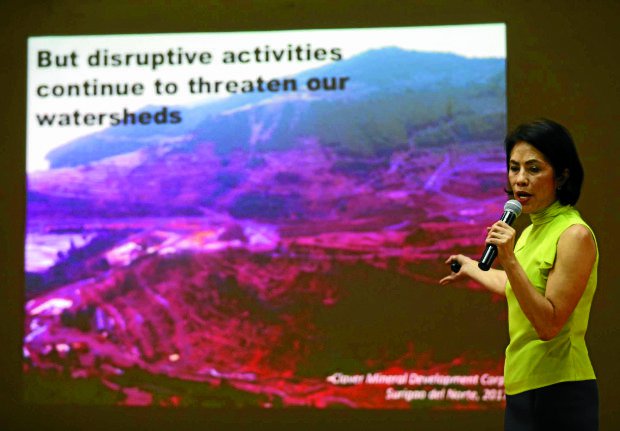
The bishops are trying to find common ground with this administration—this strange administration, if I may say so. For starters, might the mining issue be common ground? When Pope Francis came to visit in 2015, the CBCP-National Secretariat of Social Action and the Alyansa Tigil Mina issued a joint statement on mining. It referred to the 1995 CBCP call for the repeal of the Philippine Mining Act (Republic Act No. 7942), citing the “devastating effects and the adverse social impacts of mining that will destroy both environment and people that will lead to social unrest.”

On Wednesday Inquirer’s banner story said: “Gina kills 75 mine deals” and called her move a “Valentine’s Day massacre.” The subhead read: “Environment Secretary Gina Lopez cancels 75 mining contracts as a ‘gift of love’ to the Filipino people, drawing protests and threats of legal action from the mining industry.”

But it seems Lopez has the President’s ear. Yet, her confirmation as environment secretary could be massacred.

The devastated vastness wrought by irresponsible mining is a curse on the Filipino people. Here, on the wounded landscape, the Church and the Duterte administration could find common ground.#

Thursday, February 9, 2017

'Buwan at Baril': déjà vu.

Philippine Daily Inquirer/OPINION/by Ma. Ceres P. Doyo

Was “Buwan at Baril sa Eb major” difficult to watch? No and yes.

No, because everything was so clear and real to me—the stories, the characters, the acting, the emotions, the sounds, the faces, the voices, the words spoken and unspoken. I couldn’t ask for more.

Yes, because a tsunami of memories came surging at me with the force of 14 years under a cruel dictatorship. Yes because in those two hours in the darkened theater at the Bantayog ng mga Bayani where martyrdom and heroism are enshrined, something so real suddenly leapt and came alive with so much force. Call it déjà vu.


So it was a welcome difficult, if I may call it that, especially because the bunch of us who survived martial rule under the Marcos dictatorship—scathed but unbowed—and who were reliving the dark years scene after scene after scene last Sunday, were seated among young people, a number of them familiar faces in show biz who needed to know what it was like then. And, God forbid, what it might be like if ever it happens again.

Go catch “Buwan at Baril” in the last days of its two-week run: Feb. 9 (today), 10, 11 and 12 at 3 and 8 p.m. in the Yuchengco Auditorium, Salonga Building, at the Bantayog ng mga Bayani on Quezon Avenue, Quezon City. First-timers might want to come early and stroll around to behold the almost 300 names of martyrs and heroes engraved on the black granite wall or gaze at the Castrillo monument depicting a defiant mother holding a fallen son.

“Necessary” theater is how a critic called the restaging of “Buwan at Baril.” Portable, too. The play is lean and mean, with only eight actors in all. Props are kept to a minimum, but vintage images are flashed on screen. A guitarist and a cellist provide live music.

The initial offering of the Sugid artists’ collective comes in five parts that form a whole. To call them vignettes might make them seem trivial. The first one is straight out of Lakbayan, the 1985 protest march of farmers and workers from Central Luzon to Metro Manila. Long-lost brothers, one a farmer, the other a factory worker, meet and talk about their struggles. (I covered that event and walked from Angeles to Bulacan until I got leg cramps. I have photographs.)

The next scene is a heartrending one; you can’t have enough tears for the Itawes woman (played by Angeli Bayani) who lost family and home. She bears cigarette burns on her shoulders and wounds in her soul. The young, bewildered priest helps her tell her story to the media. There is the widow who must retrieve her husband’s body. Her grief turns to rage. How many women like them have I listened to in real life? I remember Purificacion Viernes…)

Jackie Lou Blanco is a scream as the socialite-turned-activist. (The Rotonda rally she plans to attend was a real one. There, a friend’s son got a bullet in the back. I heard the shot.)

Joel Saracho is the devil incarnate as a former activist-turned-cop/interrogator (“dapat praktikal lang”) of a student caught with subversive stuff. (Ouch. I had gone through something similar and traumatic, but without the kicks and punches. I had been under surveillance. Then while driving at night straight from the printing press with a car full of subversive materials… Guns were poked in my face… I have written about that experience.)

Written in 1984 by Chris Millado (after he survived arrest) and first staged in 1985, the play is directed by Andoy Ranay. It gets its title from the children’s rhyme “Buwan, buwan, hulugan mo ako ng sundang.” E flat major is a “heroic” key, used by Beethoven for his major works. I don’t know if that is the reason Millado used it in the title.

But heroic indeed are the characters in “Buwan at Baril” for telling it like it is—the cruelty inflicted and received, the pain, the loss, the confusion and bewilderment, and, finally, the resolve. This play is unforgiving; it goes straight to the gut, then to the heart, the mind and finally the cells of your body. You ask yourself: Where was I in it? #