UT IN OMNIBUS GLORIFICETUR DEUS.

UT IN OMNIBUS GLORIFICETUR DEUS.

UT IN OMNIBUS GLORIFICETUR DEUS.

UT IN OMNIBUS GLORIFICETUR DEUS.

UT IN OMNIBUS GLORIFICETUR DEUS.

Thursday, May 29, 2014

Giving stolem money to the Church

Philippine Daily Inquirer/OPINION/by Ma. Ceres P. Doyo

When someone gives stolen money to the Church or to religious groups, what does the giver have in mind or hope to happen? That he will receive pardon for his sins? That the evil that he has done will somehow be balanced by the good that will come out of the donation? That God’s punishment in this life or in the afterlife will not be more severe than if he just took it all? So that Church persons and those in the know would think so highly of him they couldn’t, for the life of them, imagine that such a generous giver has stained hands? Panghugas kamay(serving as hand sanitizer)? To polish one’s image (as in Na-polish)?

Much has been made of the donations that Janet Lim Napoles, the alleged mastermind of the multibillion-peso pork barrel scam, lavished on some Church persons or Church projects. Now she’s saying that she should not be called mastermind, brains, or queen of it all, but that is another issue. Whatever she is called, she does not deny that she donated money—in the name of her deceased mother, she said—to Church persons or Church institutions. The act may be seen as one with redemptive value, if not for the fact that what was stolen was stolen, and the donation, whether a big part or an infinitesimally small part of the loot, is not supposed to be given away at whim by the one who stole the money.

One cannot polish one’s image that way. The sheen will be gone in no time. The truth will be out.
Napoles cannot be likened to Robin Hood who stole from the rich in order to give to the poor or, in this age of widening societal gaps, the so-called Church of the Poor. Robin Hood did not steal for himself or for his next of kin. He and his Merry Men of Sherwood Forest did not live easy lives. Still, whether in the medieval setting or under present-day laws, that style of philanthropy or altruism is considered criminal. Thou shalt not use the name of the poor in vain.
 Napoles and her bagmen and bagwomen stole—allegedly—from the poor to give to the already rich and those who wanted to be richer. What she gave away for Church purposes (if at all they were used for Church purposes) does not expiate her evil deeds.

Thursday, May 22, 2014

El Niño redux

Philippine Daily Inquirer/OPINION/by Ma. Ceres P. Doyo

In 1997, or 17 years ago, I wrote a three-part series on the El Niño phenomenon. I did a lot of reading on the subject on hard copy. The Internet was not yet just a click away. I tried to understand the scientific explanations, I interviewed experts and those who might be affected—the pre-writing part, we call it. Then I sat down to write. I remember receiving a science and technology award for that special report and going home with a cash award and a trophy. (They gave cash awards in those days.) Yes, for writing about an impending calamitous phenomenon.

I remember little of that long piece now. I have to again get acquainted with the subject of El Niño/La Niña. But this time, gathering information is easier. The Internet is now just a click away. I called up the Inquirer library to ask if my November 1997 special report had been digitalized and if I could please be sent a copy via e-mail. I did not want to dig into my clippings. After a few minutes I received a copy via e-mail. (Thanks, Ellen.)

How technology has made getting information faster and easier. But don’t we all wish that science and technology, which are developing by leaps and bounds, would also solve the world’s weather problems just as fast? If they can’t, there is the consolation that they can at least be used to deliver the bad news and warnings pretty fast so that the world as we know it does not perish sooner but later.

We are now being inundated with El Niño warnings for 2014, and the weird weather we will experience—hot-dry, wet-wild. Some places will get the worst of one or the other, or both. Food producers will feel the blow, but so will the rest of us who are dependent on what the much abused earth, sea and sky can deliver to our dining tables given the hostile conditions.

What things did I say about El Niño in 1997? “An unwelcome climatic phenomenon that, scientists say, will confound us all,” I began. I quoted something I had read: “A global-scale oceanographic/meteorological phenomenon that develops in the Pacific, most often off Peru. It is associated with extreme climatic variability characterized by devastating rains, winds, drought and other events that could result in economic disaster.”

I did interview at that time Pagasa’s chief meteorologist, Aida Jose, and this is what I gathered: El Niño is not a direct result of global warming that is blamed on the havoc that human beings have done to the earth, sea and sky. There is something else that is at work on this planet and in the atmosphere, something that has gone on for millions of years outside of humankind’s doings.

Doesn’t the Bible have stories of strange climatic conditions that brought about deluges and droughts as well as plagues and famines? During the time of the pharaohs and the prophets, there was as yet no greenhouse effect, no hole in the ozone layer to speak of.

But here is the big But. The severity of the effects of El Niño will be proportionate to the severity of the situation on the ground—that is, how badly people have treated the areas that it will hit. Water will be doubly scarce in logged-over areas. Floodwaters will be doubly high in places with clogged canals. In other words, humans have only themselves to blame.

It’s bad enough that a calamity of biblical proportion outside of humankind’s doing—literally the act of God—occurs. But when it doubles in severity because of uncaring citizens of Earth, we are indeed the worse for it.

I did learn that during a severe El Niño event, sea surface temperatures are measurably higher than normal over a large expanse of the South Pacific which can prevail for more than a year. The implication of El Niño spreads from the local to the global. It is linked to the devastating climatic impacts on North America, Europe, West Africa and India, not just in the Southern Pacific. This occurrence in the Pacific clearly affects the rest of the world because of the extra heat it generates and the storms it triggers. An unlikely wind-ocean conspiracy results in temperature change over a large equatorial swath of the Pacific Ocean and further results in weird weather and extreme situations.

Climatologists and meteorologists can explain away the dynamics at work, but the why of it is the mystery. So, are we prepared for El Niño’s return? Without El Niño, the Philippines has had more than its share of calamities in the past years. How much more can we endure?

From my readings, I gathered that El Niño experts bewail the fact that forecasters sound too conservative for fear of causing a panic. Panic could mean increase in food prices because of expected poor agricultural production. What to do?

Now scientists are saying that the El Niño event that occurs every 20 years or so could become more frequent, like every 10 years, due to global warming. We can now blame ourselves for its devastating frequency. Think about this: more severe and more frequent. A quadruple whammy. It’s not all God’s doing then.

Today scientists are discovering how El Niño responds to global warming. There is El Niño and there is extreme El Niño, which develops differently from the regular El Niño that originates in the Western Pacific. Extreme El Niño has a different area of origin—the normally cold and dry eastern equatorial Pacific Ocean.

An El Niño event usually straddles two years, which means that the 2014 event will spill over to 2015. Already, scientists are about to declare that 2014 could be the hottest yet since temperature recording began, and that there would be more devastating floods, droughts, wild fires and other calamities that will befall our planet.

Oratio imperata, our plea for divine deliverance, will have effects only if we buckle down to prepare. Like Noah, we have to do our part.

Thursday, May 15, 2014

Claiming reparation for HR violations

Philippine Daily Inquirer/OPINION/by Ma. Ceres P. Doyo

May 12 was the first day of submission of reparation/compensation claims by victims of human rights violations under martial law. This is provided for in Republic Act No. 10368, or “An Act providing for reparation and recognition of victims of human rights violations during the Marcos regime, documentation of said violations, appropriating funds therefor and for other purposes.”

President Aquino signed the law on Feb. 25, 2013, the 27th anniversary of the People Power revolt that toppled the Marcos dictatorship. It took a year for the President to constitute the nine-member claims board and a few months for the board to draw up the implementing rules and regulations (IRR) that would be the basis for the processing of claims.

Reparation will be drawn from the P10 billion that the government has allotted (from recovered Marcos ill-gotten wealth) for the victims. This is apart from the $2 billion (P88 billion) assigned by the Hawaii Court for the members of a class suit.

I was one of the early birds at the HRV Claims Board (HRVCB) office at Virata Hall on E. Jacinto Street, University of the Philippines Diliman. It was a nice place to be because of the huge trees that cast cooling shadows on the grounds where claimants were warmly welcomed and assigned numbers, and where they filled out forms and had their documents assessed by legal and paralegal staff in nipa-bamboo kiosks.

Thursday, May 8, 2014

Women in the news

Philippine Daily Inquirer/OPINION/by Ma. Ceres P. Doyo

In the news almost every day in the past weeks and until now are three women involved in crimes: Janet Lim-Napoles, Ruby Chan Tuason and Deniece Cornejo. Also in the news are the women going after wrongdoers: Justice Secretary Leila de Lima, Ombudsman Conchita Carpio Morales, Internal Revenue Commissioner Kim Henares and Commission on Audit Chair Grace Pulido-Tan.

Napoles is the alleged queen behind the multibillion-peso scam that involved lawmakers’ Priority Development Assistance Fund allocations that were channeled through dubious nongovernment organizations of her making. Tuason is the confessed bag lady who served as conduit between Napoles and lawmakers who were recipients of kickbacks of their own PDAFs coming from Napoles. Cornejo is a young woman—22 years old—who filed a rape complaint that backfired on her when the purported rapist, an entertainment celebrity, charged her and her group (one of them well-connected) with serious illegal detention, extortion, etc.

Comments on how women have been hogging the headlines—in negative or positive ways—are not few and far between. But what of it? Do men have the monopoly of being criminals and crime-busters?

Those who expect women to be the better half of the population are having a rude awakening. Well, alas, indeed. This is not to say that women have come full circle by becoming at par with men in committing headline-grabbing crimes, plunder and extortion among them. “Coming full circle” may not be the right way to describe it. “Gone astray” is more like it. It is hard to accept that just because the females of the species are now in step with the males in terms of positive achievements, they now have an equal share of the blame for the evil sown in this world.

For the women who commit wrong, there are the words “Kababae mong tao.” You’re a woman and more is expected of you. For the men, it is “Kalalake mong tao.” You’re a man and you’re not supposed to be weak. After the Moor’s last sigh on losing Alhambra came the admonition that reverberates to this day: “You do well to weep like a woman for what you failed to defend as a man.” And it was his mother who said that to him.

Thursday, April 24, 2014

JPII in 1981: walking a tightrope

Philippine Daily Inquirer/OPINION/by Ma. Ceres P. Doyo

Before and during Pope John Paul II’s second visit to the Philippines in 1995, the Inquirer ran many articles on him. One of the pieces I had to write was about his first visit in 1981. Good thing I still had my 1981 notes! With JPII’s canonization (also Pope John XXIII’s) set on April 27, I visit the 1981 scenes once again through that article. Here is a much shorter version:
Everything was at fever pitch by the time JPII went down the Alitalia jet and kissed Philippine soil. For the next six days (Feb. 17-22, 1981) of his pastoral visit, he became the darling of millions of cheering Filipinos. JPII, without really trying, had power. If only he would use it to cast down and castigate tyrants. 
Everywhere he went there was a throng, sometimes millions strong, that rushed to get a glimpse of him. There were oceans of people praying, shrieking, fainting, waving, sobbing. That was perhaps the most rousing welcome ever given a visiting foreign dignitary, unparalleled in the Philippines’ history.
The welcome was typical Filipino hospitality, Filipino affection gone wild and free.

Many wanted to cash in—dictator and street peddler, conservative and radical, sinner and saint, the Left and the Right. The Left-leaning People’s Assembly on the Pope’s Arrival (Papa) grabbed the opportunity to make an exposé of the evils that Ferdinand Marcos’ dictatorship stood for. At the mammoth gathering at the Quezon Memorial Circle, activists suddenly unfurled a big streamer on behalf of political prisoners. This caught the eye of the Pope.

The Marcos regime clumsily did all it could to put itself in the good graces of JPII and the foreign press. Marcos was perhaps apprehensive that the Pope might throw some invectives in his direction. A month before the Pope’s arrival, Marcos announced the “fake lifting” of martial law. Marcos tried his best to get JPII on his side and spoke of a revolution that was pounding at the gates.

Thursday, April 17, 2014

Agnihotra for Earth's health

Philippine Daily Inquirer/OPINION/by Ma. Ceres P. Doyo

On April 9, Araw ng Kagitingan, I attended a workshop offered by kindred souls concerned about the healing of Earth and its inhabitants. But more than just being concerned about our wounded planet, these persons are preoccupied with the enrichment of our earthly dwelling and our own human lives.

Accepting the invitation was easy because the workshop was to be held in a farm set up and tended by friends of more than three decades, a place where I have felt at home since its beginnings. I wrote a cover story about this place in the Sunday Inquirer Magazine many years ago when it seemed so very far away, when little was heard about women of good education and comfortable means who put their hands on the plow and tilled fields. I am referring to my friends Emma Alday and Isyang Lagahit, who had left the comfort of convent life to dig into the riches of the earth.

Off I went to the farm in Tiaong, Quezon, site of the “Bahay Madre,” the cradle of the Susi Foundation that continues to serve farmers and advocates natural and organic farming and other soul-enriching pursuits. I was one of 20 or so persons of very diverse backgrounds who were seeking, if not already walking, the same less-trodden path.

Our group had a journalist (me), women farmers, a brass sculptor, a chemist, teaching scientists/agriculturists, information technologists, promoters of indigenous culture, a soprano and her Belgian husband, several NGO veterans, a young Frenchwoman from an NGO, two women from a shelter for abused children, and a transgender (now a woman). Four have had religious formation in a convent setting, and two were drug addicts who have recovered and who now help the young find wholeness.

“Agnihotra” practitioners freely shared (it has to be free) their knowledge and experience of this ancient yajna (ritual or sacrifice) that began in ancient Hindu civilization. Many Agnihotra practitioners around the world are into natural farming. Scientists are now discovering that Agnihotra resonates with their fields of expertise.

After almost a whole day of exercises, reflections and nourishing farm food, we were ready for Agnihotra. The word is derived from the Sanskrit agni which means fire, and hotra or healing. Agnihotra is a process of purifying the atmosphere through a especially prepared fire. It is performed at sunrise and sunset. The use of healing fire goes back to the ancient science of Ayurveda.

Wednesday, April 16, 2014

Fr. Suarez says last Mass on Easter before returning donated land to San Miguel

 
The “healing priest” Fr. Fernando Suarez will celebrate his last Mass at MonteMaria in Alfonso town, Cavite province, on Easter Sunday after his Mary Mother of the Poor Foundation (MMPF) decided to return the 33-hectare property donated to it by San Miguel Corp. (SMC).
 
Suarez is known in the Philippines and abroad for his gift of healing. Many people who have experienced or witnessed the miraculous healing have confirmed the priest’s gift.
 
But like most gifted people, Suarez always says he is only a channel and that it is God who heals those who have faith.
Not all bishops welcome Suarez in their ecclesiastical territories and some have been speaking unfavorably of him in a recent series of reports on the Monte Maria property published in the Inquirer.
 
But Bishop Antonio Palang, SVD, DD Vicar Apostolic of the Vicariate of San Jose, Occidental Mindoro province, has issued a letter to dispel doubts about his integrity.
 
In that letter, Bishop Palang says: “To whom it may concern: Between March 5 and 9, 2014, a series of articles was printed in the Philippine Daily Inquirer newspaper. The article alleged irregularities in the charitable foundation called Mary Mother of the Poor that [Fr. Fernando Suarez] founded. In addition, his healing ministry and lifestyle were also attacked.
 
“I certify that the accusations in these articles are unfounded and not true. Fr. Fernando Suarez [of the] Missionaries of Mary Mother of the Poor is a priest of good standing in the Apostolic Vicariate of San Jose, Occidental Mindoro.”
 
San Mig and MonteMaria
 
Last month, the Inquirer published a five-part series that highlighted the withdrawal by food and beer giant San Miguel Corp. (SMC) of its donation of a 33-hectare property in Alfonso town, Cavite province, that would have been the site of an MMPF project, the MonteMaria Shrine complex, which would include a statue of the Virgin Mary taller than the 30-meter Christ the Redeemer statue in Rio de Janeiro.
 
Among the reasons cited was failure of the MMPF to erect the structures within five years of the donation.
The series also quoted critics who questioned Suarez’s ministry and lifestyle.
 
Suarez was in the Holy Land when the series was published. In his absence, MMPF board member Deedee Sytangco (former spokesperson of President Cory Aquino) offered some explanation.
 
Only after Suarez had returned from the pilgrimage that he was able to air his side, which appeared in the fifth part of the series.
 
“It was too late, the damage had been done,” a friend of Suarez said.
 
Columnist Ramon Tulfo also wrote negatively about Suarez. The priest later said Tulfo had personally apologized, admitted he was misinformed and sought to be prayed over.
 
GMA News Channel 11’s “Mareng Winnie’s Bawal ang Pasaway” aired Winnie Monsod’s interview with Suarez for two Monday nights last month.
 
Monsod asked Suarez point-blank about the allegations. Suarez either explained them away or flatly denied them.
When asked if he thought SMC might have had something to do with the bad press he was getting, Suarez answered yes.

Christian forgiveness
 
Suarez himself had admitted that MMPF could not meet SMC’s expectation, which was to build the Marian complex as originally planned within five years. The foundation has decided to return the property.
 
Interviewed backstage by a TV5 crew after last Palm Sunday’s Mass, Suarez confirmed that the SMC property will indeed be returned.
 
The MMPF, he said, had offered SMC one of three things: Make a loan so that the MonteMaria project could proceed, build a columbarium, or just build the statue of the Virgin Mary. SC rejected all three.
 
The original MonteMaria project is no more. But a Marian site for prayer and healing remains on the horizon.
Suarez has denied accusations of having a lavish lifestyle, but admitted that playing tennis kept him sane, his way of warding off stress, and that he was merely invited to tennis clubs frequented by the rich.“I ask for nothing, I decline nothing,” he would always say when questioned about donations to him and to the foundation.
 
Suarez ministers to both the poor and the rich, to people from all walks of life who come to his healing Masses.


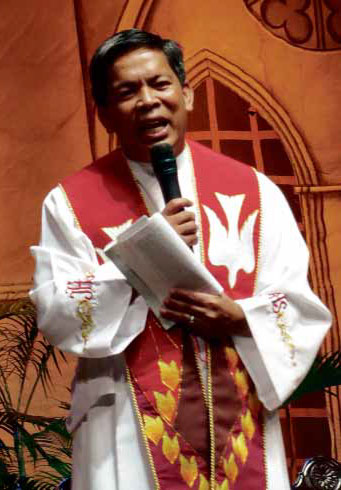
‘MOVING ON, REJOICING’ “The healing priest,” Fr. Fernando Suarez, delivers the homily during the Palm Sunday Mass at Meralco Theater.He spoke about moving on with service and sacrifice with rejoicing. CERES P. DOYO

He had some strong words for those who had written negatively about him without getting his side.Merely saying later that they were misinformed, which was not an excuse.He considered suing for libel those who besmirched his reputation and his ministry but Christian forgiveness prevailed over him, he said.
 
Moving on
 
Despite the negative publicity, Suarez continues to pack them in. The Meralco Theater was packed when he concelebrated Mass and delivered the homily on Palm Sunday.
 
The homily theme assigned to him, “Moving On,” was in sync with his personal decision to move ahead and not look back on hurts and accusations hurled at him.
 
Pointing to the cross as a starting point, Suarez urged the people to move on from there toward sacrifice and service. Suarez gave meaning to every letter in the word “cross.”  C, he said, stood for Jesus saying, “Come to me.”  R was not only for repentance but, more important, for rejoicing. O stood for openness to God’s message. The two S’s in the word “cross” stood for sacrifice and service, which, Suarez said, is what mission is all about.
 
Mission, not commission
 
“Mission,” he stressed, “not asking for commission.”
He could have been referring to the P10-billion pork barrel scam that involved lawmakers and government officials who allegedly channeled public funds to dubious organizations and into their own bank accounts.
Those who seek commissions, Suarez said, end up in distress.
Admitting to being a fan of Pope Francis, Suarez, while delivering his homily, was holding a copy of the Pontiff’s apostolic exhortation “Evangelii Gaudium (The Joy of the Gospel)” and often quoted from it.He sometimes picked up his cell phone and read from it quotes from the Pope.
 
Live joyful lives
 
Christians must live joyful lives, he said, echoing the Pope’s exhortation. “Do not be too hard on yourself,” he said, paraphrasing Sirach 14:11: “My child, treat yourself well. Do not deprive yourself of enjoyment.”
As long as it is not sinful, Suarez added. But he also said: “Do not be afraid of the cross. Jesus is offering us joy. Then we can move on.”

Shifting to a light mood, Suarez said someone commented about his good looks. “I said it’s because I am being persecuted,” he said, laughing.Suarez’s down-home homilies and Batangueño humor resonate well with Filipinos from all walks of life.
 
Ministry among Mangyan
 
Suarez also spoke about his new mission assignment among the Mangyan in Occidental Mindoro.
Bishop Palang recently assigned him to be the apostolic vicar to the Mangyan in the diocese in addition to MMPF apostolate among the poor and the running of a formation house for seminarians on the remote island of Ilin off Occidental Mindoro.
 
He separated from the Canada-based Companions of the Cross and founded the Missionaries of Mary Mother of the Poor (MMMP), which has a “pious association” status for now.Bishop Palang took Suarez and his group into his diocese several years ago.Suarez described his arduous mountain trek to a Mangyan community in Lagnas town in Mindoro and the difficult life of the Mangyan.
 
“When I asked them what we could do together, their answer was, ‘Father, let us build a church,’” he said. Poor as the Mangyan were, they did not ask for material assistance, he added.

Road to God's heart
 
Suarez was one of six priests who concelebrated the midday Mass after the Palm Sunday Family Recollection organized by the Angel Mission, a group of lay people animated by Fr. Jerry Orbos, SVD.
 
The yearly recollection for lay people is now in its 18th year, said Sytangco, one of the organizers.The other Mass celebrants aside from Orbos were SVD priests Ed Guarin and Paul Dogba; Nelson Cabanero, SMM, and Eliseo Santos, SDB.The blessing of the palms was part of the service.
 
Before the Mass, the audience listened to personal testimonies from lay people who had undergone physical and moral sufferings followed by the healing of body and spirit. Santos, a Salesian, delighted the audience with his talk punctuated with witty remarks and his creative use of props.
 
Let it go, let it be
 
Orbos, who writes a Sunday column in the Inquirer, kept pointing to the road to God’s heart. He sang the refrain of the hit song “Let It Go” that segued into the Beatles’ “Let It Be.” After the Mass, Suarez did a general healing prayer for those with physical, mental and spiritual ailments. He did not go down to the audience to touch the sick. Instead, a priest holding a monstrance with the consecrated host went around for eucharistic healing. #


Thursday, April 10, 2014

Her womb and other Lenten thoughts

Philippine Daily Inquirer/OPINION/ by Ma. Ceres P. Doyo

Former President Joseph Estrada, accused of plunder, had a problem with his knees and he was allowed to fly to Hong Kong for surgery. There were concerns about his not returning and facing the charges against him. But he did return, resumed house arrest in his Tanay rest house, was convicted, and was quickly pardoned by his successor, Gloria Macapagal-Arroyo.

Toward the end of her 10-year presidency, Arroyo developed a life-threatening, potentially disabling condition involving her cervical spine. Also accused of plunder and under hospital arrest, she had undergone very delicate operations. Arroyo’s attempt to leave the country while in a wheelchair was dramatically foiled at the airport by the Department of Justice. Now a congresswoman representing the second district of Pampanga, she is detained at the Veterans Memorial Medical Center in Quezon City.

In contrast to these two former presidents who bared their infirmities in order to receive humanitarian treatment, the dictator Ferdinand Marcos kept his health issues under wraps. There was no danger of flight on his part as he clung tight to this woebegone country. In fact, being flown out of the country he had ruled with an iron first for almost two decades and forced into exile were not severe enough punishments.

When Marcos was rumored to be ailing toward the end of his rule, he was never seen in a wheelchair. Only after he was deposed through people power were the rumors confirmed. The medical contraptions found in Malacañang confirmed the reports about “the autumn of the patriarch.”

The wheelchair has become the subject of jokes, the symbol of flight, the refuge of the accused. Confinement in posh health centers are preferred by high-profile detainees with deep pockets. They present their medical test results in the hope that they would not be thrown into crowded, malodorous city jails and suffer the company of common criminals. As if they are not so common themselves.

Thursday, April 3, 2014

Healers


Philippine Daily Inquirer/OPINION/by Ma. Ceres P. Doyo
I write this in the wake of the five-part series in the Inquirer about Fr. Fernando Suarez, known as “the healing priest,” who was mercilessly bashed to smithereens by some critics while he was abroad based mainly on what they had observed or heard, and with no damning documentation presented. It was only in the last part of the series that the priest, probably jet-lagged when asked to react, was given what looked like token space to air his side.

In Suarez’s absence it was Deedee Siytangco (former spokesperson of President Cory Aquino), a member of the board of the Mary Mother of the Poor Foundation (MMPF) that Suarez founded, who had to provide some answers to questions. As someone said, “They shot him first and asked questions later.”

His supporters and those who believe in him could only sigh, “It is useless to raise a howl. The damage has been done.” In other words, those who wished to put him in a bad light have succeeded. I quote a Suarez believer: “Ang Diyos may awa. At gaba.” (God shows mercy. And also punishes.)

The series sounded like a “killing-him-softly” type. I was waiting for a bombshell that never came.

As far as I knew, the story was supposed to be about why food and beer giant San Miguel Corp. was withdrawing its donation of a 33-hectare property in Alfonso, Cavite, from the MMPF. The story segued into the personal.

(A disclosure here: Early this year the Inquirer asked me to do the Suarez-San Miguel story, but I declined. By the way, I wrote a page 1 feature article on Suarez for the Inquirer in December 2007. That was when stories about his healing gift were beginning to spread.)

Thursday, March 27, 2014

From Payatas to St. Scho, magna cum laude

Philippine Daily Inquirer/OPINION/by Ma. Ceres P. Doyo

Payatas in Quezon City is often pictured as a landscape most foul, a garbage dump, the receptacle of the city’s refuse. I’ve been there thrice: to do stories on a woman who turned scraps into exquisite underwear, on a thriving Church microlending cooperative for the poor, and, in 2000, on the collapse of the garbage dump, burying hundreds of waste pickers (mangangalahig).
Today I’m writing about someone who hails from Payatas—poor, very bright—and who studied as a college scholar in St. Scholastica’s College. Jessa Bacala graduated last Monday with a bachelor’s degree in business administration, major in financial management, magna cum laude. She also received two academic excellence awards from the Philippine Council of Deans and Educators in Business and the Philippine Association of Collegiate Schools in Business.
She need not join the thousands of new graduates who flock to job fairs. She can just choose from the job offers from reputable corporations.

Time was when St. Scho was considered a school for girls with financial means and a good brain for academics, and who could withstand the rigors of German-style Benedictine discipline while getting steeped in ora et labora spirituality. “To be a woman of character” was a mantra stamped on our souls.

Established 108 years ago, the school has evolved into a more inclusive one and puts even greater emphasis on social involvement (which has always been there) and women-gender awareness.

Even before Jessa graduated valedictorian from the Payatas High School (a public school since renamed Justice Cecilia Muñoz-Palma High School), she had received scholarship offers from top schools. She did the round of interviews, sized up the schools’ offerings and campuses, and finally settled for St. Scho in Manila.

“I just knew this was it,” Jessa told me. She felt awed by the neo-Romanesque St. Hildegard building which has intricate arches and beautiful columns. And the chapel, she had not seen anything like it.

St. Scho gave Jessa a 4-year, tuition-free college scholarship, while the Justice Cecilia Muñoz-Palma Foundation (JCMPF) provided for the miscellaneous expenses. To keep her scholarship, she had to maintain an average grade of 3.5 (4 being the highest) and above.

Thursday, March 20, 2014

Partial compensation from the Marcos loot

Philippine Daily Inquirer/OPINION/by Ma. Ceres P. Doyo

Thousands of victims-survivors and relatives of those who perished and vanished during the dark night of martial rule have each been handed their compensation checks for the second time. I received mine last Monday. A photo of that came out on page 2 of the Inquirer last Tuesday. I was wearing my “Martial Law Survivor” overshirt and holding the EastWest Bank check. Also in the photo was our lead counsel Robert Swift, smiling.

Unlike in 2011, this second distribution was much slower but surer that no fraudulent claims would get through. Many claimants’ steps have also become slower than in 2011 when they came for the first distribution. A number of them have since passed on to the Gentle Beyond—activists who were claimed by sickness, aging claimant-parents of those who had fallen in the night long ago.

Personally handing the checks was American lawyer Swift, who led close to 10,000 martial law victims-survivors in winning the class suit against the estate of the late dictator Ferdinand Marcos. We hope that after this second check more would be forthcoming from discovered hidden wealth of the Marcos family. The check distribution in Metro Manila will continue until tomorrow, March 21.

In 1995 a Hawaii Court judgment set a $2-billion compensation for human rights abuse victims. Alas, the discovered Marcos wealth had not been easy to come by, no thanks to the other claimant, the Philippine government. This has changed, thanks to Republic Act No. 10368. This 2014 compensation derives from a $10-million settlement over an 1899 Monet painting previously owned by Imelda Marcos and fraudulently sold by her former secretary Vilma Bautista, who has been sentenced in New York.

The $2-billion compensation for some 7,000 claimants (down from almost 10,000) is different from the P10 billion allotted by RA 10368, “an Act providing for reparation and recognition of victims of human rights violations during the Marcos regime, documentation of said violations, appropriating funds therefor and for other purposes.” An eight-member compensation board was recently formed to preside over the screening of claimants and the compensation.

Last Monday, there was a long line of chairs for the waiting claimants and so, as I had planned, I did interviews and listened to stories from victims-survivors. (For those born yesterday: The martial law years spanned the period 1972-1986.) Here are reminiscences from the queue.

I was surprised when two claimants told me how I had helped them during those dreadful years. Oh, now I remember, I said to Ave Enrile-Carlos, a former student activist who was detained. She and her husband now run a restaurant on Session Road in Baguio City. Yes, I said to Ed Buenaventura and his wife after he reminded me that we were together in the Friends of Slum Dwellers. Ed was detained twice for subversion. He is now a project development assistant in the Department of Agriculture.

Their reminders brought back memories of the times when, at great risk, I carried persons on the run in my small car and drove them to their hiding places. Well, one day military surveillance caught up with me… How did I become a claimant? Google “The Years of Writing Dangerously” (Sunday Inquirer Magazine). It’s also in my book “Human Face: A Journalist’s Encounters and Awakenings.”

Thursday, March 13, 2014

Empowered women farmers

Philippine Daily Inquirer/OPINION/by Ma. Ceres P. Doyo


Filipinos have a way of using superlatives when they see a how-good-can-it-get situation. So let me say: Women farmers na, empowered pa.

That is said with the supposition that being a woman farmer is not (or should no longer be) a burden but a blessing, not a diminishment of status and gender but an empowered state of being. Of course, the ideal is still far from what is happening on the ground. But maybe romanticizing the image of woman as farmer might help remove the stigma attached to working the soil, growing food and harvesting the fruits of the earth. But why shouldn’t that be a cherished calling if not a chosen way of life?
I know a number of well-educated women who turned their back on professional careers that many covet. Off they went to answer the call of the wild, so to speak, to nourish and bring back to life the fallow earth. These women’s immersion can even be described as spiritual. They have emerged from the experience richer and fuller in substance and in essence.


They personify the spirit of Ceres, the goddess of agriculture and bounty in Roman mythology. (Ceres’ Filipino counterpart is Ikapati. The word “cereal” comes from Ceres.) Fecund and fertile, she is usually depicted carrying grain and fruits of the earth. ]

March being International Women’s Month, those in the gender equality advocacy are calling attention to the role of women in the fight against hunger. And 2014 being the International Year of Family Farming, there is even more reason that women in farming families should be more visible.