
UT IN OMNIBUS GLORIFICETUR DEUS.

UT IN OMNIBUS GLORIFICETUR DEUS.

UT IN OMNIBUS GLORIFICETUR DEUS.

UT IN OMNIBUS GLORIFICETUR DEUS.

UT IN OMNIBUS GLORIFICETUR DEUS.

Thursday, May 28, 2015

The Philippines as refuge

Philippine Daily Inquirer/OPINION/by Ma. Ceres P. Doyo


In the past days and hours, I have been receiving updates on the Muslim Rohingya refugees who continue to sail in droves from Burma’s (Myanmar’s) Rakhine State to Southeast Asia. They are unwanted even in their country of origin and they are looking to distant shores where they can live in safety and peace.

Much has been written about who they are, why they are, where they come from. The fact is that thousands of the Rohingya have been adrift at sea and looking for shore. Many have died at sea and even on land after disembarkation. Six mass graves have been discovered in Malaysia. Hunger, disease and violence have taken their toll on these hapless refugees who find themselves without a country, without citizenship, without a homeland to call their own.
Much, too, is being said about the Philippines as a country that has taken in, over the centuries, refugees of all races and religions, victims of political persecution and discrimination—from the so-called White Russians fleeing the Bolsheviks to the German Jews who were in danger of incineration by the Nazis during World War II and, only three decades ago, the Vietnamese fleeing a war and an imminent communist takeover.

The so-called Indian Sepoy who mutinied against the British troops in the 1700s and refused to leave may not be considered refugees, but they found in the Philippines a home and stayed put in Cainta, Rizal. And over the centuries, there were the Chinese from mainland China in search of greener pastures.

The Philippines may not have turned out to be the country of their dreams compared to the US of A—many left eventually—but during the most difficult time of their lives, the Philippines opened its doors and these islands became a safe haven for them. And those who chose to stay could stay. In the case of the Vietnamese who had nowhere to go when the refugee camps run by the United Nations High Commissioner on Refugees (UNHCR) had to be closed, they were given a place of their own (like Vietville in Palawan) courtesy of the Catholic Bishops’ Conference of the Philippines.

I’d like to think of my beloved country as the refugees’ “first stop” or temporary haven, and if they do not really want to stay for good because their eyes are set on more progressive countries, that is fine. Vaya con Dios.

But with the Rohingya’s plight becoming a problem that needs to be addressed not only by Southeast Asia but the international community, some Philippine officials have spoken up. An official from the Autonomous Region in Muslim Mindanao said the ARMM could take in some refugees. Justice Secretary Leila de Lima has met with UNHCR representative Bernard Kerblat on what position and action the Philippines can take vis-à-vis the Rohingya.

But geographically speaking, the Philippines is quite far from where the boat people are adrift (the Andaman Sea), far from the route they are taking (the Strait of Malacca). The shores along these waters are those of Thailand, Malaysia and Indonesia. And, well, even of India, Bangladesh and Burma, the latter two of which could be the unwanted Rohingya’s homeland but do not want them.

I am told that Burmese authorities do not want to hear the word “Rohingya,” which would mean that these people qualify as Burmese. They’d rather refer to them as Bangladeshi. Sure, they look more like South Asians than Southeast Asians, but should skin color determine a people’s right to a homeland? Here are a million or so ethnic minorities caught in a game of ping-pong.

Tomorrow, a meeting of Southeast Asian country representatives will take place in Malaysia. Their meeting on the refugee issue should result in immediate relief for the Rohingya. Long before this, Philippine officials had made known their soft spot for the refugees.

I had a long lunch conversation with Kerblat during the weekend. He gave the Philippines two thumbs up for its eagerness to step forward to address the plight of the Rohingya. It may not take the form of again opening sites for refugee camps, but the eagerness and willingness are to be emulated, he said.

Concretely, what can the Philippines do? I asked. For starters, Kerblat said, maybe one or two Philippine Coast Guard vessels can help scour the seas and bring the refugees to safety. The Philippines can also offer shelter to even a token number of refugees. It can again show the way without jumping the gun on its Asean neighbors.

I chuckled and said Filipinos are often known to be presentado and adelantado. Kerblat, a Frenchman, understands Filipino ways, having lived and worked here these last six years and being married to Filipino visual artist Vicky Abad of Batanes. (The two were relief workers on the Thai-Cambodian border 30 years ago when they met inside a bunker while shelling was going on. Their two grown sons are now also in the humanitarian field. Kerblat has been in many difficult missions around the world.)

And where is Burma’s “The Lady,” human rights icon and Nobel Peace Prize awardee Aung San Suu Kyi in all these? The former political prisoner who is now a member of parliament has yet to make a concrete stand. Will she or won’t she? Is there much to lose politically if she comes out in favor of the Rohingya?

Kerblat’s latest text-bulletin: “As we celebrate, honor and commemorate the day of UN peacekeepers, a dream came to my mind. I dreamt that the Pambansang Watawat for which Rizal gave his life is now a vector of peace floating in the Andaman Sea rescuing refugees and migrants at the invitation of neighboring states. And, with other member states, contributing their assets around the Gulf of Bengal, [saving] the waves of victims of human trafficking.” #

Thursday, May 21, 2015

Remember 1991's garments factory fire

Philippine Daily Inquirer/OPINION/by Ma. Ceres P. Doyo

With 72 persons dead—the majority of them women—in last week’s fire in a slipper factory in Valenzuela, I could not help but recall the fire in 1991 that claimed the lives of 19 women workers in a garment factory in Mandaluyong. I interviewed some of the survivors and next of kin of the victims and wrote a Sunday Inquirer Magazine feature article (“Death by Fire at a Garments Factory”) on that tragedy.

That fire was not the last of factory fires and factory tragedies. I would again write a magazine story about the deaths in a paper factory (“There’s Blood in Your Paper”) where workers either got swallowed up in vats of paper pulp or fell into them. Somehow I was allowed into the paper mill to see for myself the cauldrons of death and figure out how the series of unfortunate events took place. Geez, I thought while I was there, I hope I don’t slip into one of these heaving pools of goo. I wasn’t wearing proper footwear, you see.

With “Valenzuela’s 72” on my mind, I dug up my 1991 magazine piece and read the opening quote from a protest song: “Si Lina ay isang magandang dalaga/ Panggabi sa isang pabrika…/Nang muling makita, hubad at patay na/ Halina, halina/ Damitan ang bangkay at sa ating puso/ Hayaang humimlay si Lina…”

Was it Lina? I wrote then. Was it she in a tabloid’s banner photo of a severed head with half a face being poked at by firemen, policemen, media men and grieving relatives? In the early morning hours of March 14, 1991, shortly after the fire at Edral Garments in Mandaluyong was put out, firemen and police, with the help of survivors, came up with a tentative list of those who had perished in the blaze. The initial roster contained the names of 19 young women, two of whom were listed merely as “Lina” and “Merly.” Later their full names were made known, but these didn’t help to establish which names belonged to which heap of crumbling bones and ashes.

Thursday, May 14, 2015

FOI: soon or never

Philippine Daily Inquirer/OPINION/by Ma. Ceres P. Doyo

More than 14 years and three presidents ago, or since the 12th Congress, freedom of information advocates have been pushing for the FOI bill’s passage. It’s been an uphill trek, with lots of rock slides and turnbacks, and on the part of the lawmakers, dillydallying and last-minute disappearing acts.

If the FOI bill were a cardiac patient in the emergency room, it would have had several near-death experiences. But FOI believers never said die every time the bill flat-lined.

 If this were a telenovela, it should be on its nth season by now. The next nine months will be crucial to the FOI bill’s passage or nonpassage into law. It is now in the hands of the 16th Congress and up to the pushing power of the Aquino administration whose mandate ends in June 2016.

 Two days ago, the Right to Know, Right Now! (R2K RN) Coalition issued a statement urging Congress to speed up work on the FOI bill so that it would be passed into law by February 2016. The coalition says that if that happens, the law will become “the perpetual pillar and legacy of the democracy that Filipinos claimed and restored under Aquino’s late mother, Corazon ‘Cory’ Aquino.” It will be the best 2015 Christmas gift for the Filipino people. What a great way to mark the 30th anniversary of the February 1986 People Power uprising that toppled the Marcos dictatorship and ushered in freedom.

Thursday, May 7, 2015

Canada's trash still here after two years

Philippine Daily Inquirer/OPIION/by Ma. Ceres P. Doyo

Despite cries of “Return to sender,” “Nimby” (not in my backyard), “Take back your garbage” and protest actions by environmental groups against the 50 containers of trash that arrived here from Canada in June to August 2013, the foul, toxic and disease-causing cargo is still here.

Are Philippine authorities so uncaring that something as undesirable as foreign garbage would be allowed to sit on our soil for that long? And why would a supposedly friendly and wealthy nation such as Canada play deaf? Do Canadians think we can be so easily ignored and brushed away? Well, yes, if you recall the massive devastation that a Canadian mining company wrought upon the island of Marinduque about two decades ago, the adverse effects of which the island’s residents suffer to this day.

President Aquino’s state visit to Canada this week is a good time to raise the stink once again. Opening a foul topic to one’s host may be an undiplomatic act of a guest head of state, so people’s voices should win the day.

Like a foul-smelling rot that continues to seep through the cracks until it is taken away, this garbage issue will fester if it is not addressed. So this state visit is a great opportunity to release the foul smell once again for concerned parties to inhale.

Thursday, April 30, 2015

Refugees

Philippine Daily Inquirer/OPINION/by Ma. Ceres P. Doyo

“They hope to tell the world about the boundless love that returned to the remaining boat people their inalienable human dignity. That boundless love is none other than the Philippines’ undiscriminating embrace.”

That moving statement is in a document written on behalf of the Vietnamese boat people who had chosen to permanently settle in the Philippines. I shed Filipino tears when it was read at the inauguration of Vietville in Puerto Princesa City in Palawan in 1998.

For so long, the Vietnamese refugees were without a country. There was no room for them in the inn. It was the Philippines that made their long wait bearable. It was, in fact, the Philippines that gave many Vietnamese boat people a permanent home after the refugee camps were closed and when no country out there had space for them at that time.

Today marks the 40th year since the so-called Fall of Saigon. On April 30, 1975, the capital city of South Vietnam fell to the communist North Vietnamese forces and marked the end of the Vietnam War in which the United States was massively involved. Millions of Vietnamese (civilians and soldiers from opposite sides) and Americans lost their lives in that internecine war that wounded and scarred several generations.

Tuesday, April 28, 2015

Inquirer pundit wins Sarihay Media Award


MANILA, Philippines–Inquirer columnist Ma. Ceres P. Doyo was cited for Best Commentary or Editorial Article in the First Sarihay Media Awards for her column “El Niño Redux” (Opinion, 5/22/14) during ceremonies on April 24 at Luxent Hotel in Quezon City.

Organized by the Foundation for the Philippine Environment, the Sarihay Media Awards recognize the role of media in promoting awareness and better understanding of environmental and sustainable development issues among policymakers, decision makers and the public.

The other winners for print were: Best News Story (National): “Ensuring Rivers are Clean” by Jonathan L. Mayuga, Business Mirror; Best News Story (Regional): “Davao Gulf: Rich Spawning Ground” by Stella A. Estremera, Sun Star Davao; Best Investigative Report: “Stinking Snag” by the Manila Bulletin Research Team; and Best Feature Story: “PH Birds Caught Between Discovery, Extinction” by Monch Mikko E. Misagal, Manila Bulletin.

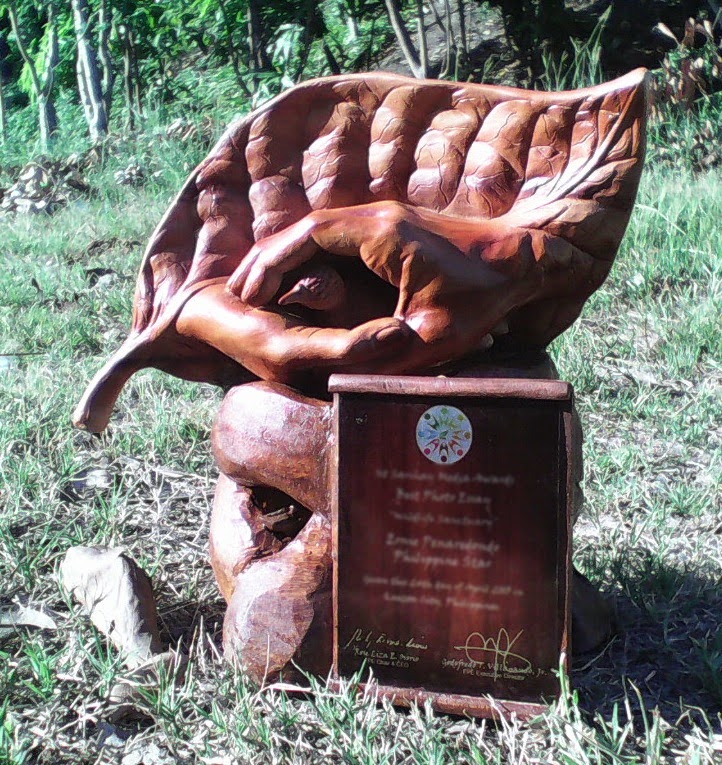
There were also winners for TV, radio, online and photojournalism. Each winner received a cash prize and a trophy designed by Los Baños-based artist Yvette Co on the theme “Nurturing Life Together.”

The Sarihay Media Awards were launched in February 2014 in partnership with the Department of Environment and Natural Resources’ Biodiversity Management Bureau and Public Affairs Office, Philippine Tropical Forest Conservation Foundation Inc., Tanggol Kalikasan Inc. and Miriam College Environmental Studies Institute.

The term “sarihay” was coined from “samu’t saring buhay,” a Filipino phrase that best describes biodiversity. #

Saturday, April 25, 2015

Here's to the Kalinga Brave!

Philippine Daily Inquirer/OPINION/by Ma. Ceres P. Doyo


“You ask if we own the land and mock us saying, ‘Where is your title?’ When we ask the meaning of your words you answer with taunting arrogance, ‘Where are the documents to prove that you own the land?’ Titles? Documents? Proof of ownership? Such arrogance to speak of owning the land when we instead are owned by it. How can you own that which will outlive you? Only the race owns the land because the race lives forever.”—Macli-ing Dulag

Tomorrow, April 24, is Cordillera People’s Day, celebrated by Cordillerans who value their culture and heritage and who wish to honor Kalinga chief Macli-ing Dulag who was slain on April 24, 1980, by government soldiers. But there is another Cordillera Day in July, supposedly a nonworking holiday, which is a government-initiated celebration.

But suffice it to say that April 24 is important enough to make it a special day, official or not, because it was a watershed moment for Cordillerans.

I am sharing here the Author’s Note for my book, “Macli-ing Dulag: Kalinga Chief, Defender of the Cordillera” (University of the Philippines Press, 2015), which was launched yesterday, April 22, at UP Baguio. The launch was in anticipation of Cordillera People’s Day. It was also launched, along with 21 other books, last April 17 on the occasion of UP Press’ 50th anniversary at UP Diliman. Today I am supposed to do an Author’s Talk at Mount Cloud Bookshop in the City of Pines.

My thanks to UP Baguio anthropology professor Analyn “Ikin” Salvador, the university’s Cordillera Studies Center and UP Press for making the Baguio book launch possible. The book (with photos that I took in 1980) is affordable at P200. Great cover and book design, lovely paper.

It was at UP Baguio 35 years ago that our Church-initiated fact-finding team descended and held a forum on the killing of Macli-ing Dulag.

We had come from Bugnay, Macli-ing’s village, where we found his blood still splattered on the wall of his home. The ascent to the Butbut tribe’s mountain village was not an easy one. But first we had to cross the raging Chico River on the backs of Kalinga men who wore G-strings. I had several minor slips and falls. The scar on my right elbow still shows.

Here is my introduction to the book:

Thursday, April 16, 2015

The 173rd

 
She had a name, a face, a story, a family, a track record. She had a life. She did not want to become just a number. She is Melinda “Mei” Magsino, a former Inquirer correspondent based in Batangas who was gunned down by an unknown assailant at high noon last Monday. She was 40.
 
I did not know Mei personally but some editors in the Inquirer did. This tragedy, so close to home, sends the hair-raising message that even former media workers like Mei are not safe. Glaring is the fact that the Philippines ranks third, after Iraq and Somalia, as an unsafe place for journalists. The ranking is based on the number of journalists killed during a period of time.
 
Mei was the 173rd Filipino journalist killed since democracy was restored in 1986, the 32nd since 2010 when President Aquino was elected into office.
 
A former editor whom I texted after I learned of the bad news replied: “I was afraid that was Mei. I saw footage in the 6 p.m. news but didn’t catch the name. Very sad, tragic end for another brave journalist. She had come to see me at Inquirer … Last time I heard from her, years ago, she wanted to get a grant or work abroad, Bangkok maybe, to get away from the governor or mayor who hated her guts.”
 
Inquirer reporter Jerome Aning shared on Facebook a story about Mei that came out in the American Journalism Review in 2005. “Forced Into Hiding” was written by Sherry Richiarddi.
 
Here are the first paragraphs:

Thursday, April 9, 2015

"Complicit silence'

Philippine Daily Inquirer/OPINION/by Ma. Ceres P. Doyo

“There can be no peace between nations if there is no peace between religions.” Thus said theologian Hans Kung decades ago.

The subtext is that it is ironic that religion—any religion, in fact—preaches peace, and yet can itself be a big factor in the unpeace.

Pope Francis, during Good Friday rites, condemned what he called the “complicit silence” while human beings, particularly Christians, were being butchered by members of a terrorist group who are adherents of Islam. He was referring to the killing by al-Shabab Islamists of more than 148 persons at Garissa University in Kenya.

The terrorist jihadists separated the Muslims from the Christians, then slaughtered the latter. TV footage of the aftermath showed the corpses strewn all over the floor. The dead were young people who were there to get a university education. They were not militants or activists.

That was not enough. The murderers promised to return and kill more. These al-Qaida-aligned terrorists made it known that their acts were in retribution for Kenya’s military presence in Somalia and the ill-treatment of Muslims within Kenya. They warned that Kenyans will see their country awash in more blood.

After last Friday’s Via Crucis, Pope Francis prayed: “Today, we see our brothers persecuted, decapitated, crucified for their faith in you, under our eyes and often with our complicit silence.” “Our complicit silence,” as if to say, “Mea maxima culpa.”

His sentiments echoed till Easter Sunday. Here was a pope grieving at a time when Jesus’ resurrection from the dead was cause for celebration for Christians around the world. But how could there be total rejoicing when elsewhere in the world there was weeping and unspeakable grief?

Thursday, April 2, 2015

'Via dolorosa' for HRVCB and HRVV

Philippine Daily Inquirer/OPINION/by Ma. Ceres P. Doyo

Every day since November last year, the members of the Human Rights Victims’ Claims Board (HRVCB) and their paralegal team must have been on a “via dolorosa” as they began “the table-top evaluation” of all claims for reparation and recognition that victims had filed since May to November 2014.

Going through tens of thousands of claims that contain stories of torture, rape, detention, oppression, disappearance, loss and bereavement must be a painful, arduous walk. This is true for both the claimants who had to recall the gruesome details that would have been better left outside of memory and the evaluators who had to go through every affidavit, every story, and had to see every tear, every wound yet unhealed.

Because of the clamor from human rights violations victims (HRVVs), the period for the filing of claims has been extended. Here is the HRVCB’s announcement:

“Pursuant to Joint Resolution No. 03 of the Congress of the Philippines approved by the President on Feb. 17, 2015, and after due publication of the same in the Official Gazette on March 23, 2015, the Human Rights Victims’ Claims Board through HRVCB Resolution No. 003-2015 sets the extension of the period to file applications by HRVVs during Martial Law—[to begin] on April 8, 2015 and [to end] on May 30, 2015.”

Thursday, March 26, 2015

Help for poor, despairing college students

Philippine Daily Inquirer/OPINION/by Ma. Ceres P. Doyo

It is graduation season. Financially challenged students and parents must be in distress because of unpaid school fees and other expenses that need to be met in order for these students to be on the official roster of graduates and receive their diplomas—and on stage if possible. What they go through is different from school opening woes. This is the last hurdle, so to speak, and to be denied the long-awaited moment on the stage because of unmet payments can cause a student’s emotion to spiral down to the dark depths.

Today’s kids, how fragile they are, one might say, compared to poor, rural students of yore who went to school barefoot with little or no food in their stomachs, or their urban counterparts who toiled in sweat shops and dingy basements in order to send themselves to school. They feel no shame or diminishment for having gone through all that, only pride that in the end they reached the summit of their humble dreams and proceeded to make a life different from where they came from. And even giving back.
Despondency gets the better of students who are not able to continue what they have begun or are denied participation in school activities such as graduation because of financial issues. But there’s hope for these haplessly situated students.


I recently learned the good news that Pasig City Rep. Roman Romulo has urged the Commission on Higher Education (CHEd) and the country’s 112 state universities and colleges (SUCs) to establish a “fast-acting financial aid program” for students in dire need of help to pay for their cost of living and schooling. Romulo is the chair of the House committee on higher and technical education.

Thursday, March 19, 2015

Gang rape of 75-year-old nun

Philippine Daily Inquirer/OPINION/by Ma.Ceres P. Doyo

(PHOTO CAPTION: Local people of Nadia district protest on the streets condemning the gang rape. Source: Express Photo by Partha Paul)


What kind of men are these? From what depths of hell did they come?  In the news is how a group of men who burglarized a convent in West Bengal in India also gagged and gang-raped a 75-year-old Catholic nun who lived in that convent. India has not yet gotten over the much-publicized case of a young woman who was mercilessly violated by a gang of rapists in December 2012 and now this, and during International Women’s Month at that.

Enraged local residents have taken to the streets to condemn this despicable crime. TV footage showed an Indian church official condemning that act and also stressing the fact that this nun had vowed virginity or something to that effect, and so for her to be violated in this way…

I couldn’t help retorting that while the rape committed was indeed a horrific crime, it should not matter whether the victim was a saint, a sinner, a nun, a nanny, a street walker, or a socialite. It has nothing to do with the victim’s status in life. It has everything to do with the violators.

At least in our laws, rape is no longer a so-called private crime against chastity but a crime of violence. The state versus the accused: Someone is violated, someone has to pay for the crime.