

UT IN OMNIBUS GLORIFICETUR DEUS.

UT IN OMNIBUS GLORIFICETUR DEUS.

UT IN OMNIBUS GLORIFICETUR DEUS.

UT IN OMNIBUS GLORIFICETUR DEUS.

UT IN OMNIBUS GLORIFICETUR DEUS.

Thursday, June 22, 2017

Jeepney driver, multitaskter

Philippine Daily Inquirer/OPINION/by Ma. Ceres P. Doyo

The “Basta Driver, Sweet Lover” and other epithets that go with risqué drawings stuck on the interiors of jeepneys seem to have disappeared or been replaced. Often seen, but this time on the exteriors (sides, hoods) of these vehicles, are airbrushed images of dystopian heroes and words written in fonts in the modern-gothic style. But the staple religious images still endure and adorn the exterior of many a jeepney, the prince of Philippine urban jungles.
 
Jeepneys are again the subject of discussion because of the impending phase out of some 200,000 units all over the country, to be replaced by eco-friendly ones. An Inquirer news report said the Department of Transportation has signed the omnibus franchising guidelines “that would set in motion the three-year rollout of the agency’s modernization program.”
 
In this program, drivers will no longer be bound by the boundary system and racing dangerously for passengers, but will become employees with regular salaries and benefits.

The physical object that is the jeepney as Filipinos know it will become extinct. That is, the structure and design, the feel (also the garish decor?), and even the loud stereo that has long been banned. But there still are holdouts in the sounds department. When you are driving beside them, even with your windows closed, you can feel the pounding sound. (Grrr.)
 
Observers of Filipino culture and the symbols that define our world, better take a good, lingering look at the jeepney and everything that it represents before it zooms away into the sunset.
 
What will remain of it in the new order? The driver, yes, but what about its fare collection system—that is, the way driver and riding public transact with each other?I have always been amazed by how a jeepney driver goes about his job—picking up passengers, dodging kotong cops, braving sun and rain, holding and emptying a full bladder, etc. But the most difficult of all, if you ask me, is fare collection.
 
For the driver, it is left hand on the wheel, right arm 180 degrees to the back. A passenger tells/yells to the driver where he boarded and where he is headed—say “from Welcome Rotonda to Taft-PGH”—then gives P50 which gets passed from hand to hand until it reaches the driver’s outstretched own. The driver must then compute the fare for that distance in his head, then also the change, which he hands to a passenger behind him, who then passes it on to the payer who is far back.
 
All these while the driver is looking at the rearview mirror to see how much space there is, but he must also look at the road ahead for people waiting for a ride, or look out for a vehicle he might hit.
 
Think of a group of, say, four. One of them yells, “Four—all from Cubao, one going down in Quiapo, two in Lawton and one in Kalaw,” and hands over P100 from behind. If you are seated right behind the driver, you’d notice him massaging the P100 bill and looking up at an imaginary calculator in the heavens.  Jeez, how does he do it?  Never mind that another passenger is demanding correct change.  Or a holdup is going on.
 
With fuel prices going up and down, which means new computations for distances every time, the driver must be a wiz in arithmetic (and algebra, too, you say?) in order to compute correctly.

In the short, balikan (back and forth) routes where fare is constant, passengers buy chips from a collector behind a makeshift table, and before they get into the jeepney that waits to be filled up (alas puno, it is called), each one hands over the grimy chip to the barker. How Pinoy cool is that. This collection method saves the driver’s right arm from all that stretching.
 
More than a “sweet lover,” the driver is a multitasker. What he does while driving his decrepit jeepney is more complicated and distracting than using a cell phone while driving or at a standstill before a red light (soon a no-no).
 
What will it be like with the eco-friendly vehicles?#


Thursday, June 15, 2017

Manansala & Manalad: Framing history

 
Eye-popping. Upon beholding the collection with my child eyes, I was short on words, so that is how I can describe the pen-and-ink drawings by National Artist Vicente Manansala (1910-1981) and Amadeo Manalad (1911-1984).
 
The Assisi Development Foundation (ADF) and Ayala Museum partnered in exhibiting for the first time 70 drawings (of the 263) commissioned for the landmark history resource “Philippine Saga: A Pictorial History of the Archipelago Since Time Began,” the text of which was written by Henry Otley Beyer and Jaime C. de Veyra and first published in 1947. The book was the brainchild of Ramon Roces, publisher of The Evening News.
 
If the exhibit opening gave me an OMG! moment, it was because I had encountered that book (and the word “saga”!) for the first time when I was in fourth grade (I was eight years old). That stuck to my brain. What a huge book, I thought then.

The story about the collection is somewhat shrouded in mystery, though someone in the know had whispered some details to me. But let it be known that a postwar private collector had, for decades, kept the drawings safe. Before his death in 2012, he bequeathed the collection to the ADF.
 
At the exhibit opening, ADF founder-chair and philanthropist Howard Q. Dee (former ambassador to the Vatican) said the donor wished to remain unknown and wanted the collection to be seen especially by the Filipino youth.
 
The notes on the collection say that the illustrations were published unsigned but 129 bore Manansala’s signature and the year 1947. The collector had asked Manansala to identify and sign his works. He then concluded that the 131 others must be Manalad’s.
Manansala had turned to Manalad to help him in his huge task. For more on Manalad, read “Amadeo Y. Manalad: Drawing a Saga” (2015) by Reuben Ramas Canete.

The selected drawings are mostly of the same size, with excerpts from caption stories that accompanied them in the book. Presented in historical clusters, the exhibit gives a sweeping view of Philippine history “since time began” and understandable enough to a young reader. Historical junctures are highlighted and given bigger panels and captions. I smiled because woman warrior Gabriela Silang was given a big panel that happens to be right smack in the center of a wall.
 
(Just a small glitch: Manansala’s Kalinga warrior of the Cordillera is not wearing a G-string but is dressed like a Manobo, and wielding a Mindanao kris at that.)
Complementing the collection are contemporary artists’ creations meant to engage the postwar drawings of the masters.
 
Unlike fine art exhibits, “Manansala & Manalad: Framing History” is an interpretive kind that provides context and explanation. The exhibit title alone must have involved lots of brainstorming, and also choosing the exhibit’s “cover photo” by Manansala. It is captioned in the program and souvenir as “Defeated but never daunted, Soliman rebuilds his kingdom.”
 
Two copies of “Philippine Saga” are on exhibit but encased in glass. Oh, but yesterday I was able to peruse the book online, page by page. It is in the National Library of Australia’s website.

Cocurator Mia Fernando Cameron said that even at that time, De Veyra’s prose in the book put Filipinos—including the indigenous people and Muslim communities—front and center. “Especially notable,” she said, “was his global perspective on history—we have included a drawing of Napoleon Bonaparte—and his showing how events in Paris impacted decisions made in Madrid that in turn affected the course of events in the Philippines.”
 
Mounting this exhibit must not have been a walk in the park—but very satisfying, I am sure. Congratulations to project director Pinky Camara Roxas and guest curators Manuel Quezon III, Imelda Cajipe Endaya, and Cameron. A big thank you to the ADF’s Ambassador Dee and Mrs. Betty Dee, president and CEO Ben Abadiano, VP Viel Aquino Dee, and its curatorial team.
 
What next? Will the collection be available online for viewing, and in published form?
The exhibit opened last Monday, Independence Day, and will be on view until Aug. 27. I might +go back to view it again but in quiet—that is, without the cocktail crowd and the hors d’oeuvres.

Saturday, June 10, 2017

Independence Day June 12, 2017 - Bantayog

Thursday, June 8, 2017

'Ang Paghahanap/The Search'

Philippine Daily Inquirer/OPINION/by Ma. Ceres P. Doyo


Only recently did I learn the translation in Filipino of involuntary or enforced disappearance, the manner in which the so-called disappeared or “desaparecidos” (Spanish), vanished from this earth without a trace. All the time that I had been writing about them in English, I simply used the word “disappeared” or “desaparecido” to refer to those who had been forcibly taken by state forces during the 14 years of martial law under the Marcos dictatorship (1972-1986).

Enforced disappearance, in Filipino, is “sapilitang pagkawala” while the disappeared (plural) translates as “mga sapilitang nawawala.” Sapilitan means forced. Of the documented 2,000-plus desaparecidos of that dark era, 81 have been found, many of them buried in remote and unlikely places, and after years of search and research. (There is a book on this.) Credit the families who never gave up in finding the truth and the human rights groups that assisted them.

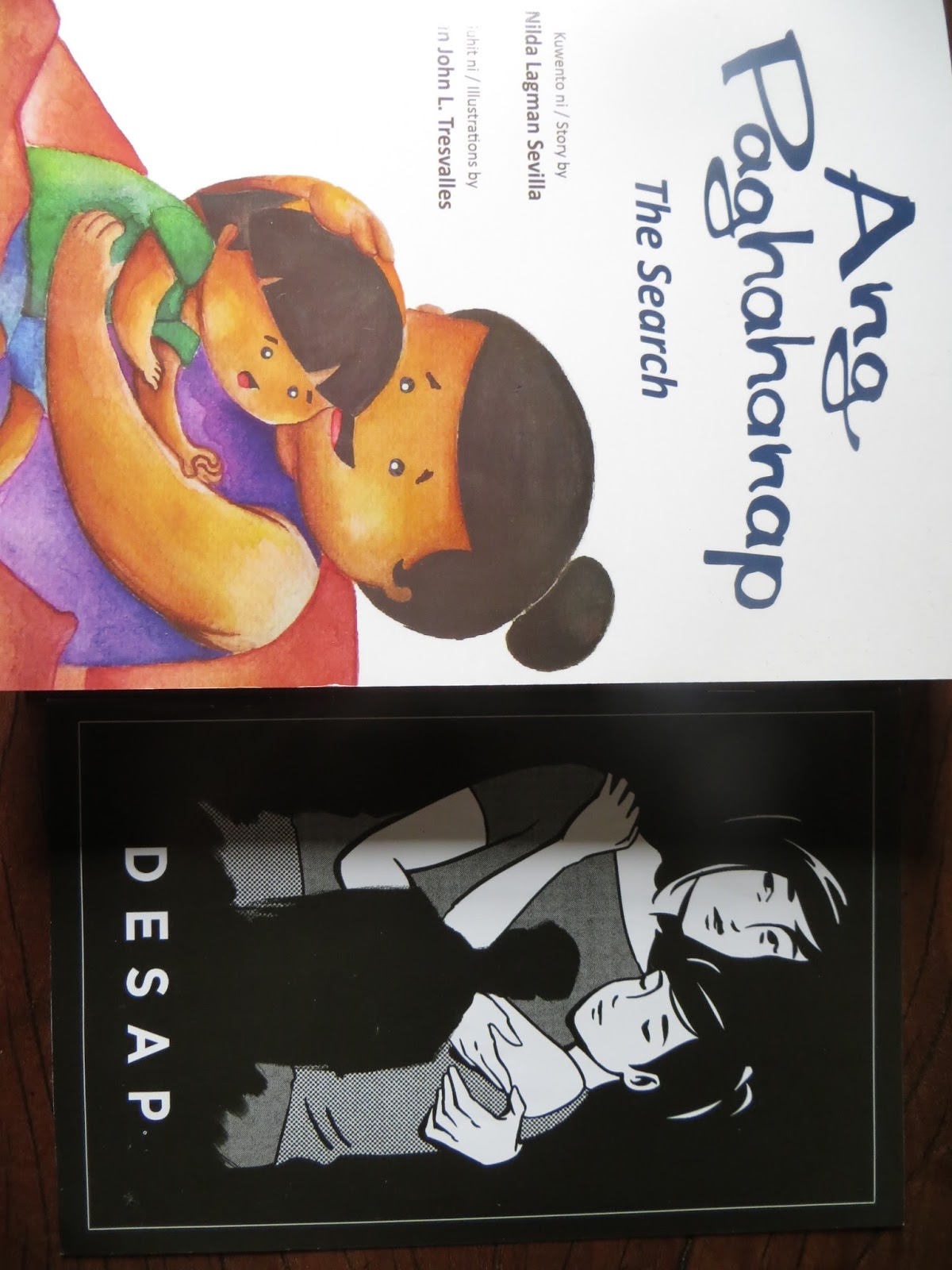
The last week of May was the International Week of the Disappeared. Before then, a small group of Filipinos flew to Geneva to be at the United Nations Human Rights Council’s Periodic Review of the Philippines. A side event there was the launch of the children’s book (for adults, too) “Ang Paghahanap/The Search” written by Nilda Lagman Sevilla and illustrated by Ryan John L. Tresvalles. It was again launched at the Commission on Human Rights office two weeks ago, with families of the disappeared in attendance.

Sevilla is the sister of labor lawyer Hermon Lagman, who disappeared 40 years ago on May 11, 1977. Rep. Edcel Lagman of the first district of Albay, their eldest brother, gave his reflections at the launch. Tresvalles is a nephew. Published by the Families of Victims of Involuntary Disappearance (FIND) and Asian Federation Against Involuntary Disappearances (Afad), the story weaves the life experiences of the children of the disappeared into a fictional narrative that shows the impact of enforced disappearance on families, their search for justice, healing and the truth.

Author Sevilla defines the crime as “the arrest, abduction, or detention of mostly political activists by the agents of the State who subsequently refuse to disclose any information on the fate and whereabouts of the disappeared, thus placing the victims outside the protection of the law.”

As with most books for children 6-10 years old, the images are big and colorful while the words are few and well chosen. It begins with a young girl named Bituin wondering why her playmates have a father and she has none. So she asks her mother, who then tells her the story about her father’s work among labor groups and about the uniformed men who took him away one night.

Fast forward. In the end they find him, but that is after the passing of the years. At last they find him where he had been buried. Bituin, a teenager by then, begins to understand.

The book’s foreword is by Phebe Gamata Crismo, national coordinator of the Philippine Interfaith Network for Children and whose first husband, Rolly Crismo, is among the disappeared. I did write about that case of disappearance in the 1980s in the alternative press when Phebe, then newly married to Rolly, was in so much pain and, with Rolly’s family, left no stone unturned to find him.

After years of search, Phebe and Rolly’s older brother Louis fell in love and got married. They raised four children. Louis is active in FIND and has been in searches, exhumations and identifications. “We would find items in their pockets,” he told me. “We even found a coin of that era.” The process is tedious, if not a suspenseful one.

Afad secretary general Mary Aileen D. Bacalso said that in the whole world, Asia has the biggest number of disappeared. Afad has a comic-book-style material (for adults) on enforced disappearances titled “Desap.” FIND has documented more than 2,000 Marcos-era cases in the Philippines. No wonder then that the Philippines was the first in Asia to pass a law against enforced disappearance.

Oh, but do you know that the Philippine government has not signed the International Convention for the Protection of All Persons from Enforced Disappearance adopted by the UN General Assembly? Big question: WHY? #

Thursday, June 1, 2017

Marawi 1986: Carmelite nuns kidnapped

Philippine Daily Inquirer/OPINION/by Ma. Ceres P. Doyo

Throwback Thursday: A cover story I was assigned to do in 1986 as a staff writer of the Sunday Inquirer Magazine was about the kidnapping of 10 contemplative Carmelite nuns in Marawi City. That was 31 years ago, when President Cory Aquino was barely five months in office and besieged by power grab attempts from all sides.

A sense of déjà vu swept over me last week when Marawi, the capital of Lanao del Sur, was suddenly besieged by the Islamic-State-inspired Maute terrorists who, at this writing, are still holding hostage a number of Marawi residents, a Catholic priest among them. President Duterte swiftly declared martial law in Mindanao on May 23; smoke continues to billow to the sky and fighting goes on.

Per reports at this writing, 89 terrorists have been killed as against 21 government soldiers who lost their lives, and 19 civilians have either died in the crossfire or been slain/beheaded by the terrorists.

In her July 20, 1986, “Sundays” magazine editorial, editor Letty J. Magsanoc wrote about the kidnapped nuns: “But there was one detail that startled the heart: the sisters had asked if they could bring their guitar, and their kidnappers whose identities were unknown at press time, said yes. “We personally don’t know any of the kidnapped sisters but … their wanting to bring with them an instrument of song into the unknown give us a picture of their life of giving, serving, loving and praying and of their daily cheerful struggles up in what would otherwise be a lonely hilltop convent in Marawi overlooking Lake Lanao.”

They were, at that time, right at home in the heart of a Muslim community. Here was how it was (now in the past tense) in Marawi Carmel: Set high on a hill, the Carmelite convent in Marawi overlooked the placid Lanao Lake. It is said that on silent nights the view from there would remind one of Bethlehem.

It must have been easy to barge into the convent, a Carmelite nun who had been there said. Marawi Carmel from where 10 nuns were abducted was not the typical gothic monastery set apart by ivy-covered walls and iron grills. It was a poor Carmel, mostly made of wood. It was decidedly meant to be that way.

The Carmelites came to Marawi in 1980 to be one with everyone, a Christian contemplative community in the land of Allah. They came not to convert, but to be witnesses to Muslim-Christian brother/sisterhood. It was therefore a surprise that a mass abduction would happen. The nuns got along with the people. The Muslims would even bring them food, a Carmelite nun from Manila said.

Mother Marie Madeleine of the Redemption (Ledesma), prioress of Marawi Carmel, was the moving spirit behind the community of cloistered nuns whose lives consisted mainly of prayer, adoration, fasting and sacrifices—an apostolate which earth-bound mortals may not easily understand. But even as they preserved the original spirit of Carmel as inspired by St. Teresa of Avila (the foundress of the Reformed Discalced Carmelite nuns and priests) their lifestyle in Marawi was indigenized and not merely a copy of western-style monastic life.

During adoration, the nuns wore malong cloaks, they sang local songs, they adapted to the spirit of the place. Mother Madeleine even fasted during the Muslim Ramadan, in addition to the months-long fasting that Carmelites normally go through every year. So little did they know that even as they were in the middle of a nine-day novena to Our Lady of Mount Carmel, they would suddenly be swept into the eye of a storm.

Shortly after, an American Protestant missionary, Brian Lawrence, was also taken from his quarters at Mindanao State University. These happened not too long after the release of French Catholic priest Michel Gigord.

Reports said the nuns were forcibly taken from their convent, which was about two miles from the city center, by armed men believed to be members of the “lost command” of the Moro National Liberation Front. The abductors demanded a P2-million ransom.

For many other reasons, the contemplative nuns each headed for other Carmelite monasteries not long after that ordeal. Marawi Carmel is no more.#

Thursday, May 25, 2017

90 metric tons of dates

Philippine Daily Inquirer/OPINION/by Ma. Ceres P. Doyo

On the lighter side of foreign aid, especially after last week’s “We don’t need you, EU” outburst of the Philippines’ quarrelsome President, here’s something from the desert to chew on.

As a non-Muslim, I feel some kind of discrimination because the 80 metric tons of dates from the Kingdom of Saudi Arabia were meant as food aid only for Muslim Filipinos, and not for members of other faiths. Food aid, meaning for the needy. On the other hand, when the Catholic-run global charitable institution Caritas Internationalis sends aid, it never specifies particular faith groups as beneficiaries.

This is just an observation, not a judgment. As Filipinos are wont to exclaim with a wince and a smile when they are left out, “Paano naman kami?” (What about us?)

A news story in the Inquirer (and other media outfits, too) said: “The Kingdom of Saudi Arabia (KSA) turned over on Thursday at least 50 metric tons of pressed dates to the Philippine government as part of food aid to Muslim Filipinos. “At a press conference, Ambassador Abdullah N.A. Al Bussairy said ties between the KSA and the Philippines were strengthened further by President Duterte’s visit to Saudi recently. “The 50 metric tons of dates turned over last May 18 are in addition to 30 tons which were officially turned over last week to the World Food Programme for distribution to Filipinos.”

Saudi King Salman bin Abdulaziz al-Saud also donated 50 metric tons to the Maldives. Call it dates diplomacy.

I love dates, pitted or not. They are not cheap and not easily available in regular supermarkets, not even in the halal section. When I have the chance, I buy them from stores selling Middle Eastern and Indian stuff along UN Avenue. The yummiest Food for the Gods has chopped dates and walnuts in it.

What do 80 metric tons (80,000 kilograms) of dates look like? I googled and learned that 25,000 kg of the stuff would fit into a 20-foot shipping container, the lumbering kind you see on the road. So make it three or four containers for the KSA’s donated dates then.

Dates usually come in individual rectangular boxes or plastic packs. A photo of the turnover shows big cartons. I do not know how the dates from KSA were distributed and received by Muslim Filipinos. I know that in Muslim countries they are a favorite repast at the end of Ramadan. This year, Ramadan begins tomorrow, May 26, and ends on June 24.

I read up on the cultivation of date palm trees, the work of cross-pollinating (there are female and male trees) to make them bear fruit, the stages of ripening, and finally, the harvesting. These trees will not thrive in the Philippines where there is too much moisture. Would they thrive in desert-like, mined-over areas? T

he Koran tells the story about Mary giving birth to Jesus, not in a stable, but beside the trunk of a date palm. Famished and in pain, Mary heard a voice telling her to shake the tree, whereupon ripe dates fell on her. Dates are a good postpartum repast, I suppose. It is said (and research is being done on this) that pregnant women who eat dates regularly have a shorter period of labor.

When I wrote about this Nativity account years ago, I received nice letters from Muslims, one of them from the Middle East. Dates ripen around summer, which means that, if we go by the Koran account, Mary gave birth to Jesus, not in December, but around July or August. Not that dates (times of year) matter now.

As the Marian month of May closes, we note the centennial celebration of the first of the series of Marian apparitions that occurred in 1917 in Fatima, Portugal. On May 13, Pope Francis flew to Fatima and officially proclaimed the canonization of two of the three visionaries, Francisco and Jacinta, who died a year or so after the apparitions. Lucia, the keeper of the so-called “third secret of Fatima,” died only in 2005 at the age of 97.

Fatima takes its name from a Moorish princess who is the namesake of the Prophet Muhammad’s daughter Fatima.#

Thursday, May 18, 2017

"Said the Spider to the Fly'

Philippine Daily Inquirer/OPINION/by Ma. Ceres P. Doyo

Like the Brothers Grimm’s fairy tales of our childhood that warn of cunning and deception, the poem/fable “The Spider and the Fly” (1829) by Mary Howitt also serves notice that not every sweet-talking entity offering gifts or a good time is to be believed or trusted.

I still remember the poem’s opening lines: “‘Will you walk into my parlour?’ said the Spider to the Fly.” Oh, you do remember well if you had recited it as a child. Not to demonize spiders, which are really shy creatures, and as there is such a thing as a pecking order in the natural world. But after much cajoling on the part of the crawler and much hemming and hawing on the part of the fly, the latter walks into the silky web, gets trapped, and becomes a meal.

Such, too, is the modus operandi of the budol-budol operatives who, by sweet talk, con unsuspecting persons, usually the elderly walking alone, to clean out their bank accounts or hand over their life savings and jewelry without protest.

The cautionary poem for children came to mind with China’s just-ended Silk Road Summit that showcased its ambitious plans to bring back to life the ancient trade routes, this time again spanning continents, from Asia to Europe and Africa. Attending the summit were heads of states and representatives of 30 countries that could be brought into this physical worldwide web.

An Inquirer report said that China vowed $890 billion for 900 infrastructure projects worldwide and gave a preview of the massive undertaking dubbed as the “Belt and Road Initiative.”

Massive is truly the word. Railways that cross national borders, sea ports, international airports, industrial parks, name it, some of which are already ongoing. China’s President Xi Jinping said his government has “no desire to impose our will on others.” But remember, too, that there is no such thing as a free lunch.

While the Philippine delegation probably came home moist-eyed because of the hefty pledges (and, hopefully, not because of too much MSG), India’s officialdom crafted a no-holds-barred statement on the “Belt and Road Initiative” that other nations should mull over. It should:

be based on universally recognized international norms, good governance, rule of law, openness, transparency and equality.

follow principles of financial responsibility to avoid projects that would create an unsustainable debt burden for communities.

uphold balanced ecological and environmental protection and preservation standards. conduct transparent assessment of project costs.

conduct skill and technology transfer to help long-term running and maintenance of the assets created by local communities.

be pursued in a manner that respects sovereignty and territorial integrity.

The last one obviously refers to a contested area in Kashmir, a source of tension between India and Pakistan, but on which China state-owned companies have already set foot.

The Philippine Center for Investigative Journalism has just come out with a two-part series, “Romancing China Under Du30.” It lists the “abject lessons,” two failed and foiled China-funded projects approved by then President Gloria Macapagal-Arroyo, a close ally of both President Duterte and China:

“The $330-million NBN-ZTE national broadband project that was aborted in 2006 amid allegations of kickbacks sought and received by certain senior officials close to Arroyo; and

“The $400-million loan from China Export-Import Bank for the 32-kilometer first section of the North Luzon Railways Corp. (Northrail) project that the Arroyo administration awarded in 2003 to a subsidiary of a China state-owned enterprise. Hailed then as China’s biggest loan ever extended to the Philippines, the second section of the Northrail project was to have been funded by another $500 million loan from the Export-Import Bank of China (China Exim).

“In 2012, because of supposed project revisions and delays, the Aquino administration cancelled the supply contract for the Northrail project. In a decision dated Feb. 7, 2012, the Philippine Supreme Court en banc declared the contract invalid because it had been awarded without public bidding. The total loan value for Northrail’s Section 1 component came up to $503 million in combined principal and interest payments.”

The title of the second part of PCIJ’s series by Malou Mangahas asks: “Who is the screwer, screwed?”

Thursday, May 11, 2017

Reparation is recognition

Philippine Daily Inquirer/OPINION/by Ma. Ceres P. Doyo

blogslider4.jpgIt is true. Unspeakable horrors happened during the martial law years under the Marcos dictatorship more than 30 years ago. Let no one weave a contrary tale.

The summary killings of human beings. The involuntary disappearances. The arbitrary arrests and detention. The rape, torture and mutilation. The massacres. The forcible seizure and destruction of properties. The uprooting of families. The suppression of freedom of speech and of the press. These happened.
Call it a historic Monday, the 8th of May 2017. On that day, the Philippine government released partial monetary reparation to the first 4,000 (of the tens of thousands) who filed claims with the Human Rights Victims’ Claims Board (HRVCB). This is provided for in Republic Act No. 10368, signed by President Benigno S. Aquino III in 2013, “an act providing for reparation and recognition of victims of human rights violations during the Marcos regime, documentation of said violations, appropriating funds therefor and other purposes.”


The funds (P10 billion) will come from a Marcos hidden deposit returned by the Swiss government.

It is partial reparation because the adjudication process of all claims has not been completed and the total monetary reparation for each claimant has yet to be computed and finalized. President Duterte wants a speedier process. But it would be good for him to know that the HRVCB paralegals and lawyers working on the bloody cases are themselves being vicariously traumatized.

I do not want to dwell on the point system as provided for in RA 10368 because it quantifies and somewhat diminishes the sufferings of the victims.

But may I note that the almost 7,000 claimants in the Hawaii class action suit (Ferdinand E. Marcos Human Rights Litigation, MDL No. 840) have been awarded $2 billion and are getting equal shares (so far in trickles, though) whenever a hidden Marcos stash (cash, art, real property, etc.) is discovered and successfully claimed. But this groundbreaking, world-class suit against a dictator and plunderer was altogether a different procedure.

Last Monday, many of us strode into the HRVCB offices with brisk steps and wildly beating hearts, but a good many—mostly parents of the deceased and the disappeared—walked in with slow, feeble steps. A few were in wheelchairs. The release of Land Bank cash cards to the victims-survivors would have been a cause for merriment (the HRVCB served a filling merienda) but the mood in the hall was far from party-like. Conversations were mostly serious, thoughtful, intimate. But warm greetings were aplenty.

Suddenly before me was Trining Herrera, who headed the Zone One Tondo Organization (or Zoto) and was a firebrand in those days—a thorn in Marcos’ side. I had not seen Trining in decades and I could sense that the years have slowed her down a lot.

Trining was tortured while in detention. I was with a group of human rights workers and nuns who regularly attended the military hearing against the military officer (I remember the name) accused of torturing her. It was a test case, sort of, and Trining lost. She was on the run after that, and at one time I drove her to a hiding place in the Malabon-Navotas area. I was steady behind the wheel because on the front seat beside me was a Good Shepherd nun (either Sr. Angge Sanchez or Sr. Joan Salamanca).

A conversation around our table was about reparation and recognition: that with the monetary reparation comes recognition that there was suffering inflicted—and endured. But also material to this recognition is the building of the memorial museum where many of the accounts and proofs of tyrannical rule will be displayed and, even more important, where the bravery of Filipinos who fought and fell in the night as well as those who survived, albeit with scars, will be enshrined. Tarry not, National Historical Commission of the Philippines and Commission on Human Rights.

The horrors of martial law under the Marcos dictatorship is not fiction. Let no one weave a tale of denial, like the attempt to deny Hitler’s holocaust that sent millions of Jews to their deaths in Europe during World War II, or to deny that humans landed on the moon in 1969.

Thursday, May 4, 2017

A world of 'hibakusha'

Philippine Daily Inquirer/OPINION/by Ma. Ceres P. Doyo

It is not the movies, folks, and there certainly are nuclear scenarios of the apocalyptic kind in the realm of the possible. News report after news report describe one rogue leader’s attempt to flaunt his country’s nuclear arsenal, his way of serving notice to his perceived enemies. It has made three missile tests that, fortunately for the jittery, all went pffft shortly after lift-off.

Duds, yes, or umido (Spanish for wet), the Ilonggos would say about firecrackers that fail to explode. But those rockets weren’t firecrackers and there’s more where those duds came from.

The Associated Press reported the other day how Japan is bracing itself in case of a nuclear attack from North Korea with residents near the US base receiving instructions on what to do. Drills have been held in some prefectures, but skeptics think the concern is overblown and that Kim Jong-un is bluffing. But who knows?

AP reported, “A possible missile strike and what to do about it have dominated TV talk shows and other media in Japan in recent weeks as regional tension spiked, with the North Korean regime continuing to test-fire rockets and US President Donald Trump sending an aircraft carrier to nearby waters in a show of force.”

Japan, now a US ally and host to US military presence, is the country that has experienced two nuclear strikes in succession from the United States during World War II, the population of its two cities decimated and the survivors becoming the walking wounded, near-dead and disfigured—the “hibakusha,” as they came to be known.

The postwar demilitarization of Japan did not last all that long, the hibakusha’s hope for long-lasting peace dashed when Japan remilitarized and was swept into the arms of its former enemy. I first met some hibakusha in the 1980s. A handful of hibakusha (survivors of the atom bombs dropped on Hiroshima and Nagasaki) came here to lend support to the antinuke campaign. They had with them not only their experiences but also scientific findings on the effects of radiation on hundreds of thousands of lives, including theirs.

I sat in lectures, hearings and symposia on the nuke issue. I watched documentaries and went to photo exhibits. I learned nuke jargon. I wrote articles on the hibakusha. At that time the Bataan Nuclear Power Plant was rising in what was supposed to be an earthquake fault and was a stone’s throw from two US military bases. Hibakusha originally referred only to A-bomb victims.

Later, H-bomb victims were included. In 1954, a Japanese fishing vessel called Fifth Lucky Dragon was at point 91 nautical miles east of the Bikini-Eniwetok Atolls when it was overcome by nuclear fallout from the Castle Tests in the area. The ship returned to Japan and was found to have radioactive particles. The crew of 26 suffered from radioactive sickness and one eventually died.

Although many hibakusha are now in their twilight years or have died, there still are survivors who can recall what it was like or can show proofs of that nuclear nightmare that are etched on their bodies and which, through their genes, future generations might have to bear.

North Korea had already landed four ballistic missiles a few hundred kilometers off the coast of Japan, a way, AP said, to simulate a nuclear strike on US troops stationed there. Here are some simple instructions given the Japanese people in case of a nuclear attack, and for us Filipinos to take note of: If you are outdoors, take refuge in strong buildings or underground shopping arcades and if no such facilities are nearby, drop to the ground and cover your head. A chemical attack is possible, so cover your nose and mouth with a cloth and shut doors and windows.

Will we see a 21st-century world of walking hibakusha? The Philippines is also within striking distance, but we are not being prepared for that kind of unnatural disaster. We have enough natural disasters to prepare for—earthquakes, supertyphoons, volcanic eruptions—and man-made ones such as mudslides, toxic spills and bomb explosions. Some days we don’t know what hit us. Filipinos live from one disaster to another, and we think the world of ourselves.

Thursday, April 27, 2017

Cash cards for martial law victims/survivors

Philippine Daily Inquirer/OPINION/by Ma. Ceres P. Doyo

blogpdimug222.jpgOn April 21, the Human Rights Victims’ Claims Board (HRVCB) issued a notification in Filipino which, translated into English, reads: “Notice to Metro Manila residents who are among the first 4,000 eligible claimants. We wish to inform you that your Notices of Resolution (with attached resolutions) have been sent to your mailing addresses through Philpost.

“In case you have not received yours, you may get a copy from our office in Room 101, ISSI Building, Virata Hall, E. Jacinto Street, UP Diliman Campus, Quezon City.

“Only the claimant may claim his or her resolution. If you intend to come to our office, please contact us beforehand via text message or by calling 09995059737 so that we can prepare a copy of the resolution.

“The rest of the notices of resolution for the first 4,000 eligible claimants have also been sent.”

Early this month I went to the HRVCB office to pick up my Notice of Resolution as a claimant. I am among the first 4,000 eligible claimants whose names have been posted/published. There are thousands more being processed. I saw the paralegals hunched at work. Think of the 75,000 claims they were processing and the accounts of suffering they have to read. I learned that some of them were deeply affected by the traumas recounted and had to undergo some kind of processing themselves.

The notice contains a letter, the bar-coded and dry-sealed resolution which summarizes one’s case, reasons for approval, and the awarded points. Mine was very well written by the assigned ponente (five pages, single-spaced) and signed by the members of the division that processed my claim. Thank you, HRVCB for the warm welcome.

Soon the HRVCB will announce how and in what bank claimants can get the cash card which will contain the partial equivalent of the awarded points. There is yet no final cash equivalent for each point because this can only be computed after the final list of eligible claimants has been completed. For now, the claimants will receive one-half of the tentative amount equivalent to their points.

The suffering that people went through during the martial law years under the Marcos dictatorship cannot be merely reduced to points. But this is provided for in Republic Act No. 10368 (“An act providing for reparation and recognition of victims of human rights violations during the Marcos regime, documentation of said violations, appropriating funds therefor and for other purposes”).

The funds are from the P10 billion that came from the Marcos accounts turned over by the government of Switzerland to the Philippine government, on condition that these are given to the victims/survivors of the excesses of the Marcos dictatorship.

Note that this is different from the class suit filed by more than 9,000 victims/survivors (myself among them) that was upheld by a Hawaii court in the 1990s. The court awarded some $2 billion (about P100 billion now), but the award has come in trickles because of difficulties in tracking down the Marcos hidden wealth (cash, art collections, jewelry, properties) abroad. And the Philippine government also gets in the way, claiming that if it is Marcos ill-gotten wealth, it should go to the national coffers—a case of finders-keepers.

Here are excerpts from Redemptorist Fr. Amado Picardal’s 21-page account submitted to the HRVCB:

“While I was inside the ‘dragon room,’ I felt so helpless. I cried out to God but he seemed so distant and absent. I felt abandoned. Under the glare of a light bulb over my head, the intelligence agents continued to take turns in interrogating me and hitting my solar plexus, ears, chest and kidneys every time I refused to answer their questions. I was gasping for air every time they hit me. The pain became so unbearable that I passed out. When I regained consciousness I lost the sense of time since it was dark inside the room. I didn’t know whether it was night or day. I was hungry and thirsty. Instead of giving me water, somebody forced me to drink Tanduay rum. I became groggy and they continued to ask me who my comrades were and where they could be found. They thought that too much alcohol would loosen my tongue. Instead, I wailed like a little child.”

Thursday, April 20, 2017

The Marian icon and Filipinos

Philippine Daily Inquirer/OPINION/by Ma. Ceres P. Doyo

Fr. Amado L. Picardal CSsR recalls that when he was a political prisoner during the martial law years, he had a fellow inmate bearing a tattoo of Our Mother of Perpetual Help (OMPH) on his back. There was teasing for the guy to take off his shirt so the tattoo would be displayed while the inmates prayed the Marian novena.

Who is not familiar with the image of OMPH and who it represents, the reason thousands of Filipinos flock to the Baclaran shrine and to other churches nationwide on Wednesdays?

The image or icon (a representation in the Byzantine style) shows Mary holding the infant Jesus, with angels floating beside them. It has become so popular it is now part of the Philippine cultural landscape and everyday life.

I think it was Filipinos who were first, or are the only ones, to affectionately call the mother of Jesus “Mama Mary,” as if she were a member of the family. Filipinos took to calling her that quite recently (I don’t think it has been 40 years). In yesteryears she was reverently called “Blessed Mother,” “Virgin Mary,” “Mahal na Birhen,” etc. She sure has many formal titles, among them “Our Lady of Perpetual Help/Succor,” with many translations in Filipino languages such as “Ina ng Laging Saklolo.”

Just out is the book “Our Mother of Perpetual Help Icon and the Filipinos,” with a mouthful of a subtitle, “Multidisciplinary Perspectives to a Perpetual Help Spirituality.” It comes out in time for the 150th year since the time Pope Pius IX entrusted the icon to the Redemptorists in 1866 with the admonition, “Make her known.” The icon is now in St. Alphonsus Church on the Via Merulana on Esquiline Hill in Rome.

St. Alphonsus Liguori is the founder of the Congregation of the Most Holy Redeemer. The Redemptorists (CSsR), as they are called, came to the Philippines in 1906. The Irish and Australian Redemptorists started the devotion in the islands after World War II, in Iloilo (1946) and Baclaran (1948). Marking the 150th anniversary is the International Congress of Redemptorists of the Philippines and Asia-Oceania on April 24-27 at the Redemptorists’ OMPH shrine compound in Baclaran.

Edited by Bro. Karl Gaspar CSsR and Desiree A.B. Mendoza, the book contains eight essays by experts in theology, history, sociology, anthropology, spirituality, etc. Coming from different perspectives, the authors help us understand the history, evolution and meaning of the Filipinos’ unabashed devotion, and more. The book is published by the Institute of Spirituality in Asia and the Redemptorists in the Philippines.

The book is a great sequel to “The Baclaran Story,” written by Fr. Luis Hechanova CSsR in 1998. It presents the devotion in newer light, and with more depth and breadth, so to speak, partly because of how the Church and Philippine society evolved and is evolving. The fervor has not dimmed, that is for sure, and has even gone abroad with overseas Filipino workers.

I do not have enough space to dwell on each of the eight chapters in the book, but the titles are descriptive enough to give an idea about each author’s take on the devotion: “Devotion to the Mother of Perpetual Help in the Philippines: Phenomenological and theological reflection” by Amado L. Picardal CSsR; “Make Her Known: How the devotion to OMPH flourished in the Philippines” by Trizer Dale Mansueto; “Embracing the Mother’s Perpetual Compassion: The specific place of OMPH icon novena in the Philippines’ varied Marian devotions” by Karl M. Gaspar CSsR; “Assessing the Relevance of the Perpetual Help Devotion in the Philippines Today: A view from the social sciences” by Manuel Victor J. Sapitula;

“The Devotion to OMPH at the Baclaran Church Before and After Vatican II” by Agnes M. Brazil; “Novena Prayers to One Like Us” by Ramon D. Echica; “The Year of Mercy and the 150th Jubilee of OMPH” by Carlos Ronquillo CSsR; “The Baclaran Story: Towards Debo(Mi)syon: Devotion and mission” by Victorino A. Cueto.

Take your pick, get the book. In some way you also get to know more about being Filipino. #

Thursday, April 13, 2017

No name for her pain

Philippine Daily Inquirer/OPINION/by Ma. Ceres P. Doyo


ANGUISHED HOMECOMING Arriving from Kuwait, Luzviminda Siapo breaks down in her brother’s arms at the airport (below), and from there she goes straight to the barangay hall to confront village officials (below), before finally seeing her son Raymart in a coffin at their Navotas City home.—PHOTOS BY RAFFY LERMA
Luzviminda Siapo is mater dolorosa in the truest sense of the word; her ordeal is a Holy Week meditation. Hers is a mother’s story that gives a face and a voice to the so-called war on drugs. There is no name for her pain. No name.

Aie Balagtas See’s report last Sunday (“Drug war sends OFW rushing home for son who ‘couldn’t run’”) and Raffy Lerma’s three photos jolted me so early in the day. I learned later that I was not alone in mixing tears with morning coffee. Here was an overseas Filipino worker learning about her son, shot and killed, that he could not even run for his life (he was clubfooted). She had to kiss the feet of her Kuwaiti employer three times just so she would be allowed to fly home. She had to show her employer the online news about her son. She was finally allowed to go but was made to leave her belongings behind, to make sure she would come back. She flew home with only her grief.

Read and contemplate that scene in Kuwait. Remember, too, that her name is Luz-Vi-Minda.

Lerma, the Inquirer’s award-winning photographer who has been documenting President Duterte’s so-called war on drugs (and mostly the poor!) and the vigilante and extrajudicial killings (EJKs) that happen day and night, was in on this story to capture with his camera the ethos and the pathos: from the moment Luzviminda arrives at the airport and slumps in the arms of her brother, to her first stop at the barangay hall to confront officials, to finally beholding her son lying cold and dead inside a white coffin.

Her face, always her face, was the main focus of Lerma’s camera. While writing this piece and whenever I cast a glance at the photos, I could only gasp, my God, my God, what pain, what pain. And my eyes would moisten. As we say in Filipino, ang sakit.

There are different names for the bereaved, they say. Children who lost their parents are called orphans; wives who lost their husbands are called widows; husbands who lost their wives are called widowers. But how does one call a parent—a single mother, in the case of Luzviminda—who lost an only child, and in so brutal a manner? And yet, they say, losing a child is the most painful of all.

I remember Philippine National Police chief Ronald dela Rosa, chief implementer of the war on drugs, discussing statistics with Pia Hontiveros of CNN Philippines. The word “killed” is so unpleasant to the ears, he said. So he suggested: Why not use the word “died” instead? Another Dios ko moment there. Dude, pinatay is different from namatay.

In last Monday’s Inquirer, Caloocan Bishop Pablo Virgilio, who had read the story, was quoted as saying, “My heart was crushed when I read the news. I could not swallow the bread I was eating, so I decided to come here to tell you that we are here for you.”

He was talking to Luzviminda, the mother of Raymart Siapo, the teenager who was gunned down by unknown assailants (now an everyday occurrence hereabouts—so what’s new? you ask) after a neighbor tagged him as a marijuana peddler.

And so on March 29 the men, some 14 of them, came for Raymart. According to Raymart’s uncle and guardian, five entered the house of their target but they couldn’t find Raymart. They found him in a friend’s house, made him ride with them on a motorcycle till they reached a place called Bangkulasi.

Run, the men told him. Raymart could not run because his feet were deformed. So they made him sit down. The Navotas police report said Raymart was shot twice in the head. His mother discovered that his arms were broken.

A mother’s lament rises to the heavens: “All it took was a false accusation for these people to murder my son. They did not bother to investigate, they did not bother to verify. They just killed him.”

“Eli Eli lama sabachthani?”

Relish the solemnity of Holy Week, and hold on to the glimmer of hope that Easter brings. #