



UT IN OMNIBUS GLORIFICETUR DEUS.

UT IN OMNIBUS GLORIFICETUR DEUS.

UT IN OMNIBUS GLORIFICETUR DEUS.

UT IN OMNIBUS GLORIFICETUR DEUS.

UT IN OMNIBUS GLORIFICETUR DEUS.

Friday, January 27, 2023

Philippine Daily Inquirer/OPINION?by Ma. Ceres P. Doyo 

Woman condemning a woman

Condemning a penitent or nonpenitent to hellfire is a no-no, with or without biblical admonitions from the sanctimonious and the pure of heart, but verily it is right and just to condemn the evil deed itself for which a penitent is asking for forgiveness.

More than relief (because what else is new after a series of recantations by witnesses?), it was disgust. It was my reaction upon learning of the acquittal for a murder case of self-styled whistleblower Sandra Cam and, more importantly, her admission that she had wrongly implicated former justice secretary and former senator Leila de Lima in drug and corruption cases. Cam’s admission and recantation, though too late in the series, was the breaking news of the day, not so much her acquittal, if you ask me. She had wronged someone.

How I wish I could say, another one bites the dust. With Cam’s acquittal came her penitential confession of having added to the weight of the case against De Lima, that is, adding manufactured tales to the bombshell that belongs to the “sex, lies, and videotapes” movie genre.

A couple of weeks from now, Feb. 24 to be exact, De Lima would have been six years in detention. Well, unless in the coming days some miracle happens in the legal conundrum that set her up to be behind bars for crimes she has belied in court. These were crimes she had allegedly committed as secretary of justice during the Aquino administration, trumped-up charges the succeeding president Duterte and his minions pinned on her to make her suffer.

As a senator during the Duterte reign, De Lima had exposed what she thought needed to be exposed, namely what was wrong with the so-called Duterte drug war and whatever else she had perceived to be a travesty of justice. Could Cam’s admission of having lied (or to have been forcibly made to lie, as she said she was) be the last nail to be removed from the door of De Lima’s prison cell? After all, Cam had also driven a nail herself.

De Lima has become a poster girl for those deprived of liberty for a considerable stretch of time, even while witnesses against her were recanting one by one. With the release on bail of Gigi Reyes, chief of staff of former senate president Juan Ponce Enrile, after nine years in detention for a plunder case, comes a sliver of hope for De Lima. No similarities whatsoever in their cases, except for their prolonged detention while their cases drag on. Justice delayed is justice denied. But that is another story.

The case of De Lima is one where so-called macho men ganged up on her, from the past president, to his underlings in the justice system, to the inmates of the national penitentiary, drug traffickers in their own right, who implicated De Lima for whatever promise they might have been offered. The last group of men are euphemized as PDLs or persons deprived of liberty, but who ain’t deprived at all. Again, that is another story.

Added to this bunch of men is one controversial woman (on and off the media limelight) named Sandra Cam, who also wanted to see De Lima in irons. She was forced to, is her story now. Whatever and whoever pushed her is the story we need to know. I have always thought that women should stand up for fellow women who are oppressed, unjustly accused, with added sexist and sexual ingredients to titillate the public and the fornicators in suits.

Publicly admitting guilt and repentance are not enough; it should not free the penitent from responsibilities to help restore justice. True, Cam said she has asked De Lima for forgiveness that the latter freely gave. Should it stop there? The penitent evildoer has to make some kind of atonement, which can take many forms. I leave it to Cam to be creative, but not to exclude standing with a megaphone on a busy sidewalk. Walking on one’s knees in Baclaran Church is forbidden. Seriously, Ms. Cam, sign a sworn statement before a lawyer, that way, your traitorous act of perfidy against a fellow woman—done under threat perhaps?—is on record. I would appreciate a copy.

I had a barrage of invectives held back inside me for the likes of Cam, who had stepped out of the line to join a cabal of men to unjustly persecute a fellow woman. Dare me and say that this is not a woman issue. It is, too, and shouldn’t we want to know from the penitent how this came to be? I am eager to know.


Friday, January 20, 2023

 https://opinion.inquirer.net/160453/onion-suicides

Onion suicides

 / 05:11 AM January 20, 2023

I have in my head a story scenario—dystopian, fictional—where poor Filipino onion farmers who are heavily in debt rise up in revolt because of the neglect and shabby treatment they get from government officials who choose to hobnob with the world’s wealthiest and wallow in food porn, instead of addressing problems of starvation on the ground. I have it all written out in my mind, except for the details on how it would end—perhaps a bloody denouement for the protagonists and the antagonists that would spark a national revolt worthy of world attention. Think Basi Revolt of 1807 or something like that, but with media coverage.

But before I could finish the story in my cinematic imagination, here comes this newspaper’s headline story where cases of suicide by distressed onion farmers are cited, because of their desperation over their debts, loss of joy and purpose in life, the dark scenario ahead, the burden that is too heavy to bear.

I assume that the farmers’ despair and hopelessness are unlike those of the differently situated suicidals who are also experiencing extreme emotional pain and hopelessness—results of many factors—that are nevertheless just as legit. In comparison, farmers who till the soil are a hardy breed physically and emotionally, or so we think.

Many of our farmers are still into so-called subsistence agriculture for their own survival, lucky if they have surplus to sell. But I think of them as so much better situated than those who had moved to the cities and live under bridges and beside garbage-filled creeks. Alas, farmers who stay and endeavor to produce cash crops later realize that the big world out there is one sinister, dog-eat-dog world where predators hold sway.

Whenever farmers raise an outcry (as in the case of the rice tariffication law that was detrimental to them), I think of French artist Jean-François Millet’s painting that inspired American poet Edwin Markham’s “The Man with the Hoe” that we had to memorize and recite in class. It is an ekphrasis or poem that describes a piece of art, a protest poem that deals with social injustice.

Straight from memory, here goes: “Down by the centuries he leans/ Upon his hoe and gazes on the ground,/ The emptiness of ages in his face,/ And on his back the burden of the world./ Who made him dead to rapture and despair,/ A thing that grieves not and that never hopes,/ Stolid and stunned, a brother to the ox?”

Google the entire poem and the painting which is not, by any standard, Amorsolo-esque.

Last Tuesdays’ banner story (“Losses driving onion farmers to desperation,” by Melvin Gascon, Jordeene B. Lagare, and Marlon Ramos) said: “Merlita Gallardo of Bayambang, Pangasinan, the widow of an onion farmer who killed himself in January 2021, recounted to the Senate committee hearing on agriculture how their sustained losses beginning with the pandemic year worsened their anxieties.

“‘He went far away from the farm to kill himself. Because our debts were piling up, and he didn’t want to borrow [money] anymore.’” Her husband, Roger, was 49.

“Elvin Jerome Laceda, president of nongovernmental organization Young Farmers’ Challenge Club of the Philippines, said his group has learned about four other farmers in Bayambang who were also driven to suicide because of debt.”

That, while the President of this republic and himself as (his self-appointed) secretary of agriculture and his coterie of 70 or so (as reported) how-do-you-call-them are in snowy Switzerland for the World Economic Forum. While airline personnel who bring home a few kilos of onions as tacky pasalubong are threatened with smuggling charges, and the big-time onion smugglers are smug and happy.

From Leonardo Montemayor, chair of the Federation of Free Farmers: “If there had to be importation, it could have been done earlier. It should not coincide with the harvest period. It is painful for farmers who toiled in the face of typhoons, pests, high prices of fertilizers and pesticides, and then at harvest time, when they expect to recoup their expenses, imported onions would arrive.” (A translation from Tagalog.)

In some parts of the world, India among them, the farming sector has some of the highest number of suicides. Even the US farming sector has a noticeable high rate of suicide.

In this country, farming as a livelihood—not as a hobby or pastime—could drain the life out of those who till the land, an irony because it is the farming sector that nourishes us to life. How is it that the life-giving land has become a curse, a graveyard for their dreams?


Friday, January 13, 2023


HUMAN FACE

Acquitted!

 / 05:11 AM January 13, 2023

Read more: https://opinion.inquirer.net/?p=160279#ixzz7s2XxYcyw
Follow us: @inquirerdotnet on Twitter | inquirerdotnet on Facebook

 In the end, it was a triumph for those wrongly accused of perjury, a triumph for the 10 human rights defenders whose only intention or fault, if you may, was to seek protection for themselves and their fellow human rights workers but who, as a result, were accused as liars, perjurers. They may have had disruptions in their everyday lives while the case was going on, they may have had sleepless nights and worry days, but after what they had gone through—going to trial and all—they became the poster people for those who suffer harassment from those who wield power. A double win, I must say.

Oh, but their main accuser and the prosecutors who lost the case could claim triumph, too—because they had successfully, if unwittingly (?), caused fear, worry, and anxiety among the accused, their families, and communities. The case was a warning—clear, dangerous, fearsome. Unprecedented even. A lesson, too.


For how is it that a group of people who seek succor from the Supreme Court by filing a petition for a writ of amparo and habeas data would be slapped with a perjury case by a high-ranking government official on account of a slight error in their petition? Unbeknownst to the petitioners, the Rural Missionaries of the Philippines (RMP), to which a petitioner belongs, was no longer registered with the Securities and Exchange Commission (SEC). “Slight” to me, because the petitioners were mostly human rights workers, not corporate types with hired corporate lawyers who look after their papers.


And so they are liars, perjurers who must be haled to court, a nun among them, Sister Elenita Belardo of the Religious of the Good Shepherd, former chair of the RMP? So is Edita Burgos, widow of press freedom icon Jose Burgos who belongs to the Secular Order of Discalced Carmelites? (Her son Jonas is a desaparecido who was allegedly abducted by military men.)


From the decision penned by Judge Aimee Marie B. Alcera of the Metropolitan Trial Court (Branch 139) of Quezon City:


“In sum, for failure of the prosecution to establish beyond reasonable doubt that all accused made a willful and deliberate assertion of a falsehood, all accused must perforce be acquitted.


“WHEREFORE, in light of the foregoing,” Sister Elenita Belardo, RGS, Elisa Tita Lubi, Cristina Palabay, Roneo Clamor, Gabriela Krista Dalena, Edita Burgos, Jose Mari Callueng, Wilfredo Ruazol, Joan May Salvador, Gertrudes R. Libang “are ALL hereby ACQUITTED of the charge of perjury, all on the ground of REASONABLE DOUBT.


“SO ORDERED. 09 January 2023, Quezon City.”


What a relief for the 10 accused who, for more than three years since 2019, had to endure anxiety and worry, not to mention disruptions in their everyday lives, simply because of an erroneous entry in their 2019 petition for a writ of amparo and habeas data.


The RMP, founded some 50 years ago, is a mission partner of the Conference of Major Religious Superiors in the Philippines. It has been tagged by the military as a communist-terrorist front. Red-tagged. The perjury case against the 10 accused was an effort of Gen. Hermogenes Esperon, National Security Adviser and vice chair of the National Task Force to End Local Communist Armed Conflict during the Duterte administration.


I have a copy of the decision of Judge Alcera and the trial memorandum “for accused Belardo,” which I found a bit entertaining, if not instructive. There it was argued that the SEC registration is not even material to the amparo petition. The prosecution also failed to discredit Belardo’s invocation of good faith. In her judicial affidavit, Belardo stated: “I am at peace because I did not lie.”


And when asked about the group’s petition for a writ of amparo and habeas data, Belardo answered: “The writ of amparo will protect us from respondents’ acts of Red-tagging and harassment that threaten our security and safety. Personally, it was my hope and prayer that with the filing of the petition, the respondents would relent from committing further acts of Red-tagging and harassing RMP and its members.”


That is where it all started. But even before the petition of amparo was filed with the Supreme Court on May 6, 2019, Esperon already had the goods on RMP. “One curious fact,” the memorandum called it. But that, folks, is called “intelligence.”


With all due respect to those in power who are into intelligence work and, uh, oodles of so-called “intelligence funds” that citizens of this country may not be privy to, use the funds intelligently.

Words of triumph from Burgos: “This acquittal is a downpour on parched land!”


Read more: https://opinion.inquirer.net/?p=160279#ixzz7s2XYr1CB
Follow us: @inquirerdotnet on Twitter | inquirerdotnet on Facebook

Friday, January 6, 2023

 COLUMNISTS

HUMAN FACE

Scrollback: ‘Ein Papst aus Deutschland’

 / 05:11 AM January 06, 2023

Pope Emeritus Benedict XVI (Joseph Ratzinger, German) died on Dec. 31, 2022 at the age of 95 and was laid to rest yesterday amid solemn rites at the Vatican City. As we all know, he resigned from the papacy in 2013 for health reasons and was succeeded by Pope Francis (Jorge Bergoglio, Argentinian).

Here are excerpts from my piece on his election as Pope Benedict XVI in 2005. He succeeded the charismatic Pope St. John Paul II (Karol Wojtyła of Poland).

2005: I kept switching to Deutsche Welle (DW), the German channel on cable TV, right after Cardinal Joseph Ratzinger was elected Pope last week. What was it like for the Germans, the predominantly Catholic Bavarians especially, to have one of them become Papst Benedikt XVI? The crawler on the TV screen said “Ein Papst aus Deutschland” (the Pope from Germany).

DW had first crack at the butcher, the baker, and the candlestick maker, so to speak, in Ratzinger’s hometown in Bavaria. Now, cookies and bread are being named after him.

DW showed tabloids with screaming headlines saying “Papa Ratzi,” “German Shepherd,” “God’s Rottweiler,” and something about the Hitlerjugend, to which Ratzinger was conscripted in his youth.

Bavarians are supposed to be warmer in disposition compared with Germans from the north. Several of my mentors in college were German Benedictine nuns who hailed mostly from Bavaria. I can name all of them, with their family names.

Shock, joy, acceptance. These were some reactions I solicited in the aftermath of Ratzinger’s election.

“When I heard his name mentioned, my heart sank,” said American Maryknoll sister and theology professor Helen Graham the morning after the announcement. She’s had little sleep since the news broke the night before, she confided.

To console those who felt the same way, Graham reminded: “Ratzinger’s role in the Sacred Congregation for the Doctrine of the Faith differed from this new role as Pope which is to focus on unity.”

Ratzinger was the late Pope John Paul II’s enforcer of orthodoxy, the one who cracked the whip on doctrinal matters. He authored the “Letter to the Bishops of the Catholic Church on the Collaboration of Men and Women in the Church and in the World” which was hugely criticized by women’s rights advocates. Rep. Risa Hontiveros’ maiden speech in Congress last year was a stinging criticism of Ratzinger’s letter.

ADVERTISEMENT

Graham was not entirely distraught. “I have some hope that this new role would take him in new directions. Now he has a different agenda, a different job, which is to be a symbol of unity.”

Interviewed by the Inquirer just before the conclave, Graham had said she “was saddened by the opposition to even discussing the issue of women’s ordination, the stifling of imaginative theological thinking, and the inability to make any change whatsoever in reproductive issues that profoundly affect the lives of women.’” Graham is a proponent of the use of inclusive language in the liturgy.

I noticed that John Paul II’s funeral and Benedict XVI’s installation liturgies were grandly, hugely, almost entirely all-male. Even the choir was all-boys.

“I was very happy,” Bishop Rolando Tria-Tirona of the recently devastated Prelature of Infanta told the Inquirer. “I hope to see him put back moral, spiritual, and pastoral sense in Western Europe where the church is dwindling. There has been too much relativism, a kind of wishy-washiness there.”

In his homily before the conclave, Ratzinger had warned about relativism. Tirona added the new pope might leave his old public persona behind. “When you are in another position, you will shed your old role. You have greater perspective.” Tirona and Ratzinger had met briefly in the past, and Tirona was impressed by Ratzinger’s aura of humility.

And what does Sister Mary John Mananzan, Germany-educated prioress of the Missionary Benedictine Sisters in the Philippines, known feminist and women’s rights advocate here and abroad, founder of the Institute of Women’s Studies of St. Scholastica’s College, and one of the driving spirits behind the Ecumenical Association of Third World Women Theologians? “The only thing I want to say is: I believe in the Holy Spirit more than I believe in my human judgment. That is why I am accepting Pope Benedict XVI in faith. I have nothing more to add.”

Interviewed some years ago on Bavarian TV, Ratzinger was asked if he really believed the Holy Spirit plays a role in the election of the Pope. His answer: “I would not say so in the sense that the Holy Spirit picks out the Pope, because there are too many contrary instances of popes the Holy Spirit would obviously not have picked. I would say that the Spirit does not exactly take control of the affair, but rather like a good educator, as it were, leaves us much space, much freedom, without entirely abandoning us … Probably the only assurance he offers is that the thing cannot be totally ruined.” I agree. Only I refer to the Holy Spirit as a she.

2023: And may it be so when the time comes for Pope Francis’ successor to be elected.

ead more: https://opinion.inquirer.net/160106/scrollback-ein-papst-aus-deutschland#ixzz7s2YqhnpL

Follow us: @inquirerdotnet on Twitter | inquirerdotnet on Facebook

Friday, December 30, 2022

 COLUMNISTS

HUMAN FACE

‘Chasing Windmills’

 / 05:06 AM December 30, 2022

Eyes are on the city of Utrecht in the Netherlands, where Communist Party of the Philippines’ (CPP) founder Jose Ma. Sison died on Dec. 16 after his almost four decades in the land of windmills. Utrecht is where a group of Filipinos is on self-exile, working for decades to promote the fulfillment of the CPP’s ideological and political agenda in the Philippines. They belong to the so-called RAs (reaffirmist wing) of the CPP and its National Democratic Front of the Philippines-New People’s Army allied with Sison that remain after the RJs (the rejectionists) broke away. The latter have since created their own paths individually or as political groups in mainstream Philippine society.

What now? is the question in the minds of both the pro-Sison and not-so-pro-Sison who had once worked together to fight the Marcos dictatorship. That was long before so-called people’s revolt emerged from left field, so to speak, to steal the thunder and ousted the dictator and his helmsmen/women who had plundered this country and brought it to its knees.

Those are the big stories. But forming the warps and woofs of the antidictatorship movement were lives under the radar, some lived outside the home country and in the service of the ideology they believed in and fought for.

Such was the life of Maya Butalid, a political activist who was sent to and worked as a CPP functionary in the Netherlands from 1983 until 1993—a good 10 years—after which the CPP split into the so-called RAs and RJs, and the leadership descended into a bloody purge that saw comrades killing fellow comrades. When the smoke had cleared, persons essential to the hierarchy abroad, like Butalid, had to make decisions for themselves, their families, and their future.

The book “Chasing Windmills” (Olympia Publishers, London, 2022) tells Butalid’s story of leaving the home country in service of a political ideology, and staying for good in a foreign land that she and her family embraced as their own. That is, despite her break from those who brought her to the land of windmills, symbols of quixotic pursuits. But that is going ahead of the story.

“My windmills,” writes Butalid, “[were] the challenges that I successfully faced during the various phases of my life.” She describes her written work as “conversations with my soul.”

The book’s chapters do not necessarily follow a timeline, but one can see a first half and a second half—life as a CPP functionary abroad while doing so-called solidarity work, and life after—with flashbacks set in the homeland.

Born in 1957, in Cebu City, Butalid studied at the University of the Philippines, where she developed into a political activist. Butalid recounts her search for God while in the university (a whole chapter), and how it led her to the oppressed sectors of society. To make a long story very short, Butalid found answers in political activism. One thing led to another, and before long, she was holding important positions (as political officer, among them) in the underground movement.

“Chasing Windmills” is a collection of no-frills stories about Butalid’s journey mainly in the Netherlands, raising a family abroad, working with the CPP hierarchy in exile, and breaking away, integrating, and immersing herself in Dutch society as an immigrant, pursuing higher studies (a master’s degree from the University of Tilburg), building a career, serving as a civil servant. She even went through a bout with cancer.

I was looking for juicy bits about the CPP characters in Utrecht, her bosses, the cabal that gave directives to the underground movement in the Philippines, but they were few and far between. Those in the know might be able to tell whereof Butalid speaks, the whys, the wherefores. These could have been instructive. There was much that was left unsaid. “Chasing Windmills” is not a tell-all.

The instructive parts, especially for immigrants in Europe, are Butalid’s observations, reflections, and the lessons she learned that could benefit those caught in a cultural maelstrom, while pursuing a meaningful life for one’s growing family, details about day-to-day life, decision-making, seeking new avenues to be of service, etc.

From 2003 to 2010, Butalid served as Tilburg city councilor. She now works with the Netherlands Council for Refugees and, since 2012, with Pasali, a development nongovernment organization in Mindanao. Butalid and husband Carlo have two daughters and four grandchildren.

As it was in the beginning of the book when Butalid wrote about her search for God in her youth, so does she end with the chapter “About God,” the constant one while she chased her windmills.

Read more: https://opinion.inquirer.net/159926/chasing-windmills#ixzz7s2ktw9HV
Follow us: @inquirerdotnet on Twitter | inquirerdotnet on Facebook

Friday, December 23, 2022

 COLUMNISTS

HUMAN FACE

Flashback: Ceasefire 1986

05:05 AM December 23, 2022

With the death on Dec. 16 in the Netherlands of Jose Maria Sison, 83, founding head of the Communist Party of the Philippines/National Democratic Front/New People’s Army (CPP-NDF-NPA), speculations are rife on what’s ahead for the world’s longest running insurgency which is in the Philippines. No peace talks or ceasefire in the horizon.

ADVERTISEMENT

Sison was still in prison when I made him tell his story in a two-part series in the Sunday Inquirer Magazine (“Joma tells all,” April 6 and 13, 1986). In December 1986, when the CPP-NDF-NPA and the Cory Aquino government were to hold the first peace talks ever, I wrote the magazine’s Sunday editorial (“Ceasefire: Media’s suckling child,” Dec. 7, 1986). Here are excerpts with some rewrites from 36 years ago:

Imagine yourself waiting on a wharf on a cold morning for a figure to emerge from the mist. Or bathing in a freezing river to wash off mud just before a press conference in the mountain fastness. Or backriding on the wheels of a member of the deadly Sparrow Unit. Or waiting by a doughnut stand where, after half a doughnut, somebody comes to haul you off to an “undisclosed place.” (Eyes down, you are told, so that even if torturers threaten to gouge your eyes, you will never be able to reveal which way you went.)

For journalists who covered the underground, it’s always been a waiting, a leap in the dark, or to borrow more mystical language, an entering into the “cloud of unknowing” from where you emerge later with a story with the whats, wheres, whos, and hows but without the wheres. And if your editor insisted on a place, you had to come up with “the suburbs of Manila” or the “forest primeval.”

Journalists who have been through this since the martial law era and, more recently, during the ceasefire negotiations will hopefully no longer play hide and seek with imagined or real stalkers in military uniforms for a period of 60 days starting Dec. 10 (Human Rights Day) when the ceasefire agreement between the government and communist rebels takes effect.

The ceasefire document signed on Nov. 27, 1986 lists surveillance as one of the “hostile acts” that the two signing parties may not indulge in during the ceasefire period. We, in the media, may sound presumptuous or paranoid in thinking that we are of any consequence, but surveillance was indeed one of the threats reporters feared. Try following a reporter. Where their roads end could be a story and more.

Putting possible stalkers off track was therefore one of those dizzying games reporters played when getting to underground sources. It was fun and exciting only because we psyched ourselves to believe it was so. But it could sometimes be perilous and torturous. For some, it was a death-defying act, especially when they came under heavy mortar fire. One of our photographer-friends recalls how he suddenly froze during one of those, and recovered only when a guerrilla shook his shoulders and said, “Pare, okay lang, walang mangyayari sa iyo!”

Climbing mountains to get “there” was exciting only after, when we regaled friends with jungle stories, close brushes, or how we covered our tracks to protect our news sources and, of course, ourselves. But some colleagues have died in an armed encounter as in the case of the late ace Vietnam war photographer Willy Vicoy and reporter Pete Mabazza. Some of us have been accused of “giving comfort to the enemy” or “writing propaganda” in favor of one side.

The night before the signing of the pact, journalists waiting for NDF negotiators to break the news about the agreement, drank and toasted the ceasefire’s imminent success, stopping only when they thought the heady brew might affect the next day’s headlines.

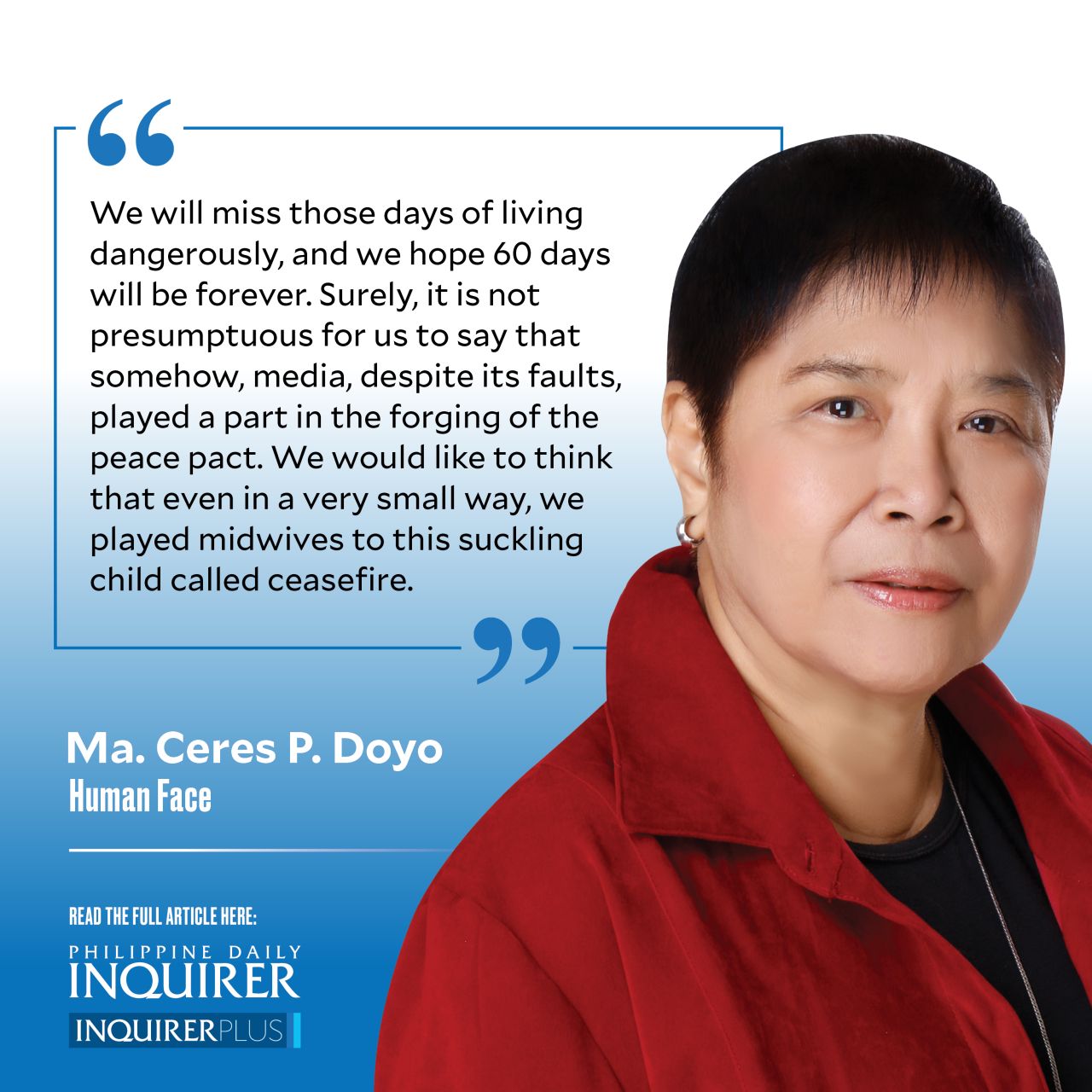
We will miss those days of living dangerously, and we hope 60 days will be forever. Surely, it is not presumptuous for us to say that somehow, media, despite its faults, played a part in the forging of the peace pact. We would like to think that even in a very small way, we played midwives to this suckling child called ceasefire.

ADVERTISEMENT

It is the season of Advent. For us, the irreverent lot, here are some Advent lines from Isaiah, the prophet and writer who knows what ceasefire is all about.

The wolf shall dwell with the lamb

And the leopard shall lie down with the kid,

And the calf and the lion and the fatling together,

And a little child shall lead them.

The cow and the bear shall feed,

Their young shall lie down together

And the lions shall eat straw like the ox

The suckling child shall play over the hole of the asp

And the weaned child shall put his hand on the adder’s den. 

They do not hurt nor harm on all my holy mountain,

For the country is filled with the knowledge of Yahweh

As the waters swell the sea.


Read more: https://opinion.inquirer.net/?p=159753#ixzz7s2mX7Sbf
Follow us: @inquirerdotnet on Twitter | inquirerdotnet on Facebook